Thank you for visiting SNEWPapers!
Sign up free
The Rhode Island American, And General Advertiser
Providence, Providence County, Rhode Island
What is this article about?
In this installment (No. 3), SEXTUS critiques the Democratic party's inconsistencies, citing Mr. Carey's 'Olive Branch' that condemns their policies, especially Jefferson's unilateral rejection of the Monroe-Pinkney treaty with England, leading to commercial ruin and war risks. Calls for Democratic repentance and Federalist-Democrat unity.
Clipping
OCR Quality
Full Text
FOR THE RHODE-ISLAND AMERICAN.
No: 3.
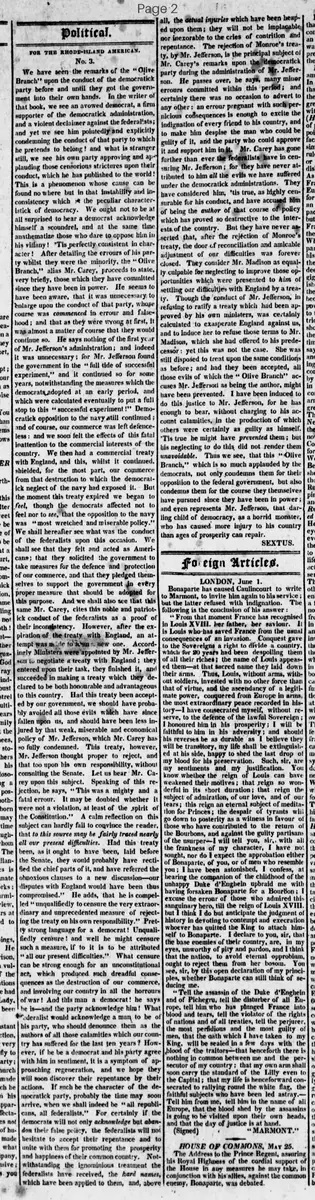
We have seen the remarks of the "Olive Branch" upon the conduct of the democratick party before and until they got the government into their own hands. In the writer of that book, we see an avowed democrat, a firm supporter of the democratick administration, and a violent declaimer against the federalists; and yet we see him pointedly and explicitly condemning the conduct of that party to which he pretends to belong! and what is stranger still, we see his own party approving and applauding those censorious strictures upon their conduct, which he has published to the world! This is a phenomenon whose cause can be found no where but in that instability and inconsistency which is the peculiar characteristic of democracy. We ought not to be at all surprised to hear a democrat acknowledge himself a scoundrel, and at the same time anathematize those who dare to oppose him in his villany! 'Tis perfectly consistent in character! After detailing the errours of his party whilst they were the minority, the "Olive Branch," alias Mr. Carey, proceeds to state, very briefly, those which they have committed since they have been in power. He seems to have been aware, that it was unnecessary to enlarge upon the conduct of that party, whose course was commenced in errour and falsehood; and that as they were wrong at first, it was almost a matter of course that they would continue so. He says nothing of the first year of Mr. Jefferson's administration; and indeed it was unnecessary; for Mr. Jefferson found the government in the "full tide of successful experiment," and it continued so for some years, notwithstanding the measures which the democrats adopted at an early period, and which were calculated eventually to put a full stop to this "successful experiment!" Democratick opposition to the navy still continued; and of course, our commerce was left defenceless: and we soon felt the effects of this fatal inattention to the commercial interests of the country. We then had a commercial treaty with England, and this, whilst it continued, shielded, for the most part, our commerce from that destruction to which the democratick neglect of the navy had exposed it. But the moment this treaty expired we began to feel, though the democrats affected not to feel nor to see, that the opposition to the navy was "most wretched and miserable policy." We shall hereafter see what was the conduct of the federalists upon this occasion. We shall see that they felt and acted as Americans; that they solicited the government to take measures for the defence and protection of our commerce, and that they pledged themselves to support the government in every proper measure that should be adopted for this purpose. And we shall also see that this same Mr. Carey, cites this noble and patriotick conduct of the federalists as a proof of their inconsistency. However, after the expiration of the treaty with England, an attempt was made to form a new one. Accordingly Ministers were appointed by Mr. Jefferson to negotiate a treaty with England; they entered upon their task, they finished it, and succeeded in making a treaty which they declared to be both honourable and advantageous to this country. Had this treaty been accepted by our government, we should have probably avoided all those evils which have since fallen upon us, and should have been less injured by that weak, miserable and economical policy of Mr. Jefferson, which Mr. Carey has so fully condemned. This treaty, however, Mr. Jefferson thought proper to reject, and that too upon his own responsibility, without consulting the Senate. Let us hear Mr. Carey upon this subject. Speaking of this rejection, he says, "This was a mighty and a fatal errour. It may be doubted whether it were not a violation, at least of the spirit of the Constitution." A calm reflection on this subject can hardly fail to convince the reader, that to this source may be fairly traced nearly all our present difficulties. Had this treaty been, as it ought to have been, laid before the Senate, they would probably have rectified the chief parts of it, and have referred the obnoxious clauses to a new discussion--our disputes with England would have been thus compromised." He adds, 'that he is compelled "unqualifiedly to censure the very extraordinary and unprecedented measure of rejecting the treaty on his own responsibility." Pretty strong language for a democrat! Unqualifiedly censure! and well he might censure such a measure, if to it is to be attributed "all our present difficulties." What censure can be strong enough for an unconstitutional act, which produced such dreadful consequences as the destruction of our commerce, and involving our country in all the horrours of war! And this man a democrat! he says he is-and the party acknowledge him! What federalist would acknowledge a man to be of his party, who should denounce them as the authors of all those calamities which our country has suffered for the last ten years? However, if he be a democrat and his party agree with him in sentiment, it is a symptom of approaching regeneration, and we hope they will soon discover their repentance by their actions. If such be the character of the democratick party, probably the time may soon arrive, when we shall indeed be "all republicans, all federalists." For certainly if the democrats will not only acknowledge but abandon their false policy, the federalists will not hesitate to accept their repentance and to unite with them for promoting the prosperity and happiness of their common country. Notwithstanding the ignominious treatment the federalists have received, the hard names, which have been applied to them, and, above all, the actual injuries which have been heaped upon them; they will not be implacable nor inexorable to the cries of contrition and repentance. The rejection of Monroe's treaty, by Mr. Jefferson, is the principal subject of Mr. Carey's remarks upon the democratick party during the administration of Mr. Jefferson. He passes over, he says, many minor errours committed within this period; and certainly there was no occasion to advert to any other: an errour pregnant with such pernicious consequences is enough to excite the indignation of every friend to his country, and to make him despise the man who could be guilty of it, and the party who could approve it and support him in it. Mr. Carey has gone further than ever the federalists have in censuring Mr. Jefferson; for they have never attributed to him all the evils we have suffered under the democratick administrations. They have considered him; 'tis true, as highly censurable for his conduct, and have accused him of being the author of that course of policy which has proved so destructive to the interests of the country. But they have never asserted that, after the rejection of Monroe's treaty, the door of reconciliation and amicable adjustment of our difficulties was forever closed. They consider Mr. Madison as equally culpable for neglecting to improve those opportunities which were presented to him of settling our difficulties with England by a treaty. Though the conduct of Mr. Jefferson, in refusing to ratify a treaty which had been approved by his own ministers, was certainly calculated to exasperate England against us, and to induce her to refuse those terms to Mr. Madison, which she had offered to his predecessor: yet this was not the case. She was still disposed to treat upon the same conditions as before; and had they been accepted, all those evils of which the "Olive Branch" accuses Mr. Jefferson as being the author, might have been prevented. I have been induced to do this justice to Mr. Jefferson, for he has enough to bear, without charging to his account calamities, in the production of which others were certainly as guilty as himself. 'Tis true he might have prevented them; but his neglecting to do this did not render them unavoidable. Thus we see, that this "Olive Branch," which is so much applauded by the democrats, not only condemns them for their opposition to the federal government, but also condemns them for the course they themselves have pursued since they have been in power; and even represents Mr. Jefferson, that darling child of democracy, as a horrid monster, who has caused more injury to his country than ages of prosperity can repair.
SEXTUS.
What sub-type of article is it?
What themes does it cover?
What keywords are associated?
What entities or persons were involved?
Letter to Editor Details
Author
Sextus
Recipient
The Rhode Island American
Main Argument
the democratic party exhibits inconsistency by condemning its own past actions through one of its supporters, mr. carey (olive branch), particularly jefferson's rejection of the monroe-pinkney treaty, which led to commercial destruction and war; the author hopes for democratic repentance and unity with federalists for national prosperity.
Notable Details