Thank you for visiting SNEWPapers!
Sign up free
Literary
November 19, 1896
The Saratoga Sun
Saratoga, Carbon County, Wyoming
What is this article about?
In Ireland, old Shaun and his grandson young Shaun visit the legendary Fairy Thorn tree to summon the long-lost son who emigrated to America. The son, disguised as a stranger, returns, reuniting the family and promising to cure the boy's lameness with his American earnings.
Merged-components note: Merged illustration image into 'A Fairy Thorn' literary story due to spatial overlap.
Clipping
OCR Quality
85%
Good
Full Text
A Fairy Thorn.
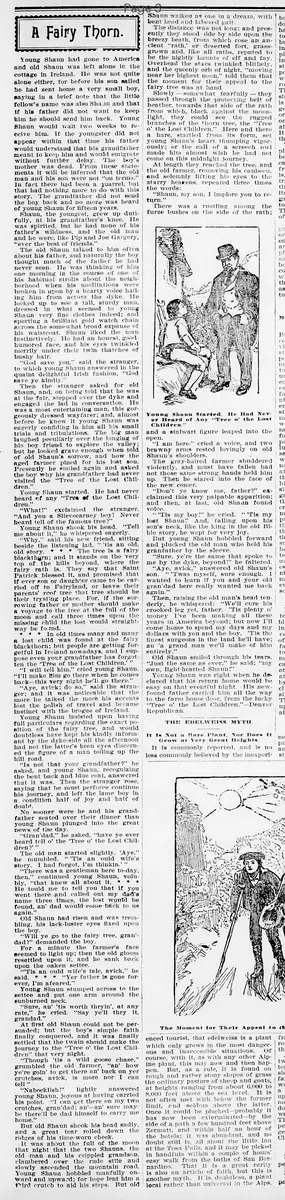
Young Shaun had gone to America and old Shaun was left alone in the cottage in Ireland. He was not quite alone either, for before his son sailed he had sent home a very small boy, saying in a brief note that the little fellow's name was also Shaun and that if his father did not want to keep him he should send him back. Young Shaun would wait two weeks to receive him. If the youngster did not appear within that time his father would understand that his grandfather meant to keep him and would emigrate without further delay. The boy's mother was dead. From these statements it will be inferred that the old man and his son were not "on terms." In fact there had been a quarrel, but that had nothing more to do with this story. The grandfather did not send the boy back and no more was heard of young Shaun for fifteen years.
Shaun, the youngest, grew up dutifully at his grandfather's knee. He was spirited, but he had none of his father's wildness, and the old man and he were, like Pip and Joe Gargery, "ever the best of friends."
The old Shaun talked to him often about his father, and naturally the boy thought much of the father he had never seen. He was thinking of him one morning in the course of one of his habitual strolls about the neighborhood when his meditations were broken in upon by a hearty voice hailing him from across the dyke. He looked up to see a tall, sturdy man, dressed in what seemed to young Shaun very fine clothes indeed; and sporting a brilliant gold watch chain across the somewhat broad expanse of his waistcoat. Shaun liked the man instinctively. He had an honest, good-humored face, and his eyes twinkled merrily under their twin thatches of bushy hair.
"God save you," said the stranger, to which young Shaun answered in the quaint delightful Irish fashion, "God save ye kindly."
Then the stranger asked for old Shaun, and, on being told that he was at the fair, stepped over the dyke and engaged the lad in conversation. He was a most entertaining man, this gorgeously dressed wayfarer; and, almost before he knew it young Shaun was eagerly confiding in him all his small trials and tribulations. The big man laughed peculiarly over the longing of his boy friend to explore the valley; but he looked grave enough when told of old Shaun's sorrow, and how the aged farmer pined for his lost son. Presently he smiled again and asked the boy why his grandfather had never visited the "Tree of the Lost Children."
Young Shaun started. He had never heard of any "Tree of the Lost Children."
"What!" exclaimed the stranger. "And you a Sllevecarney boy! Never heard tell of the famous tree?"
Young Shaun shook his head. "Tell me about it," he whispered eagerly.
"Why," said his new friend, sitting beside the listening lad, " 'tis an old, old story.
The tree is a fairy blackthorn; and it stands on the very top of the hills beyond, where the fairy rath is. They say that Saint Patrick blessed it, and promised that if ever son or daughter came to be carried off to Fairyland, or leave their parents' roof tree that tree should be their trysting place. For, if the sorrowing father or mother should make a voyage to the tree at the full of the moon and call three times upon the missing child the lost would straight way be found.
In old times many and many a lost child was found at the fairy blackthorn; but people are getting forgetful in Ireland nowadays, and I suppose even your grandfather has forgotten the Tree of the Lost Children.'"
"I will tell him," cried young Shaun. "I'll make him go there when he comes back—this very night he'll go there."
"Aye, avick; do so," said the stranger; and it was noticeable that the more he talked the more his accents lost the polish of travel and became instinct with the brogue of Ireland.
Young Shaun insisted upon having full particulars regarding the exact position of the fairy tree, and would doubtless have kept his kindly informant by the dyke-side all the afternoon had not the latter's keen eyes discerned the figure of a man toiling up the hill road.
"Is not that your grandfather?" he asked, and young Shaun, recognizing the bent back and blue coat, answered that it was. Then the stranger rose saying that he must perforce continue his journey, and left the lame boy in a condition half of joy and half of doubt.
No sooner were he and his grandfather seated over their dinner than young Shaun plunged into the great news of the day.
"Gran'dad," he asked, "have ye ever heard tell o' the 'Tree o' the Lost Children?'"
The old man started slightly. "Aye," he mumbled. "'Tis an ould wife's story. I had forgot, I'm thinkin.'"
"There was a gentleman here to-day, then," continued young Shaun, volubly, "that knew all about it. He tould me to tell you that if you went there and called out my dad's name three times, the lost would be found, an' dad would come back to us again."
Old Shaun had risen and was trembling, his lack-luster eyes fixed upon the boy.
"Will ye go to the fairy tree, gran'dad?" demanded the boy.
For a minute the farmer's face seemed to light up; then the old gloom resettled upon it, and he sank back upon the oaken settee.
"'Tis an ould wife's tale, avick," he said. * * * "Yer father is gone forever, I'm afeared."
Young Shaun stumped across to the settee and put one arm around the sunburned neck.
"Sure, an' 'tis worth thryin', at any rate," he cried. "Say ye'll thry it, grandad."
At first old Shaun could not be persuaded; but the boy's simple faith finally conquered, and it was finally settled that the twain should make the journey to the "Tree o' the Lost Children" that very night.
"Though 'tis a wild goose chase," grumbled the old farmer, "an' how ye're goin' to get there an' back on yer crutches, avick, is more nor I can tell."
"Nabocklish!" lightly answered young Shaun, joyous at having carried his point. "I can get there on my two crutches, gran'dad; an'—an' sure maybe there'll be dad himself to carry me home."
But old Shaun shook his head sadly, and a great tear rolled down the ridges of his time-worn cheek.
It was about the full of the moon that night that the two Shauns, the old man and his crippled grandson, clambered over the rude stile and slowly ascended the mountain road. Young Shaun hobbled manfully onward and upward; for hope lent him a third crutch to aid his steps. But old Shaun walked as one in a dream, with bent head and labored gait.
The distance was not long; and presently they stood side by side upon the breezy heath, from which rose an ancient "rath," or deserted fort, grass-grown and, like all raths, reputed to be the nightly haunts of elf and fay. Overhead the stars twinkled blithely, and the queenly orb of night, "moving near her highest noon," told them that the moment for their appeal to the fairy tree was at hand.
Slowly—somewhat fearfully—they passed through the protecting belt of heather, towards that side of the rath from which, black against the moonlight, they could see the rugged branches of the thorn tree, the "Tree o' the Lost Children."
Here and there a hare, startled from its form, set young Shaun's heart thumping vigorously; or the call of a screech owl made him almost wish he had not come on this midnight journey.
At length they reached the tree, and the old farmer, removing his caubeen, and solemnly lifting his eyes to the starry heavens, repeated three times the words:
"Shaun, my son, I implore you to return."
There was a rustling among the furze bushes on the side of the rath; young Shaun started. And a stalwart figure leaped into the open.
"I am here—" cried a voice, and two brawny arms rested lovingly on old Shaun's shoulders.
The gray-haired farmer shuddered violently, and must have fallen had not those same strong hands held him up. Then he stared into the face of the new comer.
"Don't ye know me, father?" exclaimed this very palpable apparition; and then, at last, old Shaun found voice.
"'Tis my boy!" he cried. "'Tis my lost Shaun!" And, falling upon his son's neck, like the king in the old Bible story, he wept for very joy.
But young Shaun hobbled forward and plucked the old man who held his grandfather by the sleeve.
"Sure, ye're the same that spoke to me by the dyke, beyond!" he faltered.
"Aye, avick," answered old Shaun's son. "'Twas myself, sure enough. I wanted to learn if you and your old gran'dad here really wanted me back again."
Then, raising the old man's head tenderly, he whispered: "He'll cure his crooked leg yet, father. 'Tis plenty o' money I've been making all these years in America beyond; but now I'll come home to spend my days and my dollars with you and the boy. 'Tis the finest surgeons in the land he'll have; an' a grand man we'll make of him entirely."
Old Shaun smiled through his tears. "Just the same as ever," he said; "my own, light-hearted Shaun!"
Young Shaun was right when he declared that his return home would be easy on that eventful night. His new-found father carried him all the way to the farm house door, from the lucky "Tree o' the Lost Children."—Denver Republican.
Young Shaun had gone to America and old Shaun was left alone in the cottage in Ireland. He was not quite alone either, for before his son sailed he had sent home a very small boy, saying in a brief note that the little fellow's name was also Shaun and that if his father did not want to keep him he should send him back. Young Shaun would wait two weeks to receive him. If the youngster did not appear within that time his father would understand that his grandfather meant to keep him and would emigrate without further delay. The boy's mother was dead. From these statements it will be inferred that the old man and his son were not "on terms." In fact there had been a quarrel, but that had nothing more to do with this story. The grandfather did not send the boy back and no more was heard of young Shaun for fifteen years.
Shaun, the youngest, grew up dutifully at his grandfather's knee. He was spirited, but he had none of his father's wildness, and the old man and he were, like Pip and Joe Gargery, "ever the best of friends."
The old Shaun talked to him often about his father, and naturally the boy thought much of the father he had never seen. He was thinking of him one morning in the course of one of his habitual strolls about the neighborhood when his meditations were broken in upon by a hearty voice hailing him from across the dyke. He looked up to see a tall, sturdy man, dressed in what seemed to young Shaun very fine clothes indeed; and sporting a brilliant gold watch chain across the somewhat broad expanse of his waistcoat. Shaun liked the man instinctively. He had an honest, good-humored face, and his eyes twinkled merrily under their twin thatches of bushy hair.
"God save you," said the stranger, to which young Shaun answered in the quaint delightful Irish fashion, "God save ye kindly."
Then the stranger asked for old Shaun, and, on being told that he was at the fair, stepped over the dyke and engaged the lad in conversation. He was a most entertaining man, this gorgeously dressed wayfarer; and, almost before he knew it young Shaun was eagerly confiding in him all his small trials and tribulations. The big man laughed peculiarly over the longing of his boy friend to explore the valley; but he looked grave enough when told of old Shaun's sorrow, and how the aged farmer pined for his lost son. Presently he smiled again and asked the boy why his grandfather had never visited the "Tree of the Lost Children."
Young Shaun started. He had never heard of any "Tree of the Lost Children."
"What!" exclaimed the stranger. "And you a Sllevecarney boy! Never heard tell of the famous tree?"
Young Shaun shook his head. "Tell me about it," he whispered eagerly.
"Why," said his new friend, sitting beside the listening lad, " 'tis an old, old story.
The tree is a fairy blackthorn; and it stands on the very top of the hills beyond, where the fairy rath is. They say that Saint Patrick blessed it, and promised that if ever son or daughter came to be carried off to Fairyland, or leave their parents' roof tree that tree should be their trysting place. For, if the sorrowing father or mother should make a voyage to the tree at the full of the moon and call three times upon the missing child the lost would straight way be found.
In old times many and many a lost child was found at the fairy blackthorn; but people are getting forgetful in Ireland nowadays, and I suppose even your grandfather has forgotten the Tree of the Lost Children.'"
"I will tell him," cried young Shaun. "I'll make him go there when he comes back—this very night he'll go there."
"Aye, avick; do so," said the stranger; and it was noticeable that the more he talked the more his accents lost the polish of travel and became instinct with the brogue of Ireland.
Young Shaun insisted upon having full particulars regarding the exact position of the fairy tree, and would doubtless have kept his kindly informant by the dyke-side all the afternoon had not the latter's keen eyes discerned the figure of a man toiling up the hill road.
"Is not that your grandfather?" he asked, and young Shaun, recognizing the bent back and blue coat, answered that it was. Then the stranger rose saying that he must perforce continue his journey, and left the lame boy in a condition half of joy and half of doubt.
No sooner were he and his grandfather seated over their dinner than young Shaun plunged into the great news of the day.
"Gran'dad," he asked, "have ye ever heard tell o' the 'Tree o' the Lost Children?'"
The old man started slightly. "Aye," he mumbled. "'Tis an ould wife's story. I had forgot, I'm thinkin.'"
"There was a gentleman here to-day, then," continued young Shaun, volubly, "that knew all about it. He tould me to tell you that if you went there and called out my dad's name three times, the lost would be found, an' dad would come back to us again."
Old Shaun had risen and was trembling, his lack-luster eyes fixed upon the boy.
"Will ye go to the fairy tree, gran'dad?" demanded the boy.
For a minute the farmer's face seemed to light up; then the old gloom resettled upon it, and he sank back upon the oaken settee.
"'Tis an ould wife's tale, avick," he said. * * * "Yer father is gone forever, I'm afeared."
Young Shaun stumped across to the settee and put one arm around the sunburned neck.
"Sure, an' 'tis worth thryin', at any rate," he cried. "Say ye'll thry it, grandad."
At first old Shaun could not be persuaded; but the boy's simple faith finally conquered, and it was finally settled that the twain should make the journey to the "Tree o' the Lost Children" that very night.
"Though 'tis a wild goose chase," grumbled the old farmer, "an' how ye're goin' to get there an' back on yer crutches, avick, is more nor I can tell."
"Nabocklish!" lightly answered young Shaun, joyous at having carried his point. "I can get there on my two crutches, gran'dad; an'—an' sure maybe there'll be dad himself to carry me home."
But old Shaun shook his head sadly, and a great tear rolled down the ridges of his time-worn cheek.
It was about the full of the moon that night that the two Shauns, the old man and his crippled grandson, clambered over the rude stile and slowly ascended the mountain road. Young Shaun hobbled manfully onward and upward; for hope lent him a third crutch to aid his steps. But old Shaun walked as one in a dream, with bent head and labored gait.
The distance was not long; and presently they stood side by side upon the breezy heath, from which rose an ancient "rath," or deserted fort, grass-grown and, like all raths, reputed to be the nightly haunts of elf and fay. Overhead the stars twinkled blithely, and the queenly orb of night, "moving near her highest noon," told them that the moment for their appeal to the fairy tree was at hand.
Slowly—somewhat fearfully—they passed through the protecting belt of heather, towards that side of the rath from which, black against the moonlight, they could see the rugged branches of the thorn tree, the "Tree o' the Lost Children."
Here and there a hare, startled from its form, set young Shaun's heart thumping vigorously; or the call of a screech owl made him almost wish he had not come on this midnight journey.
At length they reached the tree, and the old farmer, removing his caubeen, and solemnly lifting his eyes to the starry heavens, repeated three times the words:
"Shaun, my son, I implore you to return."
There was a rustling among the furze bushes on the side of the rath; young Shaun started. And a stalwart figure leaped into the open.
"I am here—" cried a voice, and two brawny arms rested lovingly on old Shaun's shoulders.
The gray-haired farmer shuddered violently, and must have fallen had not those same strong hands held him up. Then he stared into the face of the new comer.
"Don't ye know me, father?" exclaimed this very palpable apparition; and then, at last, old Shaun found voice.
"'Tis my boy!" he cried. "'Tis my lost Shaun!" And, falling upon his son's neck, like the king in the old Bible story, he wept for very joy.
But young Shaun hobbled forward and plucked the old man who held his grandfather by the sleeve.
"Sure, ye're the same that spoke to me by the dyke, beyond!" he faltered.
"Aye, avick," answered old Shaun's son. "'Twas myself, sure enough. I wanted to learn if you and your old gran'dad here really wanted me back again."
Then, raising the old man's head tenderly, he whispered: "He'll cure his crooked leg yet, father. 'Tis plenty o' money I've been making all these years in America beyond; but now I'll come home to spend my days and my dollars with you and the boy. 'Tis the finest surgeons in the land he'll have; an' a grand man we'll make of him entirely."
Old Shaun smiled through his tears. "Just the same as ever," he said; "my own, light-hearted Shaun!"
Young Shaun was right when he declared that his return home would be easy on that eventful night. His new-found father carried him all the way to the farm house door, from the lucky "Tree o' the Lost Children."—Denver Republican.
What sub-type of article is it?
Prose Fiction
What themes does it cover?
Moral Virtue
Friendship
What keywords are associated?
Fairy Thorn
Tree Of Lost Children
Irish Folklore
Family Reunion
Shaun
America
Grandfather Grandson
Emigration
Literary Details
Title
A Fairy Thorn.
Key Lines
"Shaun, My Son, I Implore You To Return."
"'Tis My Boy!" He Cried. "'Tis My Lost Shaun!"
"Aye, Avick," Answered Old Shaun's Son. "'Twas Myself, Sure Enough. I Wanted To Learn If You And Your Old Gran'dad Here Really Wanted Me Back Again."