Thank you for visiting SNEWPapers!
Sign up free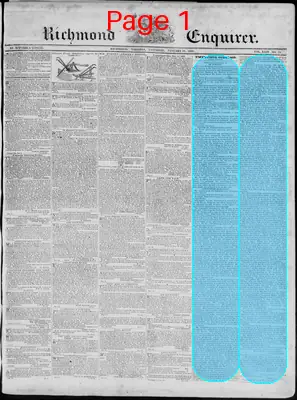
Richmond Enquirer
Richmond, Richmond County, Virginia
What is this article about?
Report of U.S. Congress proceedings on January 14, 1828, in Washington: Senate handled letters, memorials on wool and imports; House seated new member, presented city memorials, reported bills on appropriations and Indian affairs, addressed captured Africans and contested election for John Sergeant (unanimous), debated resolution on Tennessee militia court martial documents, received reports on roads, canals, and post office postage.
Clipping
OCR Quality
Full Text
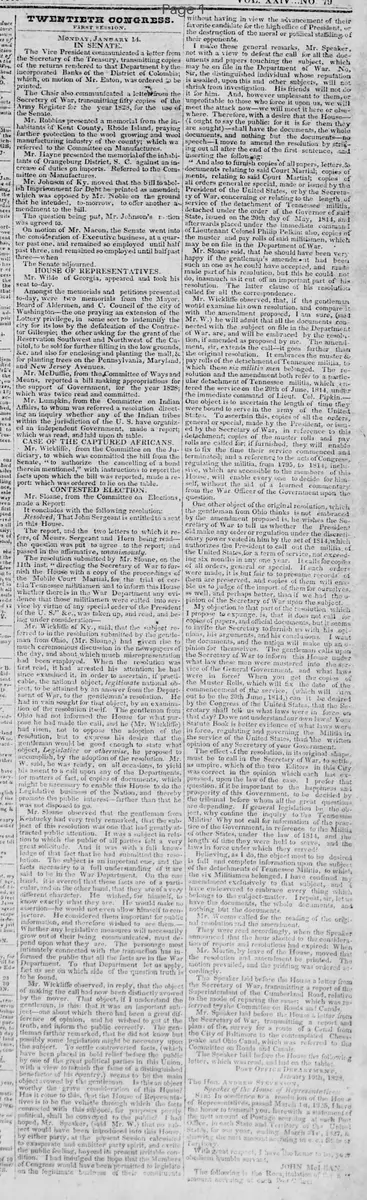
FIRST SESSION.
MONDAY, January 14
IN SENATE.
The Vice President communicated a letter from the Secretary of the Treasury, transmitting copies of the returns rendered to that Department by the incorporated Banks of the District of Columbia; which, on motion of Mr. Eaton, was ordered to be printed.
The Chair also communicated a letter from the Secretary of War, transmitting fifty copies of the Army Register for the year 1828, for the use of the Senate.
Mr. Robbins presented a memorial from the inhabitants of Kent County, Rhode Island, praying further protection to the wool growing and wool manufacturing industry of the county; which was referred to the Committee on Manufactures.
Mr. Hayne presented the memorial of the inhabitants of Orangeburg District, S. C. against an increase of duties on imports. Referred to the Committee on Manufactures.
Mr. Johnson of Ky. moved that the bill to abolish Imprisonment for Debt be printed as amended; which was opposed by Mr. Noble on the ground that he intended, to-morrow, to offer another amendment to the bill.
The question being put, Mr. Johnson's motion was agreed to.
On motion of Mr. Macon, the Senate went into the consideration of Executive business, at a quarter past one, and remained so employed until half past three—when
The Senate adjourned
HOUSE OF REPRESENTATIVES.
Mr. Wilde of Georgia, appeared and took his seat to-day.
Amongst the memorials and petitions presented to-day, were two memorials from the Mayor, Board of Aldermen, and C. Council of the city of Washington—the one praying an extension of the Lottery privilege, in some sort to indemnify the city for its loss by the defalcation of the Contractor Gillespie; the other asking for the grant of the Reservation Southwest and Northwest of the Capitol, to be sold for further filling in the low grounds, &c. and also for enclosing and planting the mall, & for planting trees on the Pennsylvania, Maryland, and New Jersey Avenues.
Mr. McDuffie, from the Committee of Ways and Means, reported a bill making appropriations for the support of Government, for the year 1828; which was twice read and committed.
Mr. Lumpkin, from the Committee on Indian Affairs, to whom was referred a resolution directing an inquiry whether any of the Indian tribes within the jurisdiction of the U. S. have organized an independent Government, made a report; which was read, and laid upon the table.
CASE OF THE CAPTURED AFRICANS.
Mr. Wickliffe, from the Committee on the Judiciary, to which was committed the bill from the Senate, "to authorize the cancelling of a bond therein mentioned," with instructions to report the facts upon which the bill was reported, made a report: which was ordered to lie on the table.
CONTESTED ELECTION.
Mr. Sloane, from the Committee on Elections, made a Report:
It concludes with the following resolution:
Resolved, That John Sergeant is entitled to a seat in this House.
The report, and the two letters to which it refers, of Messrs. Sergeant and Horn being read—the question was put to agree to the report; and passed in the affirmative, unanimously.
The resolution submitted by Mr. Sloane, on the 11th inst. "directing the Secretary of War to furnish the House with a copy of the proceedings of the Mobile Court Martial, for the trial of certain Tennessee militiamen and to inform this House whether there is in the War Department any evidence that those militiamen were called into service by virtue of any special order of the President of the U. S." &c., was taken up, and read, and being under consideration—
Mr. Wickliffe of Ky., said, that the subject referred to in the resolution submitted by the gentleman from Ohio, (Mr. Sloane,) had given rise to much ceremonious discussion in the newspapers of the day, and about which much misrepresentation had been employed. When the resolution was first read, it had arrested his attention; he had since examined it, in order to ascertain, if practicable, the national object, legitimate national object, to be attained by an answer from the Department of War, to the gentleman's resolution. He had in vain sought for that object, by an examination of the resolution itself. The gentleman from Ohio had not informed the House for what purpose he had made the call, and he (Mr. Wickliffe) had risen, not to oppose the adoption of the resolution, but to express his desire that the gentleman would be good enough to state what object, Legislative or otherwise, he proposed to accomplish, by the adoption of the resolution. Mr. W. said, he was ready, on all occasions, to yield his assent to a call upon any of the Departments, for matters of fact, of copies of documents, which might be necessary to enable this House to do the Legislative business of the Nation, and thereby promote the public interest—farther than that he was not disposed to go.
Mr. Sloane observed that the gentleman from Kentucky had very truly remarked, that the subject of this resolution was one that had greatly attracted public attention. It was a subject in relation to which the public of all parties felt a very great solicitude. And it was with a full knowledge of that fact that he had submitted the resolution. The subject is an important one, and the facts necessary to a full understanding of it are said to be in the War Department. On the one hand, it is averred that these facts are of a particular, and on the other hand, that they are of a very different character. He wished, for himself, to know exactly what they are. He would make no assertion—he would not even allow himself to conjecture. He considered them important for public information, and therefore wished to see them.—Whether any legislative measures will necessarily grow out of their being communicated, must depend upon what they are. The personage most intimately connected with the transaction has informed the public that all the facts are in the War Department. To that Department let us apply. Let us see on which side of the question truth is to be found.
Mr. Wickliffe observed, in reply, that the object of making the call had now been distinctly avowed by the mover. That object, if I understand the gentleman, is this: that it was an important subject—one about which there had been a great difference of opinion, and he wished to get at the truth, and inform the public correctly. The gentleman further remarked, that he did not know but possibly some legislation might be necessary upon the subject. To settle controverted facts, (which have been placed in bold relief before the public by one of the great political parties in this Union, with a view to tarnish the fame of a distinguished benefactor of his country,) seems to be the main object avowed by the gentleman. Is this an object worthy the grave consideration of this House? Has it come to this, that the House of Representatives is to be the vehicle through which the facts connected with this subject, for purposes purely political, shall be conveyed to the public? I had hoped, Mr. Speaker, (said Mr. W.) that no subject would have been introduced into this House, by either party, at the present Session calculated to exasperate and embitter party spirit, and excite the public feeling, beyond its present irritable condition. I had indulged the hope that the Members of Congress would have been permitted to legislate on the legitimate business of their constituents without having in view the advancement of their favorite candidate for the high office of President, or the destruction of the moral or political standing of their opponents. I make these general remarks, Mr. Speaker, not with a view to defeat the call for all the documents and papers touching the subject, which may be on file in the Department of War. No, Sir, the distinguished individual whose reputation is assailed, upon this and other subjects, will not shrink from investigation. His friends will not do it for him. And, however unpleasant to them, or unprofitable to those who force it upon us, we will meet the attack now we will meet it here or elsewhere. Therefore, with a desire that the House—(I ought to say the public: for it is for them they are sought)—shall have the documents, the whole documents, and nothing but the documents—no speech—I move to amend the resolution by striking out all after the end of the first sentence, and inserting the following:
"And also to furnish copies of all papers, letters, & documents relating to said Court Martial; copies of all orders general or special, made or issued by the President of the United States, or by the Secretary of War, concerning or relating to the length of service of the detachment of Tennessee militia, detached under the order of the Governor of said State, issued on the 20th day of May, 1814, and afterwards placed under the immediate command of Lieutenant Colonel Philip Pipkin: also, copies of the muster and pay rolls of said militiamen, which may be on file in the Department of War."
Mr. Sloane said, that he should have been very happy if the gentleman's amendment had been such an one as he could have accepted, and made part of his resolution, but this he could not do, inasmuch as it cut off an important part of his resolution. The latter clause of his resolution called for all the correspondence.
Mr. Wickliffe observed, that, if the gentleman would examine his own resolution, and compare it with the amendment proposed, I am sure, (said Mr. W.) he will admit that all the documents connected with the subject on file in the Department of War, are, and will be embraced by the resolution, if amended as proposed by me. The amendment, sir, extends the call—it goes farther than the original resolution. It embraces the muster & pay rolls of the detachment of Tennessee militia, to which these six militia men belonged. The resolution and the amendment both refer to a particular detachment of Tennessee militia, which entered the service on the 20th of June, 1814, under the immediate command of Lieut. Col. Pipkin.—One object is to ascertain the length of time they were bound to serve in the army of the United States. To ascertain this, copies of all the orders, general or special, made by the President, or issued by the Secretary of War, in reference to this detachment; copies of the muster rolls and pay rolls are called for; if furnished, they will enable us to fix the time their service commenced and terminated; and a reference to the acts of Congress, regulating the militia, from 1795, to 1814, inclusive, which are accessible to the members of this House, will enable every one to decide for himself, without the aid of a learned commentary from the War Officer of the Government upon the question.
One other object of the original resolution, which the gentleman from Ohio thinks is not embraced by the amendment proposed is, he wishes the Secretary of War to tell us whether the President did make any order or regulation under the discretionary power vested in him by the act of 1814, which authorizes the President to call out the militia of the United States, for a term of service, not exceeding six months in any one year. It calls for copies of all orders, general or special. If such orders were made, it is but fair to presume records of them are preserved, and copies of them will enable us to judge of the import of them for ourselves, as well, and perhaps better, than if we had the opinion of the Secretary of War upon the subject.
My objection to that part of the resolution which I propose to expunge, is, that it does not call for copies of papers, and official documents, but it seems to invite the Secretary to furnish us with his opinions, his arguments, and his conclusions. I want the documents, and the nation will make up an opinion for themselves. The gentleman calls upon the Secretary of War to inform this House under what law these men were mustered into the service of the General Government, and what laws were in force? When you get the copies of the Muster Rolls, which will fix the date of the commencement of the service, (which will turn out to be the 20th June, 1814,) can it be desired by the Congress of the United States, that the Secretary shall tell us what laws were in force on that day? Do we not understand our own laws? Your Statute Book is better evidence of what laws were in force, regulating and governing the Militia in the service of the United States, than the written opinion of any Secretary of your Government.
The effect of the resolution, in its original shape, must be to call in the Secretary of War, to settle, as umpire, which of the two Editors in this City was correct in the opinion which each has expressed, upon the law of the case. I prefer that question, if it be important to the happiness and prosperity of this Government, to be decided by the tribunal before whom all the great questions are depending. If general legislation be the object, why confine the inquiry to the Tennessee Militia? Why not call for information of the practice of the Government, in reference to the Militia of other States, under the law of 1814, and the length of time they were held to serve, and the laws in force under which they served?
Believing, as I do, the object most to be desired is full and complete information upon the subject of the detachments of Tennessee Militia, to which the six Militiamen belonged, I have confined my amendment exclusively to that subject, and I have endeavored to embrace every thing which belongs to the subject-matter. I repeat, sir, let us have the documents, the whole documents, and nothing but the documents
Mr. Wickliffe called for the reading of the original resolution and the amendment.
They were read accordingly, when the Speaker announced that the hour allotted to the consideration of reports and resolutions had expired: When Mr. Martin, by leave of the House, moved that the resolution and amendment be printed. The motion prevailed, and the printing was ordered accordingly.
The Speaker laid before the House a letter from the Secretary of War, transmitting a report of the Superintendant of the Cumberland Road, relative to the mode of repairing the same; which was referred to the Committee on Roads and Canals.
Mr. Speaker laid before the House a letter from the Secretary of War, transmitting a report and plan: of the survey for a route of a Canal from the City of Baltimore to the contemplated Chesapeake and Ohio Canal, which was referred to the Committee on Roads and Canals
The Speaker laid before the House the following letter, which was read, and laid on the table:
POST OFFICE DEPARTMENT.
January 10th, 1828,
The Hon. Andrew Stevenson,
Speaker of the House of Representatives
SIR: In obedience to a resolution of the House of Representatives, passed March 3d, 1825, I have the honor to transmit you, herewith a statement of the nett amount of Postage accruing at each Post Office, in each State and Territory of the Union, for one year, ending March 1, 1827, & showing the nett amount accruing in each to the Department.
With great respect, I have the honor to be, )
Your obed't humb'e serv't,
JOHN McLEAN
The following is the Resolution on
n.•
amount nett accruing each Office
in each State and Territory
of the Union, for one year ending
March 1, 1827, showing the nett
amount accruing in each to the
Department.
What sub-type of article is it?
What keywords are associated?
What entities or persons were involved?
Where did it happen?
Domestic News Details
Primary Location
Washington
Event Date
January 14, 1828
Key Persons
Event Details
Proceedings of the 20th Congress, First Session, in the Senate and House of Representatives on Monday, January 14, 1828, including communications from secretaries, presentation of memorials on wool industry protection, duties on imports, lottery privilege extension, land grants; reports on appropriations, Indian affairs, captured Africans, contested election affirming John Sergeant's seat; debate on resolution for War Department documents regarding Tennessee militiamen and Mobile Court Martial; letters on Cumberland Road, canal survey, and post office postage statement.