Thank you for visiting SNEWPapers!
Sign up free
National Gazette
Philadelphia, Philadelphia County, Pennsylvania
What is this article about?
George Logan writes to Mr. Freneau for the National Gazette, submitting experiments on crop rotations to the Philadelphia Society for Promoting Agriculture. He details methods using manure, gypsum, and sequences like corn, potatoes, flax, wheat, barley, and clover to restore exhausted soils and boost yields, while arguing that good government is essential for thriving agriculture.
Merged-components note: Long letter to the Philadelphia Society for Promoting Agriculture on crop rotations, including experiments table, continued to page 4.
Clippings
1 of 2
OCR Quality
Full Text
No. V.
MR. FRENEAU,
I
Am well aware that the exhausted condition of the plantations in Virginia and the deranged situation of the finances of the yeomanry are considerable obstacles to their estates becoming immediately productive—but I am confident that by adopting a proper rotation of crops, their exhausted fields may be made to answer the most sanguine expectations of the Farmer.
On coming into possession of the farm which I now occupy the average produce of it did not exceed six bushels of rye to the acre.
The same ground now yields from 20 to 30 bushels of wheat. This beneficial alteration has arisen from my pursuing the rotation of crops, which was some time ago addressed to the Philadelphia agricultural society. As this rotation is founded on actual experiment the whole communication merits attention.
To the Philadelphia Society for Promoting Agriculture.
GENTLEMEN,
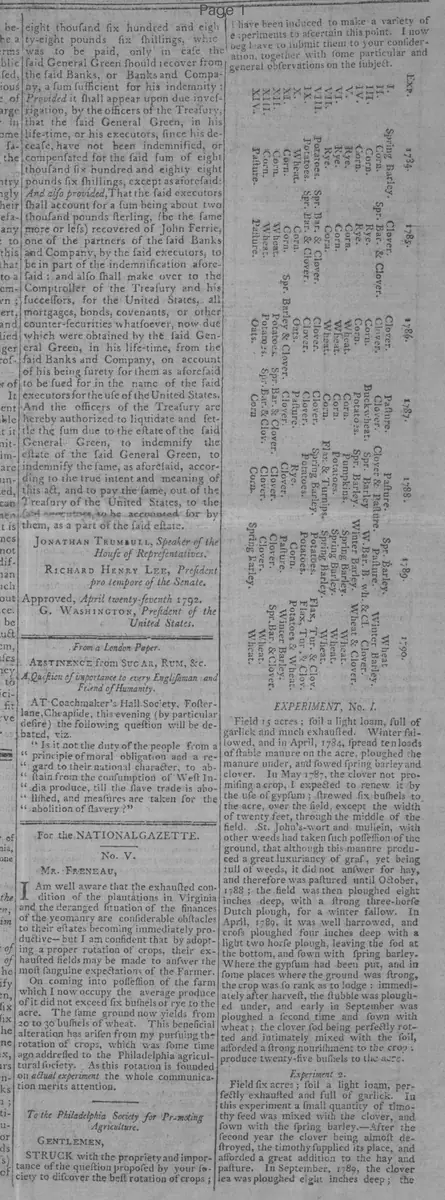
STRUCK with the propriety and importance of the question proposed by your society to discover the best rotation of crops; have been induced to make a variety of experiments to ascertain this point. I now beg leave to submit them to your consideration, together with some particular and general observations on the subject.
EXPERIMENT, No. I.
Field 15 acres; on a light loam, full of garlick and much exhausted. Winter fallowed, and in April, 1784, spread ten loads of stable manure on the acre, ploughed the manure under, and sowed spring barley and clover. In May 1787, the clover not promising a crop, I expected to renew it by the use of gypsum; strewed six bushels to the acre, over the field, except the width of twenty feet, through the middle of the field. St. John's-wort and mullein, with other weeds had taken such possession of the ground, that although this manure produced a great luxuriancy of grass, yet being full of weeds, it did not answer for hay, and therefore was pastured until October, 1788; the field was then ploughed eight inches deep, with a strong three-horse Dutch plough, for a winter fallow. In April, 1789, it was well harrowed, and cross ploughed four inches deep with a light two horse plough, leaving the sod at the bottom, and sown with spring barley. Where the gypsum had been put, and in some places where the ground was strong, the crop was so rank as to lodge: immediately after harvest, the stubble was ploughed under, and early in September was ploughed a second time and sown with wheat; the clover sod being perfectly rotted and intimately mixed with the soil, afforded a strong nourishment to the crop: produce twenty-five bushels to the acre.
Experiment 2.
Field six acres; on a light loam, perfectly exhausted and full of garlick. In this experiment a small quantity of timothy seed was mixed with the clover, and sown with the spring barley.—After the second year the clover being almost destroyed, the timothy supplied its place, and afforded a great addition to the hay and pasture. In September, 1789, the clover lea was ploughed eight inches deep; the
| Exp. | 1734. | 1785. | 1786. | 1787. | 1788. | 1789. | 1790. |
| I. | Spring Barley. | Clover. | Clover. | Pasture. | Pasture. | Spr. Barley. | Wheat |
| II. | Corn. | Spr. Bar. & Clover. | Clover. | Clover. | Clover & Pasture. | Pasture. | Winter Barley. |
| III. | Corn. | Rye. | Corn. | Buckwheat. | Spr. Barley | W. Bar. B. wh. & Cl. | Clover. |
| IV. | Corn. | Rye. | Corn. | Potatoes. | Spr. Barley | Winter Barley. | Wheat & Clover. |
| V. | Rye. | Corn. | Wheat. | Corn. | Pumpkins. | Spring Barley. | Wheat. |
| VI. | Rye. | Corn. | Wheat. | Corn. | Potatoes. | Spring Barley. | Wheat. |
| VII. | Rye. | Corn. | Wheat. | Corn. | Flax & Turnips. | Spring Barley. | Wheat. |
| VIII. | Potatoes. | Spr. Bar. & Clover. | Clover. | Clover. | Spring Barley. | Potatoes. | Flax, Tur. & Clover. |
| IX. | Potatoes. | Spr. Bar. & Clover. | Clover. | Clover. | Potatoes. | Potatoes. | Flax, Tur. & Clover. |
| X. | Wheat. | Corn. | Oats. | Pasture. | Rye. | Corn. | Potatoes & Wheat. |
| XI. | Corn. | Corn. | Spr. Barley & Clover. | Clover. | Clover. | Pasture. | Winter Barley. |
| XII. | Corn. | Wheat. | Potatoes. | Spr. Bar. & Clover. | Clover. | Clover. | Spr. Bar. & Clover. |
| XIII. | Corn. | Wheat. | Potatoes. | Spr. Bar. & Clover. | Clover. | Clover. | Wheat. |
| XIV. | Pasture. | Pasture. | Oats. | Corn | Corn. | Spring Barley. | Wheat. |
ground being very mellow, it was harrowed along the furrow, with a large brake harrow of thirty teeth; winter barley was then sown and harrowed in. The last winter was wet and open, and therefore severe on the grain, and yet this field turned out better than most in the neighborhood. From my observations on this crop, I believe that it is better husbandry to cross-plough, as in experiment No. I. than to trust to the harrow alone. To continue clover more than three years is not profitable; the fourth year of the clover was full of weeds.
Experiment 3.
Field eight acres; soil cold clay and wet—corn, rye, corn, buck-wheat, is bad husbandry, except in the present case intended merely to make manure—Coming in possession of a large farm, every part of which was exhausted, I could only manure a part of it at one time, and therefore it was good management to procure any produce, for the sake of wintering cattle to make manure. November, 1787, the buck-wheat stubble was ploughed, and in April, 1788, the field was covered with fifteen loads of dung to the acre, and sown with spring barley; the crop twenty bushels to the acre. After two ploughings, winter barley was sown, which did not produce more than ten bushels to the acre. Immediately after harvest put in buck-wheat, clover and timothy; in April last six bushels of gypsum per acre, was strewed over the young clover; at harvest the produce three tons of good hay to one acre.
Experiment 4.
Field six acres; soil clay, with a small quantity of gravel. In April, 1790, this field was sown with clover seed and strewed with six bushels of gypsum to the acre on the young wheat; the clover at present looks well.
Experiments 5, 6, and 7,
Were made on a light loam, to discover the best preparatory crop to grain. The result was greatly in favor of the potatoes.
Experiment 8.
Field two acres; soil, loam with some clay.—In November, 1787, the clover lea was ploughed eight inches deep. In April, 1788, it was well harrowed and sown with spring barley the crop very poor, evidently owing to the want of soil. Winter fallowed and in 1789, was planted with potatoes. This year it produced two valuable crops, one of flax, and the other turnips.
Experiment 9.
Field one acre; soil, loam with some clay.—In May, 1788, the clover lea was covered with stable manure, and ploughed under five inches deep; planted potatoes under every third furrow; the crop at first appeared promising, but afterwards grass took place, and the sod not being rotted, the plough could not be used, besides the grass came up in the interstices between the potatoes in the rows; at harvest the potatoes were numerous, but so small as not in general to be merchantable. I am perfectly satisfied that to have a good crop of any vegetable, it is necessary to have the ground in the most meliorated state possible.
Experiment 10.
Field ten acres; soil, light loam. In 1789, after having secured the tops and blades of the corn; and the corn being taken to the barn in the husks, the stalks were cut at the ground and taken into the barn-yard to make manure. The field was ploughed the first week in December, and in May, 1790, ploughed a second time, and eight acres planted with potatoes. In October the potatoes were gathered, and the vines being collected with a light harrow were hauled into the barn-yard—the ground was then ploughed and sown with wheat, which at present looks well. The remaining two acres was covered with dung and ploughed twice during the summer to prepare it for wheat which was sown at the same time with the potato ground. This experiment, intended to discover whether potatoes, or a clean summer fallow was the best preparative to a grain crop. At this time the potato ground has the best appearance. I examined some of the plants of wheat whilst in the seed leaf, and found their roots to extend six and eight inches; an evident mark of the advantages of deep ploughing, and having your ground in good tilth.
Experiment 11.
Field six acres; soil, light loam. The clover in 1787, produced two good crops, in 1788, one crop and pasture, in 1789, excellent pasture for cattle, sheep and hogs, until September, when it was ploughed eight inches deep, and after being well harrowed it was sown with winter barley—the crop twenty-five bushels to the acre. Immediately after harvest the stubble was ploughed under, and in October was again ploughed, and sown with wheat—the crop has a very promising appearance.
Experiment 12.
Field one acre; soil, loam, a little wet, with a clay bottom. In 1788, produced two excellent crops of hay, and nearly as good the year following. In October, the clover lea was ploughed four inches deep, the sod crumbling to pieces before the plough; after being well harrowed it was sown with winter barley; a wet, open winter, destroyed so much of the crop, that I was induced to plough the ground in April, and to sow spring barley and clover—the barley as good as most this season—the clover looks well.
Experiment 13.
A field of the size and quantity of the last experiment, and treated in a similar manner, except that it was sown with wheat—the crop was not injured by the winter, and produced twenty bushels to the acre. Wheat appears a hardier grain than barley, and therefore should have a preference where a farmer is under the necessity of sowing late.
Experiment 14.
Field six acres; soil, wet loam. After removing the corn-stalks into the barn-yard, winter fallowed the ground, and in April 1789, ploughed in twenty loads of dung to the acre, for spring barley. During the summer I added three acres of fresh land taken in from an adjoining wood, and which had been cleared the preceding winter. Soil the same as the above six acres, covered with a rich black mould; ploughed this new ground three times. In September, the old and new ground were sown the same day, with wheat; during the autumn both crops appeared promising; the following spring the three acres was almost totally destroyed by a long wet winter. At harvest the old ground produced twenty-five bushels to the acre; the new ground not six. This field having an under stratum of clay, and the roots of the trees preventing a proper depth of the ploughing, occasioned the water to stagnate about the roots of the wheat—in the old field a depth of plowing of eight inches prevented this mischief. The principal object of this experiment was to discover, whether old exhausted fields, under proper management, would not produce equal to the best new ground. In this instance the wet season was against the experiment.
We may observe, with great truth, that the uncertainty of the seasons, and the length of time required to make agricultural experiments, renders it difficult to make them with accuracy. In adopting and pursuing the rotation of crops, founded upon the experiments now recited, it will be necessary to attend strictly to some points on which the success of the rotation depends.
1st. To winter fallow, for the spring crops, ploughing at least eight inches deep.
2d. To cover your potato and flax ground with twenty loads of your best manure to the acre, to be ploughed into the ground in April, and on planting your potatoes, to put your half decayed cornstalks, or any other trash in the furrows.
3d. In breaking up your clover lea to be attentive to turning the grass sod as much as possible on its back. This is best effected by trench ploughing, one plow following another in the same track: by this method there is sufficient nourishment provided for the present crop, and the sod becomes rotten before next season, for the future crop.
As the natural strength of the soil is exhausted, by constant cropping, without manure, and as the horses, cows, and other stock, which any farm can maintain within itself, will not afford a sufficiency of manure for an annual supply to the whole farm, we have therefore been induced to consider the proposition of your very useful society, in its most extensive sense, as intended to acquire a knowledge of a rotation of crops calculated to afford—
1st. The greatest number of profitable crops—
2d. The greatest quantity of fodder to winter cattle—
3d. The greatest length of time between manuring the same field—and
4th. Such a variety of crops as may not interfere with one another, but by coming in regular succession may afford the farmer and his family the most constant employ.
No one of the rotation of crops, which I have mentioned will answer these objects, and therefore cannot merit the attention of the society.—Uninformed and destitute of proper guides, I made these experiments to discover the truth; and as they have led to the knowledge of a rotation of crops, which is perfectly satisfactory to myself, I thought it necessary to submit the whole to your consideration, to enable you to judge of the foundation of that rotation which I now offer.
Rotation of Crops.
1. Indian corn; 2, potatoes and flax; 3, wheat; 4, winter barley, and after the barley, buckwheat, with clover and timothy; 5, clover, two crops of hay; 6, clover, one crop, for hay and pasture; 7 pasture; 8, wheat; 9, winter barley.
This plan constitutes my present mode of farming and the success attending it, leaves no room to doubt of its superior advantage. To pursue it to the greatest possible profit, within the ability of one family—the farm should consist of 180 acres of land, subject to this rotation, besides woodland, orchard, &c. &c. A farm thus regulated would produce annually—
20 acres of Indian corn.
10 acres of potatoes.
10 acres of flax.
40 acres of wheat.
40 acres of winter barley.
20 acres of clover, two crops.
20 acres of clover, one crop, and pasture until November.
20 acres of clover pasture, until September.
10 acres of buckwheat with clover on the barley stubble.
Indian corn is a valuable crop on account of its grain: it is also valuable on account of the very nourishing food afforded by its tops, cut as rye-straw, and mixed with potatoes. I have long been in the practice of making potatoes a principal food for my horses and cattle. Our sheep and hogs will fatten rapidly on them, for the latter they should be boiled. Flax constitutes a valuable article too much neglected by our country. An annual produce of eighty acres of wheat and barley, and forty acres of the best clover and timothy hay, out of one hundred and eighty acres, under cultivation, must be esteemed good farming. This produce would enable a farmer to winter fifty head of stock, besides sheep; by which, and a proper system of barn-yard management, he might every year make five hundred loads of good manure. I have found great advantage in keeping the milch cows, hogs and sheep, in the yard, during the summer; sometimes giving them clover, cut green; and at all times, during the year, bringing home every kind of trash which will make manure; on this account the corn-stalks and potato-vines are very useful. Leaving a large surface of these substances exposed, during the winter, in the barn-yard, the cold would prevent them from becoming manure; therefore, the first week in December, or earlier, if necessary, the yards should be cleaned up, and the half-decayed weeds and trash, of every kind, put in a heap near the field you intend to manure. I have been particular on the subject of manure, because the success of the rotation depends on a full supply of it.
Turnips, rye and oats, are not mentioned, because the severity of our winters render the first an improper crop for the farmer, besides they are by no means equal to the potato for feeding of cattle. Rye and oats are not of equal value with wheat and corn, and therefore a preference is given to the latter.
One object of a rotation of crops, is to give constant and steady employ to the farmer and his family, without suffering one business to interfere with another. The rotation proposed will answer this intention. Flax, corn, and potatoes, will occupy the months of April and May. The first hay harvest, the month of June; barley and wheat in July; barley is naturally earlier than wheat, and being sown earlier, it may be got out of the harvest field before the wheat is in to be cut. After harvest comes the seeding for buck-wheat and grass; the second hay harvest; feeding for barley and wheat; winter following and during the severity of winter, threshing out grain.
On account of the time and stock required to conduct a farm, subject to the rotation of crops now proposed, it must appear evident, that it is not calculated for a poor tenantry, but for an independent yeomanry—such as our American farmers ought to be—gentlemen cultivating their own estates, and living under the protection of a just and enlightened government. In this situation the industrious husbandman ploughs his fields with pleasure and alacrity, well knowing that after giving to the government a fixed and certain proportion of the net produce of his farm, he will be protected in the full enjoyment of the remainder. But under a government directed by the wretched principles of frugality, and deriving its revenue from a blind and oppressive system of indirect taxation—agriculture must languish, and particularly so, when the free sale of the produce of the land is restricted by commercial regulations—So intimately is the agriculture of a country connected with its government, that it always affords the best criterion of its excellence.
Mr. Poivre, a celebrated French philosopher and traveller, after giving a particular account of the state of agriculture in Africa and Asia, says, addressing himself to his readers, "call to mind what I have said respecting the laws, customs, and manners of the different nations of Africa and Asia; where I have examined the state of agriculture—Compare one nation with another, judge if the unhappy Malabars, without property, and subject to the arbitrary will of a despot; if a people of slaves always bending under the iron sceptre of the king of Siam; if the nation of Malays for ever agitated and oppressed by feudal laws; can, even whilst possessing the best lands in the world, enjoy an agriculture as flourishing as the people of China, governed as one family, and submitting to the laws of reason."—This same enlightened traveller further observes—“I will then assert with confidence, that in every country in the world, the state of agriculture depends solely upon the established laws and customs of the country."*
Agricultural societies have long been established in the different parts of France—premiums have been offered by those societies to all who excelled in cultivating the ground; and yet, owing to the nature of that government, and the dissipated manners of the court, by which the whole country was infected—agriculture has been for many years in a languishing situation. That kingdom, which under the administration of the great Sully, exported grain to its neighbors, since his time has frequently wanted bread.
Where is the encouragement to agriculture in this country, oppressed with the most ruinous system of indirect taxation and commercial regulations, and overwhelmed with scenes of parade, extravagance and dissipation.
The improved system of English husbandry, solely consists in substituting a crop of clover, in the place of an unproductive fallow.
As frequent manuring is a very expensive operation in agriculture, the farmers in England were formerly in the practice, after taking two or three crops from a field, to leave it waste for several years; by which a poor pasture was furnished for their cattle, and the vigor of the soil was, in a small degree, renewed by an annual decay of weeds. This is, at present, the plan of conducting the farms in many parts of that country, and is universally the case in this.
By substituting clover, for an unproductive fallow, the farmer procures a valuable crop of hay, and the most luxuriant pasture, besides which, the ground becomes meliorated for a crop of wheat. The foundation of the improved English method of husbandry, and the foundation of the rotation of crops, recommended to the society, is the same.
If the object of the society was merely to have it ascertained by a course of experiments, whether an exact imitation of the English mode of farming, would be successful in this country, the 13th experiment is a complete answer in favor of such question—Potatoes, barley, clover, wheat, is one of the most approved courses of crops in that country.
The rotation of crops which I have recommended to the patronage of the society, I think, is superior to any hitherto practiced; and that on two accounts:
1st. Because upon breaking up the clover lea, in the method proposed, two equally valuable crops of winter grain is procured, in the place of one, according to the English mode of farming, and
2dly. Because by the plan proposed, a greater number of valuable crops is procured, and also a greater length of time is acquired between the periods of manuring, which is a very expensive, but highly necessary part of farming.
Seven years of close and attentive observations, enabled me to lay the foregoing experiments before the society.
GEORGE LOGAN.
Stenton, Feb. 28, 1793.
What sub-type of article is it?
What themes does it cover?
What keywords are associated?
What entities or persons were involved?
Letter to Editor Details
Author
George Logan
Recipient
Mr. Freneau / To The Philadelphia Society For Promoting Agriculture
Main Argument
a proper rotation of crops, based on experiments with manure, gypsum, and sequences including corn, potatoes, flax, wheat, barley, and clover, can restore exhausted soils and increase productivity; agriculture thrives under just government but suffers from oppressive taxation and regulations.
Notable Details