Thank you for visiting SNEWPapers!
Sign up free
Letter to Editor
November 29, 1831
Constitutional Whig
Richmond, Virginia
What is this article about?
A letter to the editors of the Whig defends William Wirt against charges of political dereliction and apostasy leveled by 'Cato' in a series of letters. The writer asserts Wirt's unwavering National Republican principles, his persistent support for Henry Clay's nomination by the Anti-Masonic Party, and criticizes 'Cato' for misrepresentation.
Clipping
OCR Quality
98%
Excellent
Full Text
FOR THE WHIG.
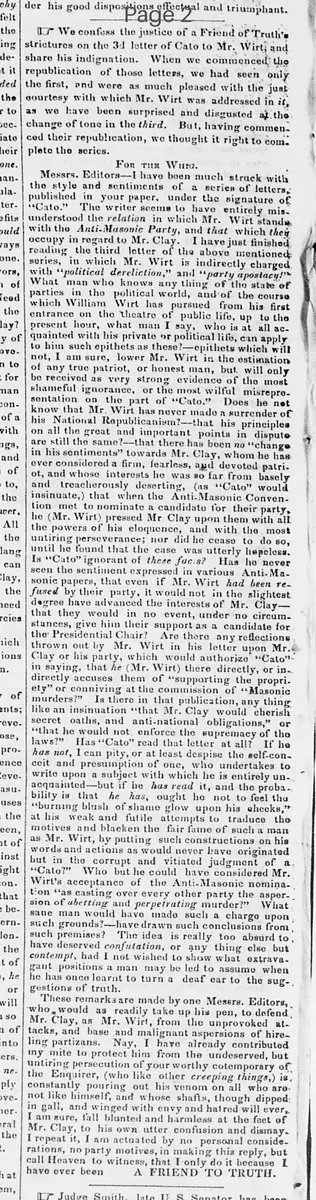
Messrs. Editors—I have been much struck with the style and sentiments of a series of letters, published in your paper, under the signature of "Cato." The writer seems to have entirely misunderstood the relation in which Mr. Wirt stands with the Anti-Masonic Party, and that which they occupy in regard to Mr. Clay. I have just finished reading the third letter of the above mentioned series, in which Mr. Wirt is indirectly charged with "political dereliction," and "party apostacy!" What man who knows any thing of the state of parties in the political world, and of the course which William Wirt has pursued from his first entrance on the theatre of public life, up to the present hour, what man I say, who is at all acquainted with his private or political life, can apply to him such epithets as these?—epithets which will not, I am sure, lower Mr. Wirt in the estimation of any true patriot, or honest man, but will only be received as very strong evidence of the most shameful ignorance, or the most wilful misrepresentation on the part of "Cato." Does he not know that Mr. Wirt has never made a surrender of his National Republicanism?—that his principles on all the great and important points in dispute are still the same?—that there has been no "change in his sentiments" towards Mr. Clay, whom he has ever considered a firm, fearless, and devoted patriot, and whose interests he was so far from basely and treacherously deserting, (as "Cato" would insinuate,) that when the Anti-Masonic Convention met to nominate a candidate for their party, he (Mr. Wirt) pressed Mr. Clay upon them with all the powers of his eloquence, and with the most untiring perseverance; nor did he cease to do so, until he found that the case was utterly hopeless. Is "Cato" ignorant of these facts? Has he never seen the sentiment expressed in various Anti-Masonic papers, that even if Mr. Wirt had been refused by their party, it would not in the slightest degree have advanced the interests of Mr. Clay—that they would in no event, under no circumstances, give him their support as a candidate for the Presidential Chair? Are there any reflections thrown out by Mr. Wirt in his letter upon Mr. Clay or his party, which would authorize "Cato"—in saying, that he (Mr. Wirt) there directly, or indirectly accuses them of "supporting the propriety" or conniving at the commission of "Masonic murders?" Is there in that publication, any thing like an insinuation "that Mr. Clay would cherish secret oaths, and anti-national obligations," or "that he would not enforce the supremacy of the laws?" Has "Cato" read that letter at all? If he has not, I can pity, or at least despise the self-conceit and presumption of one, who undertakes to write upon a subject with which he is entirely unacquainted—but if he has read it, and the probability is that he has, ought he not to feel the "burning blush of shame glow upon his cheeks," at his weak and futile attempts to traduce the motives and blacken the fair fame of such a man as Mr. Wirt, by putting such constructions on his words and actions as would never have originated but in the corrupt and vitiated judgment of a "Cato?" Who but he could have considered Mr. Wirt's acceptance of the Anti-Masonic nomination "as casting over every other party the aspersion of abetting and perpetrating murder?" What sane man would have made such a charge upon such grounds?—have drawn such conclusions from such premises? The idea is really too absurd to have deserved confutation, or any thing else but contempt, had I not wished to show what extravagant positions a man may be led to assume when he has once learnt to turn a deaf ear to the suggestions of truth. These remarks are made by one Messrs. Editors, who would as readily take up his pen, to defend Mr. Clay, as Mr. Wirt, from the unprovoked attacks, and base and malignant aspersions of hireling partizans. Nay, I have already contributed my mite to protect him from the undeserved, but untiring persecution of your worthy cotemporary of the Enquirer, (who like other creeping things,) is constantly pouring out his venom on all who are not like himself, and whose shafts, though dipped in gall, and winged with envy and hatred will ever, I am sure, fall blunted and harmless at the feet of Mr. Clay, to his own utter confusion and dismay. I repeat it, I am actuated by no personal considerations, no party motives, in making this reply, but call Heaven to witness, that I only do it because I have ever been A FRIEND TO TRUTH.
Messrs. Editors—I have been much struck with the style and sentiments of a series of letters, published in your paper, under the signature of "Cato." The writer seems to have entirely misunderstood the relation in which Mr. Wirt stands with the Anti-Masonic Party, and that which they occupy in regard to Mr. Clay. I have just finished reading the third letter of the above mentioned series, in which Mr. Wirt is indirectly charged with "political dereliction," and "party apostacy!" What man who knows any thing of the state of parties in the political world, and of the course which William Wirt has pursued from his first entrance on the theatre of public life, up to the present hour, what man I say, who is at all acquainted with his private or political life, can apply to him such epithets as these?—epithets which will not, I am sure, lower Mr. Wirt in the estimation of any true patriot, or honest man, but will only be received as very strong evidence of the most shameful ignorance, or the most wilful misrepresentation on the part of "Cato." Does he not know that Mr. Wirt has never made a surrender of his National Republicanism?—that his principles on all the great and important points in dispute are still the same?—that there has been no "change in his sentiments" towards Mr. Clay, whom he has ever considered a firm, fearless, and devoted patriot, and whose interests he was so far from basely and treacherously deserting, (as "Cato" would insinuate,) that when the Anti-Masonic Convention met to nominate a candidate for their party, he (Mr. Wirt) pressed Mr. Clay upon them with all the powers of his eloquence, and with the most untiring perseverance; nor did he cease to do so, until he found that the case was utterly hopeless. Is "Cato" ignorant of these facts? Has he never seen the sentiment expressed in various Anti-Masonic papers, that even if Mr. Wirt had been refused by their party, it would not in the slightest degree have advanced the interests of Mr. Clay—that they would in no event, under no circumstances, give him their support as a candidate for the Presidential Chair? Are there any reflections thrown out by Mr. Wirt in his letter upon Mr. Clay or his party, which would authorize "Cato"—in saying, that he (Mr. Wirt) there directly, or indirectly accuses them of "supporting the propriety" or conniving at the commission of "Masonic murders?" Is there in that publication, any thing like an insinuation "that Mr. Clay would cherish secret oaths, and anti-national obligations," or "that he would not enforce the supremacy of the laws?" Has "Cato" read that letter at all? If he has not, I can pity, or at least despise the self-conceit and presumption of one, who undertakes to write upon a subject with which he is entirely unacquainted—but if he has read it, and the probability is that he has, ought he not to feel the "burning blush of shame glow upon his cheeks," at his weak and futile attempts to traduce the motives and blacken the fair fame of such a man as Mr. Wirt, by putting such constructions on his words and actions as would never have originated but in the corrupt and vitiated judgment of a "Cato?" Who but he could have considered Mr. Wirt's acceptance of the Anti-Masonic nomination "as casting over every other party the aspersion of abetting and perpetrating murder?" What sane man would have made such a charge upon such grounds?—have drawn such conclusions from such premises? The idea is really too absurd to have deserved confutation, or any thing else but contempt, had I not wished to show what extravagant positions a man may be led to assume when he has once learnt to turn a deaf ear to the suggestions of truth. These remarks are made by one Messrs. Editors, who would as readily take up his pen, to defend Mr. Clay, as Mr. Wirt, from the unprovoked attacks, and base and malignant aspersions of hireling partizans. Nay, I have already contributed my mite to protect him from the undeserved, but untiring persecution of your worthy cotemporary of the Enquirer, (who like other creeping things,) is constantly pouring out his venom on all who are not like himself, and whose shafts, though dipped in gall, and winged with envy and hatred will ever, I am sure, fall blunted and harmless at the feet of Mr. Clay, to his own utter confusion and dismay. I repeat it, I am actuated by no personal considerations, no party motives, in making this reply, but call Heaven to witness, that I only do it because I have ever been A FRIEND TO TRUTH.
What sub-type of article is it?
Persuasive
Political
What themes does it cover?
Politics
What keywords are associated?
William Wirt
Henry Clay
Anti Masonic Party
Cato Letters
National Republicanism
Political Defense
Masonic Nomination
What entities or persons were involved?
A Friend To Truth
Messrs. Editors
Letter to Editor Details
Author
A Friend To Truth
Recipient
Messrs. Editors
Main Argument
william wirt has not committed political dereliction or apostasy; he remains a steadfast national republican who supported henry clay's nomination by the anti-masonic party and has not accused clay or his supporters of masonic crimes.
Notable Details
Response To 'Cato's' Series Of Letters
Wirt's Efforts At Anti Masonic Convention
Criticism Of The Enquirer Newspaper
Emphasis On Defense Of Truth