Thank you for visiting SNEWPapers!
Sign up free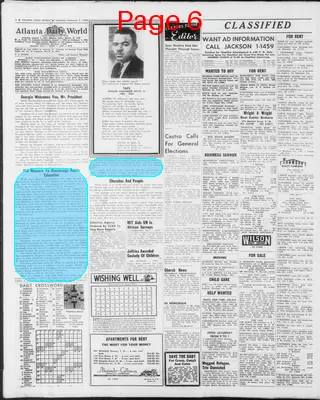
Editorial
February 7, 1959
Atlanta Daily World
Atlanta, Fulton County, Georgia
What is this article about?
Editorial criticizes Georgia Gov. Vandiver's signing of a bill imposing age limits (21 for college, 25 for graduate) on public higher education, seen as a segregation tactic with white exemptions, opposed by Board of Regents as unconstitutional, predicting legal challenge and state shame.
Clipping
OCR Quality
98%
Excellent
Full Text
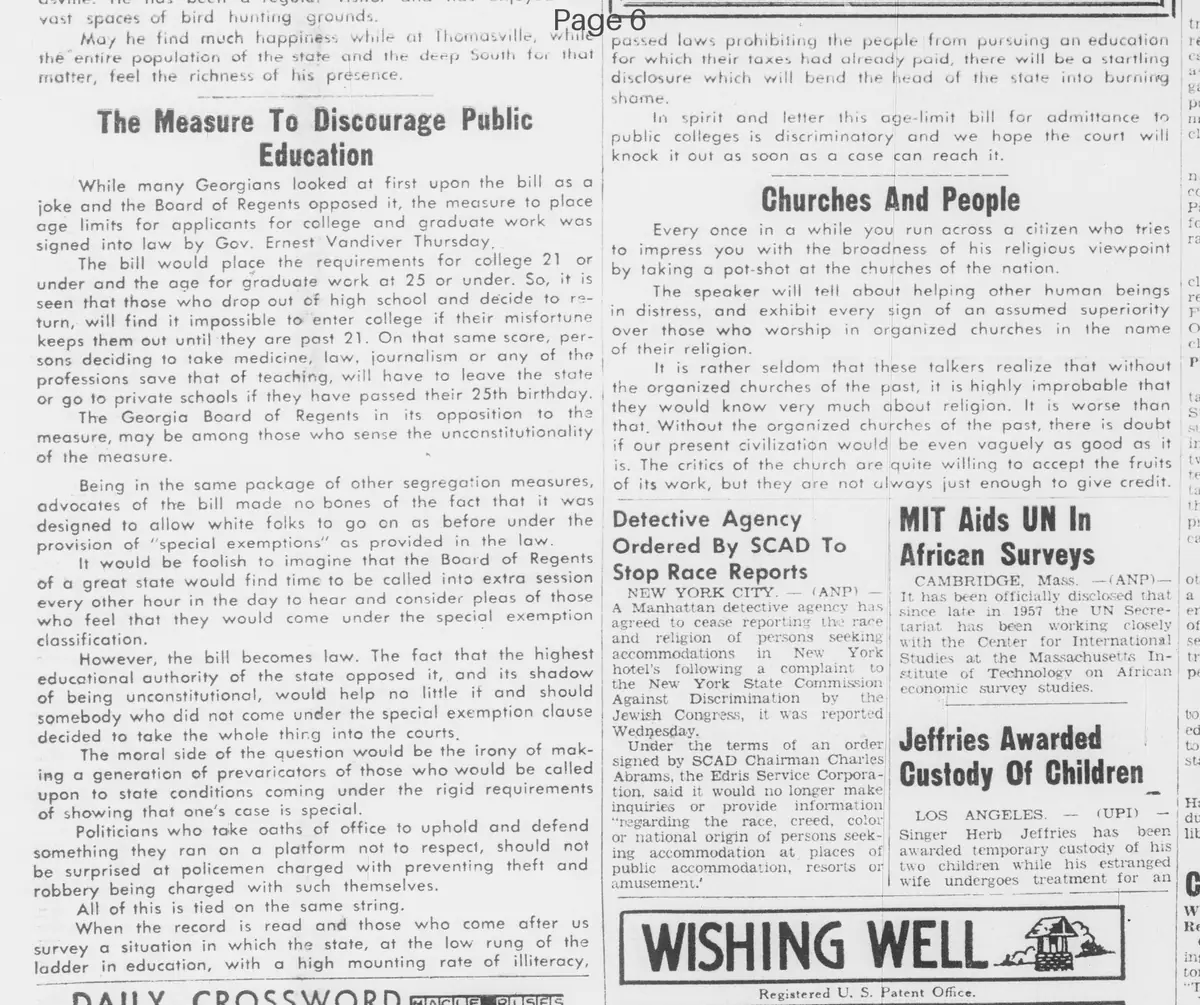
The Measure To Discourage Public Education
While many Georgians looked at first upon the bill as a joke and the Board of Regents opposed it, the measure to place age limits for applicants for college and graduate work was signed into law by Gov. Ernest Vandiver Thursday.
The bill would place the requirements for college 21 or under and the age for graduate work at 25 or under. So, it is seen that those who drop out of high school and decide to return, will find it impossible to enter college if their misfortune keeps them out until they are past 21. On that same score, persons deciding to take medicine, law, journalism or any of the professions save that of teaching, will have to leave the state or go to private schools if they have passed their 25th birthday.
The Georgia Board of Regents in its opposition to the measure, may be among those who sense the unconstitutionality of the measure.
Being in the same package of other segregation measures, advocates of the bill made no bones of the fact that it was designed to allow white folks to go on as before under the provision of "special exemptions" as provided in the law.
It would be foolish to imagine that the Board of Regents of a great state would find time to be called into extra session every other hour in the day to hear and consider pleas of those who feel that they would come under the special exemption classification.
However, the bill becomes law. The fact that the highest educational authority of the state opposed it, and its shadow of being unconstitutional, would help no little it and should somebody who did not come under the special exemption clause decided to take the whole thing into the courts.
The moral side of the question would be the irony of making a generation of prevaricators of those who would be called upon to state conditions coming under the rigid requirements of showing that one's case is special.
Politicians who take oaths of office to uphold and defend something they ran on a platform not to respect, should not be surprised at policemen charged with preventing theft and robbery being charged with such themselves.
All of this is tied on the same string.
When the record is read and those who come after us survey a situation in which the state, at the low rung of the ladder in education, with a high mounting rate of illiteracy, passed laws prohibiting the people from pursuing an education for which their taxes had already paid, there will be a startling disclosure which will bend the head of the state into burning shame.
In spirit and letter this age-limit bill for admittance to public colleges is discriminatory and we hope the court will knock it out as soon as a case can reach it.
While many Georgians looked at first upon the bill as a joke and the Board of Regents opposed it, the measure to place age limits for applicants for college and graduate work was signed into law by Gov. Ernest Vandiver Thursday.
The bill would place the requirements for college 21 or under and the age for graduate work at 25 or under. So, it is seen that those who drop out of high school and decide to return, will find it impossible to enter college if their misfortune keeps them out until they are past 21. On that same score, persons deciding to take medicine, law, journalism or any of the professions save that of teaching, will have to leave the state or go to private schools if they have passed their 25th birthday.
The Georgia Board of Regents in its opposition to the measure, may be among those who sense the unconstitutionality of the measure.
Being in the same package of other segregation measures, advocates of the bill made no bones of the fact that it was designed to allow white folks to go on as before under the provision of "special exemptions" as provided in the law.
It would be foolish to imagine that the Board of Regents of a great state would find time to be called into extra session every other hour in the day to hear and consider pleas of those who feel that they would come under the special exemption classification.
However, the bill becomes law. The fact that the highest educational authority of the state opposed it, and its shadow of being unconstitutional, would help no little it and should somebody who did not come under the special exemption clause decided to take the whole thing into the courts.
The moral side of the question would be the irony of making a generation of prevaricators of those who would be called upon to state conditions coming under the rigid requirements of showing that one's case is special.
Politicians who take oaths of office to uphold and defend something they ran on a platform not to respect, should not be surprised at policemen charged with preventing theft and robbery being charged with such themselves.
All of this is tied on the same string.
When the record is read and those who come after us survey a situation in which the state, at the low rung of the ladder in education, with a high mounting rate of illiteracy, passed laws prohibiting the people from pursuing an education for which their taxes had already paid, there will be a startling disclosure which will bend the head of the state into burning shame.
In spirit and letter this age-limit bill for admittance to public colleges is discriminatory and we hope the court will knock it out as soon as a case can reach it.
What sub-type of article is it?
Education
Constitutional
Social Reform
What keywords are associated?
Age Limits
Public Education
Segregation
Georgia Law
Vandiver
Board Of Regents
Unconstitutional
Discriminatory
What entities or persons were involved?
Gov. Ernest Vandiver
Georgia Board Of Regents
Editorial Details
Primary Topic
Opposition To Georgia Age Limit Law For Public Colleges
Stance / Tone
Strongly Critical And Discriminatory
Key Figures
Gov. Ernest Vandiver
Georgia Board Of Regents
Key Arguments
The Bill Sets Age Limits Of 21 For College And 25 For Graduate Work, Barring Older Dropouts And Professionals
Designed As A Segregation Measure With Special Exemptions For Whites
Opposed By Board Of Regents Due To Unconstitutionality
Creates Irony And Prevarication In Seeking Exemptions
Ties To Broader Hypocrisy In Politics And Law Enforcement
Will Cause Shame For Georgia's Low Education Standing And Illiteracy
Hopes Courts Will Invalidate It As Discriminatory