Thank you for visiting SNEWPapers!
Sign up free
Story
January 13, 1830
Wheeling Compiler
Wheeling, Ohio County, West Virginia
What is this article about?
Article from Journal of Health warns of diseases like croup, consumption, and rheumatism caused by wet feet, especially in children, women, and the wealthy. Criticizes fashion's thin cloth shoes exposing feet to cold and moisture despite available protective options.
Clipping
OCR Quality
95%
Excellent
Full Text
From the Journal of Health.
WET FEET.
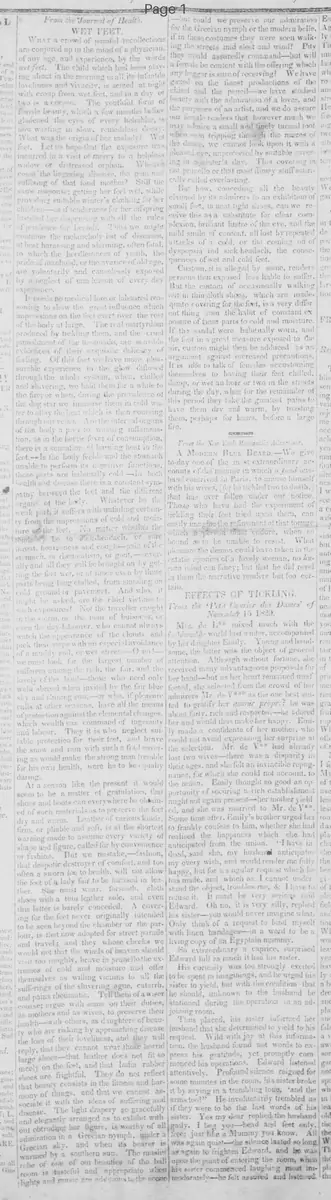
What a crowd of painful recollections are conjured up in the mind of a physician, of any age, and experience, by the words wet feet. The child which had been playing about in the morning with all its infantile loveliness and vivacity, is seized at night with croup from wet feet, and in a day or two is a corpse. The youthful form of female beauty, which a few months before gladdened the eyes of every beholder, is now wasting in slow, remediless decay. What was the origin of her malady? Wet feet. Let us hope that the exposure was incurred in a visit of mercy to a homeless widow or distressed orphan. While cogitating the lingering disease, the pain and suffering of that fond mother? Still the same response: getting her feet wet, while providing suitable winter's clothing for her children; if tenderness for her offspring instigated her dispensing with all the rules of prudence for herself. Thus we might continue the melancholy list of diseases, at best harassing and alarming, often fatal, to which the heedlessness of youth, the pride of manhood, or the avarice of old age, are voluntarily and carelessly exposed by a neglect of one lesson of every day experience.
It needs no medical lore or laboured reasoning to show the great influence which impressions on the feet exert over the rest of the body at large. The real martyrdom produced by tickling them, and the cruel punishment of the bastinado, are sensible evidences of their exquisite delicacy of feeling. Of this fact we have more pleasurable experience in the glow diffused through the whole system, when, chilled and shivering, we hold them for a while to the fire; or when, during the prevalence of the dog star we immerse them in cold water to allay the heat which is then coursing through our veins. Are the internal organs of the body apt to resisting inflammation, as in the hectic fever of consumption, there is a sensation of burning heat in the feet—Is the body feeble and the stomach unable to perform its digestive functions, these parts are habitually cold—In both health and disease there is a constant sympathy between the feet and the different organs of the body. Whatever be the sympathy between the feet and the different weak part, it suffers with unfailing certainty. No matter whether the weakness arise from the impressions of cold and moisture, tending to produce rheumatism, or sore throat, or cold—pains of the face, or rheumatism, or gout,—over all they will be brought on by getting the feet wet, or at times even by those parts being long chilled, from standing on cold ground or pavement. And who, it might be asked, are the chief victims to such exposures? Not the traveller cautiously on the farm, or the man of business, or even the day labourer, who cannot always watch the appearance of the clouds and pick their steps with an especial avoidance of a muddy soil, or wet streets. No—we must look for the largest number of sufferers among the rich, the fair, and the lovely of the land—these who need only walk abroad when invited by the fair blue sky and shining sun, or who, if pleasure calls at other seasons, have all the means of protection against the elemental changes, which wealth can command of ingenuity and labour. They it is who neglect suitable protection for their feet, and brave the snow and rain with such a hardihood as would make the strong man tremble for his own health, were he to be equally daring.
At a season like the present it would seem to be a matter of gratulation, that shoes and boots can everywhere be obtained of such materials as to preserve the feet dry and warm. Leather of various kinds, firm, or pliable and soft, is at the shortest warning made to assume every variety of shape and figure, called for by convenience or fashion. But we mistake—fashion, that despotic destroyer of comfort, and too often a sworn foe to health, will not allow the feet of a lady fair to be incased in leather. She must wear, forsooth, cloth shoes with a thin leather sole, and even thus latter is barely conceded. A covering for the feet never originally intended to be seen beyond the chamber or the parlour, is that now adopted for street parade and travel: and they whose cheeks we would not that the winds of heaven should visit too roughly, brave in grenadillo the extremes of cold and moisture and offer themselves as willing victims to all the sufferings of the shivering ague, catarrh, and pains rheumatic. Tell them of a wiser course; argue with some on their duties, as mothers and as wives, to preserve their health—a gift which they are risking by approaching disease; with others, as daughters of beauty, of the loss of their loveliness, and they will reply, that they cannot wear those horrid large shoes—that leather does not fit so nicely on the feet, and that India rubber shoes are frightful. They do not reflect that beauty consists in the fitness and harmony of things, and that we cannot associate it with the ideas of suffering and disease. The light drapery so gracefully and elegantly arranged as to exhibit without obtruding her figure, is worthy of all admiration in a Grecian nymph, under a Grecian sky, and when its bearer is warmed by a southern sun. The muslin robe of one of our beauties of the ball room is tasteful and appropriate when lights and music are gorgeous to the scene—but could we preserve our admiration for the Grecian nymph or the modern belle, if in these costumes they were seen walking the streets amid sleet and wind? Pity they would assuredly command—but will a female be content with the offering which any beggar is sure of receiving? We have gazed on the finest productions of the chisel and the pencil—we have studied beauty with the admiration of a lover, and the purposes of an artist, and we do assure our female readers that however much we may admire a small and finely turned foot when seen tripping through the mazes of the dance, we cannot look upon it with a pleased eye, unprotected by suitable covering in winter's day. This covering in not prunella or that most flimsy stuff satirically called everlasting.
By no means conceding all the beauty claimed by its admirers to an exhibition of small feet, in neat tight shoes, can we receive this as a substitute for clear complexion, brilliant lustre of the eye, and the mild smile of content, all lost by repeated attacks of a cold, or the coming on of dyspepsia and sick headache, the consequences of wet and cold feet.
Custom, it is alleged by some, renders persons thus exposed less liable to suffer. But the custom of occasionally walking out in thin cloth shoes, which are made inadequate covering for the feet, is a very different thing from the habit of constant exposure of these parts to cold and moisture. If the sandal were habitually worn, and the foot in a great measure exposed to the air, custom might then be adduced as an argument against increased precautions. It is idle to talk of females accustoming themselves to having their feet chilled, damp, or wet an hour or two in the streets during the day, when, for the remainder of this period they take the greatest pains to have them dry and warm, by toasting them, perhaps for hours, before a large fire.
WET FEET.
What a crowd of painful recollections are conjured up in the mind of a physician, of any age, and experience, by the words wet feet. The child which had been playing about in the morning with all its infantile loveliness and vivacity, is seized at night with croup from wet feet, and in a day or two is a corpse. The youthful form of female beauty, which a few months before gladdened the eyes of every beholder, is now wasting in slow, remediless decay. What was the origin of her malady? Wet feet. Let us hope that the exposure was incurred in a visit of mercy to a homeless widow or distressed orphan. While cogitating the lingering disease, the pain and suffering of that fond mother? Still the same response: getting her feet wet, while providing suitable winter's clothing for her children; if tenderness for her offspring instigated her dispensing with all the rules of prudence for herself. Thus we might continue the melancholy list of diseases, at best harassing and alarming, often fatal, to which the heedlessness of youth, the pride of manhood, or the avarice of old age, are voluntarily and carelessly exposed by a neglect of one lesson of every day experience.
It needs no medical lore or laboured reasoning to show the great influence which impressions on the feet exert over the rest of the body at large. The real martyrdom produced by tickling them, and the cruel punishment of the bastinado, are sensible evidences of their exquisite delicacy of feeling. Of this fact we have more pleasurable experience in the glow diffused through the whole system, when, chilled and shivering, we hold them for a while to the fire; or when, during the prevalence of the dog star we immerse them in cold water to allay the heat which is then coursing through our veins. Are the internal organs of the body apt to resisting inflammation, as in the hectic fever of consumption, there is a sensation of burning heat in the feet—Is the body feeble and the stomach unable to perform its digestive functions, these parts are habitually cold—In both health and disease there is a constant sympathy between the feet and the different organs of the body. Whatever be the sympathy between the feet and the different weak part, it suffers with unfailing certainty. No matter whether the weakness arise from the impressions of cold and moisture, tending to produce rheumatism, or sore throat, or cold—pains of the face, or rheumatism, or gout,—over all they will be brought on by getting the feet wet, or at times even by those parts being long chilled, from standing on cold ground or pavement. And who, it might be asked, are the chief victims to such exposures? Not the traveller cautiously on the farm, or the man of business, or even the day labourer, who cannot always watch the appearance of the clouds and pick their steps with an especial avoidance of a muddy soil, or wet streets. No—we must look for the largest number of sufferers among the rich, the fair, and the lovely of the land—these who need only walk abroad when invited by the fair blue sky and shining sun, or who, if pleasure calls at other seasons, have all the means of protection against the elemental changes, which wealth can command of ingenuity and labour. They it is who neglect suitable protection for their feet, and brave the snow and rain with such a hardihood as would make the strong man tremble for his own health, were he to be equally daring.
At a season like the present it would seem to be a matter of gratulation, that shoes and boots can everywhere be obtained of such materials as to preserve the feet dry and warm. Leather of various kinds, firm, or pliable and soft, is at the shortest warning made to assume every variety of shape and figure, called for by convenience or fashion. But we mistake—fashion, that despotic destroyer of comfort, and too often a sworn foe to health, will not allow the feet of a lady fair to be incased in leather. She must wear, forsooth, cloth shoes with a thin leather sole, and even thus latter is barely conceded. A covering for the feet never originally intended to be seen beyond the chamber or the parlour, is that now adopted for street parade and travel: and they whose cheeks we would not that the winds of heaven should visit too roughly, brave in grenadillo the extremes of cold and moisture and offer themselves as willing victims to all the sufferings of the shivering ague, catarrh, and pains rheumatic. Tell them of a wiser course; argue with some on their duties, as mothers and as wives, to preserve their health—a gift which they are risking by approaching disease; with others, as daughters of beauty, of the loss of their loveliness, and they will reply, that they cannot wear those horrid large shoes—that leather does not fit so nicely on the feet, and that India rubber shoes are frightful. They do not reflect that beauty consists in the fitness and harmony of things, and that we cannot associate it with the ideas of suffering and disease. The light drapery so gracefully and elegantly arranged as to exhibit without obtruding her figure, is worthy of all admiration in a Grecian nymph, under a Grecian sky, and when its bearer is warmed by a southern sun. The muslin robe of one of our beauties of the ball room is tasteful and appropriate when lights and music are gorgeous to the scene—but could we preserve our admiration for the Grecian nymph or the modern belle, if in these costumes they were seen walking the streets amid sleet and wind? Pity they would assuredly command—but will a female be content with the offering which any beggar is sure of receiving? We have gazed on the finest productions of the chisel and the pencil—we have studied beauty with the admiration of a lover, and the purposes of an artist, and we do assure our female readers that however much we may admire a small and finely turned foot when seen tripping through the mazes of the dance, we cannot look upon it with a pleased eye, unprotected by suitable covering in winter's day. This covering in not prunella or that most flimsy stuff satirically called everlasting.
By no means conceding all the beauty claimed by its admirers to an exhibition of small feet, in neat tight shoes, can we receive this as a substitute for clear complexion, brilliant lustre of the eye, and the mild smile of content, all lost by repeated attacks of a cold, or the coming on of dyspepsia and sick headache, the consequences of wet and cold feet.
Custom, it is alleged by some, renders persons thus exposed less liable to suffer. But the custom of occasionally walking out in thin cloth shoes, which are made inadequate covering for the feet, is a very different thing from the habit of constant exposure of these parts to cold and moisture. If the sandal were habitually worn, and the foot in a great measure exposed to the air, custom might then be adduced as an argument against increased precautions. It is idle to talk of females accustoming themselves to having their feet chilled, damp, or wet an hour or two in the streets during the day, when, for the remainder of this period they take the greatest pains to have them dry and warm, by toasting them, perhaps for hours, before a large fire.
What sub-type of article is it?
Medical Curiosity
Curiosity
What themes does it cover?
Moral Virtue
Misfortune
What keywords are associated?
Wet Feet
Health Risks
Croup
Consumption
Rheumatism
Fashionable Shoes
Women's Health
Medical Advice
Story Details
Story Details
The article recounts how wet feet cause various diseases such as croup in children, consumption in young women, and rheumatism, emphasizing the sympathy between feet and body organs, and criticizes women's fashionable thin footwear for exposing them to cold and moisture despite better options available.