Thank you for visiting SNEWPapers!
Sign up free
Buckeye Valley News And Buckeye Review
Buckeye, Maricopa County, Arizona
What is this article about?
T. J. Schmitt of the Bureau of Entomology delivered an illustrated lecture on screw worm control to agricultural classes at Buckeye Union High School on Thursday, February 18, explaining the pest's life cycle, infestation process, and recommended treatments using benzol and pine tar oil.
Clipping
OCR Quality
Full Text
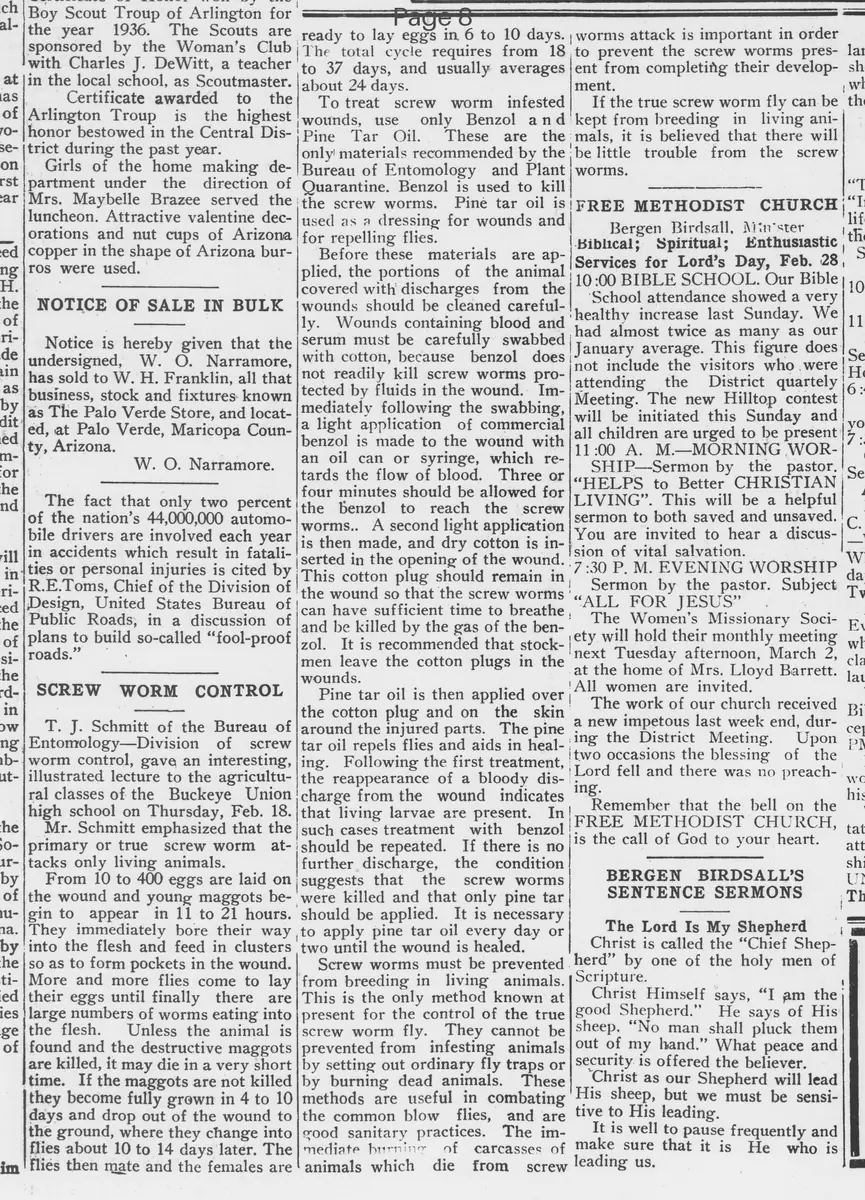
T. J. Schmitt of the Bureau of Entomology-Division of screw worm control, gave an interesting, illustrated lecture to the agricultural classes of the Buckeye Union high school on Thursday, Feb. 18. Mr. Schmitt emphasized that the primary or true screw worm attacks only living animals.
From 10 to 400 eggs are laid on the wound and young maggots begin to appear in 11 to 21 hours. They immediately bore their way into the flesh and feed in clusters so as to form pockets in the wound. More and more flies come to lay their eggs until finally there are large numbers of worms eating into the flesh. Unless the animal is found and the destructive maggots are killed, it may die in a very short time. If the maggots are not killed they become fully grown in 4 to 10 days and drop out of the wound to the ground, where they change into flies about 10 to 14 days later. The flies then mate and the females are ready to lay eggs in, 6 to 10 days.
The total cycle requires from 18 to 37 days, and usually averages about 24 days.
To treat screw worm infested wounds, use only Benzol and Pine Tar Oil. These are the only materials recommended by the Bureau of Entomology and Plant Quarantine. Benzol is used to kill the screw worms. Pine tar oil is used as a dressing for wounds and for repelling flies.
Before these materials are applied, the portions of the animal covered with discharges from the wounds should be cleaned carefully. Wounds containing blood and serum must be carefully swabbed with cotton, because benzol does not readily kill screw worms protected by fluids in the wound. Immediately following the swabbing, a light application of commercial benzol is made to the wound with an oil can or syringe, which retards the flow of blood. Three or four minutes should be allowed for the benzol to reach the screw worms. A second light application is then made, and dry cotton is inserted in the opening of the wound. This cotton plug should remain in the wound so that the screw worms can have sufficient time to breathe and be killed by the gas of the benzol. It is recommended that stockmen leave the cotton plugs in the wounds.
Pine tar oil is then applied over the cotton plug and on the skin around the injured parts. The pine tar oil repels flies and aids in healing.
Following the first treatment, the reappearance of a bloody discharge from the wound indicates that living larvae are present. In such cases treatment with benzol should be repeated. If there is no further discharge, the condition suggests that the screw worms were killed and that only pine tar should be applied. It is necessary to apply pine tar oil every day or two until the wound is healed.
Screw worms must be prevented from breeding in living animals. This is the only method known at present for the control of the true screw worm fly. They cannot be prevented from infesting animals by setting out ordinary fly traps or by burning dead animals. These methods are useful in combating the common blow flies, and are good sanitary practices. The immediate burning of carcasses of animals which die from screw worms attack is important in order to prevent the screw worms present from completing their development.
If the true screw worm fly can be kept from breeding in living animals, it is believed that there will be little trouble from the screw worms.
What sub-type of article is it?
What keywords are associated?
What entities or persons were involved?
Where did it happen?
Domestic News Details
Primary Location
Buckeye Union High School
Event Date
Thursday, Feb. 18
Key Persons
Event Details
T. J. Schmitt gave an illustrated lecture on screw worm control, emphasizing that the true screw worm attacks only living animals. The lecture covered the life cycle: 10-400 eggs laid on wounds, maggots appear in 11-21 hours, feed in flesh, mature in 4-10 days, pupate into flies in 10-14 days, females ready to lay eggs in 6-10 days, total cycle 18-37 days averaging 24. Treatment: Clean wounds, swab with cotton, apply benzol to kill worms, insert cotton plug, apply pine tar oil to repel flies and aid healing. Repeat if bloody discharge reappears. Prevention by stopping breeding in living animals; burn carcasses.