Thank you for visiting SNEWPapers!
Sign up free
Rhode Island Republican
Newport, Newport County, Rhode Island
What is this article about?
Editorial from the National Intelligencer critiques Benjamin Stoddert's defense against a congressional committee's report accusing him of illegally using funds appropriated for building six 74-gun ships to purchase six navy yards. It argues this violated the law and separation of powers. Includes a short note revealing Stoddert's earlier contrary view.
Merged-components note: The letter to the editor provides additional context on the same topic (Mr. Stoddert's actions) as the preceding editorial, forming a coherent opinion piece.
Clipping
OCR Quality
Full Text
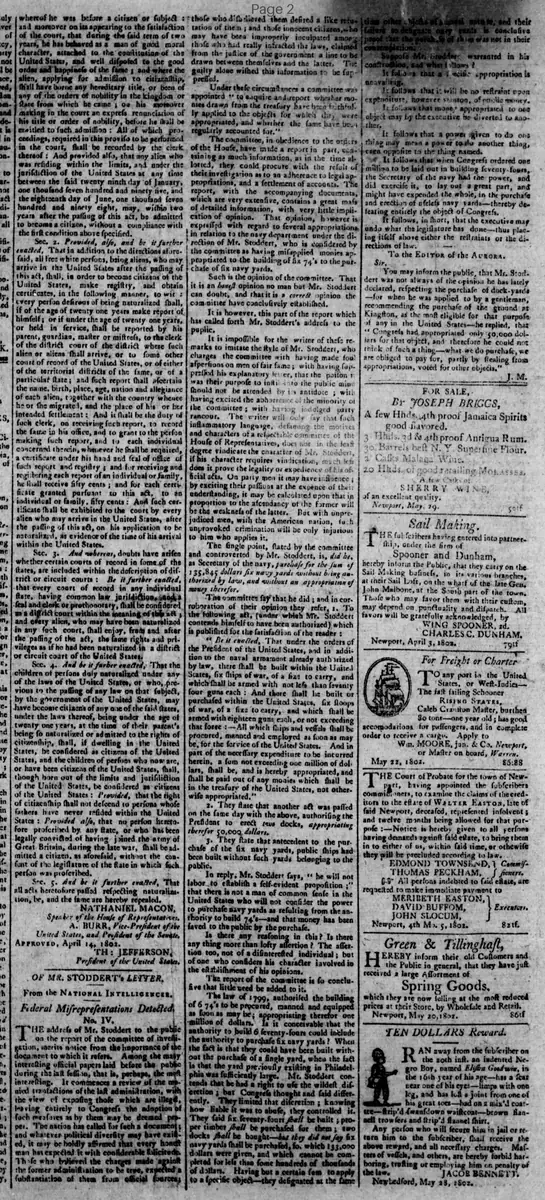
From the National Intelligencer.
Federal Misrepresentations Detected
No. IV.
THE address of Mr. Stoddert to the public on the report of the committee of investigation, merits notice from the importance of the document to which it refers. Among the many interesting official papers laid before the public during the last session, that is, perhaps, the most interesting. It commences a review of the most important transactions of the last administration, with the view of exposing those which are illegal. Leaving entirely to Congress the adoption of such measures as by them may be deemed proper. The nation has called for such a document; and whatever political diversity may have existed, it may be boldly affirmed that every honest man has expected it with considerable solicitude. Those who believed the charges made against the former administration to be true, expected a substantiation of them from official sources; those who disbelieved them desired a like refutation of them; and those innocent citizens who may have been improperly inculpated among those who had really infringed the laws, claimed from the justice of the government a line to be drawn between themselves and the latter. The guilty alone wished this information to be suppressed.
Under these circumstances a committee was appointed "to enquire and report whether monies drawn from the treasury have been faithfully applied to the objects for which they were appropriated, and whether the same have been regularly accounted for."
The committee, in obedience to the orders of the House, have made a report in part, containing as much information, as in the time allotted, they could procure with the result of their investigation as to an adherence to legal appropriations, and a settlement of accounts. The report, with the accompanying documents, which are very extensive, contains a great mass of detailed information, with very little implication of opinion. That opinion, however is expressed with regard to several appropriations in relation to the navy department under the direction of Mr. Stoddert, who is considered by the committee as having misapplied monies appropriated to the building of six 74's to the purchase of six navy yards.
Such in the opinion of the committee. That it is an honest opinion no man but Mr. Stoddert can doubt, and that it is a correct opinion the committee have conclusively established.
It is however, this part of the report which has called forth Mr. Stoddert's address to the public.
It is impossible for the writer of these remarks to imitate the style of Mr. Stoddert, who charges the committee with having made foul aspersions on men of fair fame; with having suppressed his explanatory letter, that the poison it was their purpose to instil into the public mind should not be attended by its antidote; with having excited the abhorrence of the minority of the committee; with having indulged party rancour. The writer will only say that such inflammatory language, defaming the motives and characters of a respectable committee of the House of Representatives, does not in the least degree vindicate the character of Mr. Stoddert, if his character requires vindication, much less does it prove the legality or expediency of his official acts. On party men it may have influence; by exciting their passions at the expense of their understanding, it may be calculated upon that in proportion to the ascendancy of the former will be the weakness of the latter. But with unprejudiced men, with the American nation, such unprovoked crimination will be only injurious to him who applies it.
The single point, stated by the committee and controverted by Mr. Stoddert, is, did he, as Secretary of the navy, purchase for the sum of 135,845 dollars six navy yards without being authorized by law, and without an appropriation of money therefor.
The committee say that he did; and in corroboration of their opinion they refer, 1. To the following act, (under which Mr. Stoddert contends himself to have been authorized) which is published for the satisfaction of the reader:
"Be it enacted, That under the orders of the President of the United States, and in addition to the naval armament already authorized by law, there shall be built within the United States, six ships of war, of a size to carry, and which shall be armed with not less than seventy four guns each: And there shall be built or purchased within the United States, six Sloops of war, of a size to carry, and which shall be armed with eighteen guns each, or not exceeding that force:--All which ships and vessels shall be procured, manned and employed as soon as may be, for the service of the United States. And in part of the necessary expenditure to be incurred herein, a sum not exceeding one million of dollars, shall be, and is hereby appropriated, and shall be paid out of any monies which shall be in the treasury of the United States, not otherwise appropriated."
2. They state that another act was passed on the same day with the above, authorizing the President to erect two docks, appropriating therefor 50,000 dollars.
3. They state that antecedent to the purchase of the six navy yards, public ships had been built without such yards belonging to the public.
In reply; Mr. Stoddert says, "he will not labor to establish a self-evident proposition;" that there is not a man of common sense in the United States who will not consider the power to purchase navy yards as resulting from the authority to build 74's--and that money has been saved to the public by the purchase.
Is there any reasoning in this? Is there any thing more than lofty assertion? The assertion too, not of a disinterested individual; but of one who considers his character involved in the establishment of his opinions.
The report of the committee is so conclusive that little need be added to it.
The law of 1799, authorized the building of 6 74's to be procured, manned and equipped as soon as may be; appropriating therefor one million of dollars. Is it conceivable that the authority to build 6 seventy-fours could include the authority to purchase six navy yards? When the fact is that they could have been built without the purchase of a single yard, when the fact is that the yard previously existing in Philadelphia was sufficiently large. Mr. Stoddert contends that he had a right to use the widest discretion; but Congress thought and said differently. They limited that discretion; knowing how liable it was to abuse, they controlled it. They said six seventy-fours shall be built; proper timber shall be purchased for them; two docks shall be built--but they did not say six navy yards shall be purchased, for which 133,000 dollars were given, and which cannot be completed for less than some hundreds of thousands of dollars. Having but a certain sum to apply to a specific object--they designated at the laws the other objects of expense also to prevent re, and their failure so definite any yards is conclusive proof that the purchase of them was not in their contemplation.
Suppose Mr. Stoddert warranted in his construction, and what follows?
It follows that a specific appropriation is unavailing.
It follows that it will be no restraint upon expenditure, however wanton, of public money.
It follows that money appropriated to one object may by the executive be diverted to another.
It follows that a power given to do one thing may mean a power to do another thing, even opposite to the thing named.
It follows that when Congress ordered one million to be laid out in building seventy-fours, the Secretary of the navy had the power, and did exercise it, to lay out a great part, and might have expended the whole, in the purchase and erection of useless navy yards--thereby defeating entirely the object of Congress.
It follows, in short, that the executive may undo what the legislature has done--thus placing itself above either the restraints or the directions of law.
To the Editor of the Aurora.
Sir.
You may inform the public, that Mr. Stoddert was not always of the opinion he has lately declared, respecting the purchase of dock-yards—for when he was applied to by a gentleman, recommending the purchase of the ground at Kingston, as the most eligible for that purpose of any in the United States—he replied, that "Congress had appropriated only 20,000 dollars for that object, and therefore he could not think of such a thing--what we do purchase, we are obliged to pay for, partly by stealing from appropriations, voted for other objects."
J. M.
What sub-type of article is it?
What keywords are associated?
What entities or persons were involved?
Editorial Details
Primary Topic
Critique Of Stoddert's Unauthorized Purchase Of Navy Yards Using Shipbuilding Funds
Stance / Tone
Strongly Critical Of Stoddert And Supportive Of Congressional Committee's Findings
Key Figures
Key Arguments