Thank you for visiting SNEWPapers!
Sign up free
Daily National Intelligencer
Washington, District Of Columbia
What is this article about?
House of Commons debate on May 20: Lord Castlereagh moved the Alien Bill report. Critics like Grant, Romilly, and Wynn argued against royal prerogative over aliens, citing historical precedents and abuse risks. Supporters like Best and Yorke defended it. Report approved 148-48; one-year amendment lost 151-32.
Merged-components note: Continuation of the same article on the English Parliament debate across columns.
Clipping
OCR Quality
Full Text
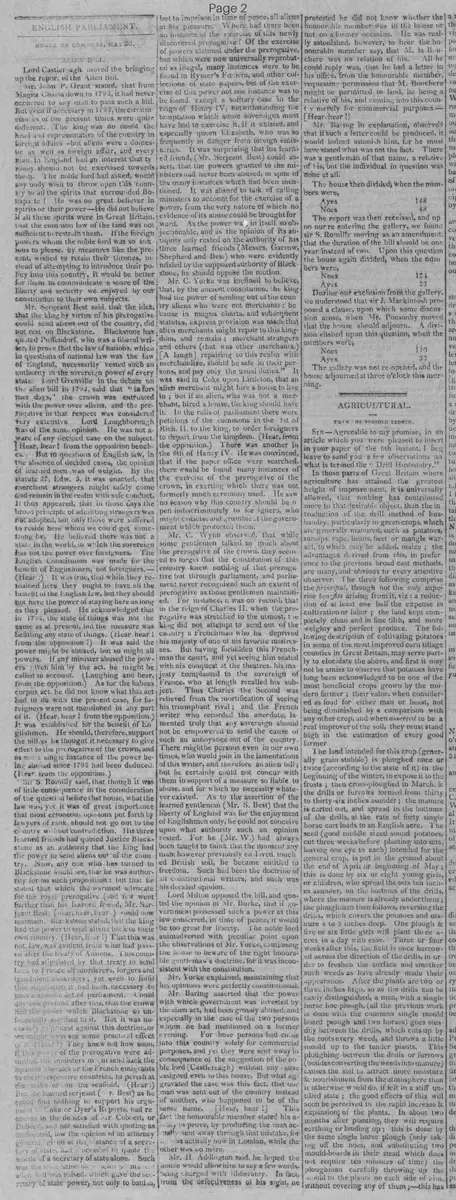
HOUSE OF COMMONS, MAY 20.
Lord Castlereagh moved the bringing up the report of the Alien Bill.
Mr. John P. Grant stated, that from Magna Charta down to 1792, it had never occurred to any man to pass such a bill. But even if necessary in 1792, the circumstances of the present times were quite different. The king was no doubt the head and representative of the country in foreign affairs—but aliens were a domestic as well as foreign affair, and every man in England had an interest that tyranny should not be exercised towards them. The noble lord had asked, would any body wish to throw open this country to all the spirits that surrounded Bonaparte? He was no great believer in spirits or their power—He did not believe if all these spirits were in Great Britain, that the common law of the land was not sufficient to restrain them. If the foreign powers whom the noble lord was so anxious to please, by measures like the present, wished to retain their thrones, instead of attempting to introduce their policy into this country, it would be better for them to communicate a share of the liberty and security we enjoyed by our constitution to their own subjects.
Mr. Sergeant Best said, that the idea that the king by virtue of his prerogative could send aliens out of the country, did not rest on Blackstone. Blackstone has quoted Puffendorf, who was a liberal writer, to prove that the law of nations, which in questions of national law was the law of England, necessarily vested such an authority in the sovereign power of every state. Lord Grenville in the debate on the alien bill in 1792, said that "in former days," the crown was entrusted with the power over aliens, and the prerogative in that respect was considered very extensive. Lord Loughborough was of the same opinion. He was not aware of any decided case on the subject. Hear, hear! from the opposition benches. But in questions of English law, in the absence of decided cases, the opinion of learned men was of weight: By the statute 27, Edw. 3, it was enacted, that merchant strangers might safely come and remain in the realm with safe conduct. It thus appeared, that in those days the broad principle of admitting strangers was not adopted, but only those were suffered to reside here whom we could get something by. He believed there was not a state in the world, in which the sovereign has not the power over foreigners. The English Constitution was made for the benefit of Englishmen, not foreigners. (Hear!) It was true, that while they remained here they ought to have all the benefit of the English law, but they should not have the power of staying here as long as they pleased. He acknowledged that in 1793, the state of things was not the same as at present, but the measure was becoming any state of things. (Hear, hear! from the opposition!) It was said the power might be abused, but so might all powers. If any minister abused the powers given him by the act, he might be called to account. (Laughing and hear, from the opposition.) As for the habeas corpus act, he did not know what that act had to do with the present case, for foreigners were not mentioned in any part of it. (Hear, hear! from the opposition.) It was established for the benefit of Englishmen. He should, therefore, support the bill, as he thought it necessary to give effect to the prerogative of the crown, and as not a single instance of the power being abused since 1792 had been adduced. (Hear, from the opposition.)
Sir S. Romilly said, that though it was of little consequence in the consideration of the question before that house, what the law was, yet it was of great importance that most erroneous opinions put forth by lawyers of rank, should not go out to the country without contradiction. His three learned friends had quoted Justice Blackstone as an authority that the king had the power to send aliens out of the country. Now, any one who has turned to Blackstone would see, that he was authority for no such proposition: but that he stated that which the warmest advocate for the royal prerogative (and few went further than his learned friend, Mr. Sergeant Best, (hear, hear, hear)) would now maintain. Blackstone stated, that the king had the power to send aliens back to their own country. (Hear, hear!) That this was not law, was evident from what had passed after the treaty of Amiens. This country had stipulated by that treaty to send back to France all murderers, forgers and fraudulent bankrupts; yet even to fulfil this stipulation it had been necessary to pass a specific act of parliament. Could any one pretend after this, that the crown had the power which Blackstone so unfoundedly ascribed to it. But it was necessary to protest against this doctrine, or we might soon see some practical effect of it. (Hear!) They knew not how soon, if this power of the prerogative were admitted, the ministers might send back the Spanish liberals or the French emigrants to their respective countries, to perish at the stake or on the scaffold. (Hear:) But he learned sergeant (Mr. Best) as he could find nothing to support his argument in Coke or Dyer's Reports, had recourse to the debates of Mr. Cobbett, or Debrett, and not satisfied with quoting as undoubted, law the opinion of an attorney general given at the instance of a secretary of state, had proceeded to quote the words of a secretary of state alone. Such was the true foundation on which an alien bill was raised, which gave the secretary of state power, not only to banish
but to imprison in time of peace, all aliens at his pleasure. Where had there been an instance of the exercise of this newly discovered prerogative? Of the exercise of powers claimed under the prerogative, but which were now universally reprobated as illegal, many instances were to be found in Rymer's Fœdera, and other collections of state papers, but of the exercise of this power not one instance was to be found, except a solitary case in the reign of Henry IV, notwithstanding the temptation which some sovereigns must have had to exercise it, if it existed, and especially queen Elizabeth, who was so frequently in danger from foreign emissaries. It was surprising that his learned friend, (Mr. Serjeant Best) could assert, that the powers granted to the ministers had never been abused, in spite of the many instances which had been mentioned. It was absurd to talk of calling ministers to account for the exercise of a power, from the very nature of which no evidence of its abuse could be brought forward. As the power was in itself, so objectionable, and as the opinion of its antiquity only rested on the authority of his three learned friends (Messrs. Garrow, Shepherd and Best) who were evidently misled by the supposed authority of Blackstone, he should oppose the motion.
Mr. C. Yorke was inclined to believe that, by the ancient constitution, the king had the power of sending out of the country aliens who were not merchants; because in magna charta, and subsequent statutes, express provision was made that alien merchants might repair to this kingdom, and remain; merchant strangers and others (that was other merchants,) a laugh repairing to this realm with merchandize, should be safe in their persons, and pay only the usual duties. It was said in Coke upon Littleton, that an alien merchant might hire a house to live in: but if an alien, who was not a merchant, hired a house, the king should have it. In the rolls of parliament there were petitions of the commons in the 1st of Rich. II. to the king, to order foreigners to depart from the kingdom. (Hear, from the opposition.) There was another in the 6th of Henry IV. He was convinced, that if the paper office were searched, there would be found many instances of the exercise of the prerogative of the crown, in exerting which there was not formerly much ceremony used. He saw no reason why this country should be open indiscriminately to foreigners, who might criticise and grumble at the government which protected them.
Mr. C. Wynn observed, that while some gentlemen talked so much about the prerogative of the crown, they seemed to forget that the constitution of this country knew nothing of that prerogative but through parliament, and parliament never recognized such an extent of prerogative as those gentlemen maintained. For instance, it was on record, that in the reign of Charles II. when the prerogative was stretched to the utmost, the king did not attempt to send out of the country a Frenchman who had deprived his majesty of one of his favorite mistresses. But having forbidden this Frenchman the court, and yet seeing him seated with his conquest at the theatres, his majesty complained to the sovereign of France, who at length recalled his subject. Thus Charles the Second was relieved from the mortification of seeing his triumphant rival; and the French writer who recorded the anecdote, lamented truly that any sovereign should not be empowered to send the cause of such an annoyance out of the country. There might be persons even in our own times, who would join in the lamentations of this writer, and therefore an alien bill; but he certainly could not concur with them in support of a measure so liable to abuse, and for which no necessity whatever existed. As to the assertion of the learned gentleman (Mr. S. Best) that the liberty of England was for the enjoyment of Englishmen only, he could not conceive upon what authority such an opinion rested. For he (Mr. W.) had always been taught to think that the moment any man, however previously enslaved, touched British soil, he became entitled to freedom. Such had been the doctrine of all constitutional writers, and such was his decided opinion.
Lord Milton opposed the bill, and quoted the opinion of Mr. Burke, that if government possessed such a power as this law conferred, in time of peace, it would be too great for liberty. The noble lord animadverted with peculiar point upon the observations of Mr. Yorke, Cautioning the house to beware of the right honourable gentleman's doctrine, for it was inconsistent with the constitution.
Mr. Yorke explained, maintaining that his opinions were perfectly constitutional.
Mr. Baring asserted that the power with which government was invested by the alien act, had been grossly abused, and especially in the case of the two persons whom he had mentioned on a former evening. For those persons had come into this country solely for commercial purposes, and yet they were sent away in consequence of the suggestion of the noble lord (Castlereagh) without any cause assigned even to this house. But what aggravated the case was this fact, that one man was sent out of the country instead of another, who happened to be of the same name. [Hear, hear!] This fact the honourable member stated his ability to prove, by producing the man actually sent away through that mistake, for he was actually now in London, while the other was no more.
Mr. H. Addington said, he hoped the house would allow him to say a few words, being charged with illiberality. In fact, from the defectiveness of his sight, he protested he did not know whether the honourable member was in the house or not, on a former occasion. He was really astonished, however, to hear the honourable member say, that M. la B.uchere was no relation of his. All he could reply was, that he had a letter in his office, from the honourable member, requesting permission that M. Bouchere might be permitted to land, he being a relative of his, and coming into this country merely for commercial purposes. Hear, hear!!
Mr. Baring in explanation, observed that if such a letter could be produced, it would indeed astonish him, for he must have stated what was not the fact. There was a gentleman of that name, a relative of his, but the individual in question was none at all.
The house then divided when the numbers were,
Ayes 148
Noes 48
The report was then received, and upon our re-entering the gallery, we found sir S. Romilly moving as an amendment, that the duration of the bill should be one year instead of two. Upon this question the house again divided, when the numbers were
Noes 151
Ayes 32
During our exclusion from the gallery, we understood that sir J. Mackintosh proposed a clause, upon which some discussion arose, when Mr. Ponsonby moved that the house should adjourn. A division ensued upon this question, when the numbers were:
Noes 110
Ayes 32
The gallery was not re-opened, and the house adjourned at three o'clock this morning.
What sub-type of article is it?
What keywords are associated?
What entities or persons were involved?
Where did it happen?
Foreign News Details
Primary Location
London
Event Date
May 20
Key Persons
Outcome
report brought up and received (ayes 148, noes 48); amendment for one-year duration lost (noes 151, ayes 32); adjournment motion lost (noes 110, ayes 32).
Event Details
Debate on Alien Bill in House of Commons: Supporters argued for royal prerogative to control aliens based on historical precedents and law of nations; opponents contested the existence of such prerogative, cited lack of historical instances, risks of abuse including deportation of political refugees, and argued for common law protections. Specific cases of alleged abuse mentioned, including mistaken deportation.