Thank you for visiting SNEWPapers!
Sign up free
Corpus Christi Caller And Daily Herald
Corpus Christi, Nueces County, Texas
What is this article about?
Statement by James Brown on Belgium's vast Congo colony in Africa: size, geography, climate challenges for whites, infrastructure progress, rich resources like rubber and ivory, $28M trade, annexed 1908. (187 chars)
Merged-components note: Continuation of the article on Belgium's colony in Africa from page 1 to page 4.
Clippings
1 of 2
OCR Quality
Full Text
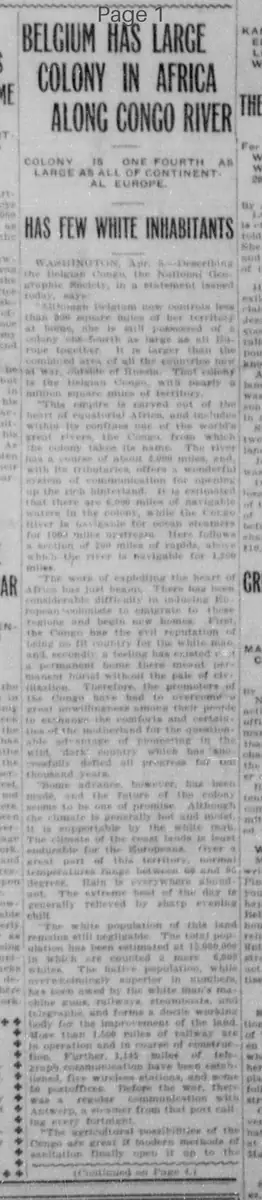
COLONY IS ONE FOURTH LARGE AREA OF CONTINENT ALL EUROPE.
HAS FEW WHITE INHABITANTS
Washington, April 5. - James Brown of the Belgian Congo the National Geographic Society in a statement issued today.
Although Belgium controls less than one square mile of her territory at home, she is still possessed of a one fourth as all Europe together. It is larger than the combined area of all the countries west of Russia. That colony to the Belgian Congo, its nearly 10 million square miles of territory.
This empire is carved out of the heart of equatorial Africa, and includes within its confines one of the world's great rivers the Congo from which the colony takes its name. The river has a course of about 3,000 miles and with the tributaries offer a wonderful system of communication for opening up the vast hinterland. It is estimated that there are 6,000 miles of navigable waters in the colony, while the total river is navigable for ocean steamers for 100 miles upstream. Here follows a stretch of 200 miles of rapids after which the river to navigable too 1,000 miles.
The work of opening the heart of Africa has just begun. There has been considerable difficulty in selecting to European colonists to emigrate to these regions and begin new homes. First, the Congo has the evil reputation of being so hot country for the white man and second, feeling has created at a permanent home there means permanent burial without the pale of civilization. Therefore the promoters of the Congo have had to overcome a great unwillingness among their people to exchange the comforts and certainties of the motherland for the questionable advantages of pioneering in the wilds countries which have been effectually closed all progress for thousands of years.
Some advance however, has been made and the future of the colony seems to be one of promise. Although the climate is generally hot and moist it is endurable by the white man. The climate of the coast lands is least endurable for the European there efest part of this territory normal temperatures range between 68 and 96 degrees Italian I everywhere asotd ant. The extreme heat of the day is generally relieved by sharp evening chilt.
The white population of this land remains still negligible. The total population has been estimated at 10,000,000 in which are counted a mere 6,000 whites. The native population, while overwhelmingly superior in number, has been awed by the white man's machine guns, railroads and telegraphs and forms a docile working body for the improvement of the land.
More than 1,000 miles of railway are in operation and in course of construction. Further, 1,145 miles of telegraph communication have been established, five wireless stations, and some 20 post offices before the war. Regular communications Antwerp steamers from that port call fortnightly.
The agricultural possibilities of the Congo are great. If modern methods of sanitation finally open it up to the coast, immense markets in largest.
BELGIUM HAS LARGE COLONY
AFRICA ALONG CONGO RIVER
(Continued from Page 1)
white
man
Its flora is very
rich and
varled
Among the
products
now cul
tivated
in
its
fields
are coffee, cotton,
yams, cassava,
pineapples,
coron
rice,
peanuts
beans
bananas tobacco
cotton
and
kaffir
corn
Its forests
abound
in
rubber
trees.
The natives
are
employed
for
gathering the rub
ber,
which
forms
the
chief article of
the
colony's
export.
Rich
cabinet
woods
are
plentiful.
and many important
gums
and
resins are
collected.All of
the
domestic
animals
thrive in this
African country
The list of native an
imals includes the elephant, hippopotamus,
buffalo,
antelope, chimpanzee
rhinoceros. and
crocodile.
Slaughter
of elephants for their ivory has been
prohibited. though the ivory exports
are still heavy coming chiefly from na.
tive accumulations.
Of the minerals
large deposits of iron. tin and coal
are found, and some rich deposits of copper
and gold are found in the southeast:
"Palm kernel oil white copal caoutchouc
coffee, corn kole nuts gum ivory gold lead cop
per and raw hides are the articles of
export
The total trade of the Congo
is about $28,000,000 It is almost even
ly divided into exports and imports
For many years this territory, as the
Congo Free State first recognized by the
United States in 1884 maintained
a quasi independence under the rule of
Leopold of Belgium It was formally
annexed to Belgium in 1908 It has an
annual revenue of about $15,000,000 ar
a public debt of more than $10,000,000
The colony is defended by about 15,000
native troops".
What sub-type of article is it?
What keywords are associated?
What entities or persons were involved?
Where did it happen?
Foreign News Details
Primary Location
Belgian Congo
Event Date
April 5
Key Persons
Outcome
annexed to belgium in 1908; annual revenue about $15,000,000; public debt more than $10,000,000; defended by about 15,000 native troops
Event Details
James Brown of the Belgian Congo and the National Geographic Society issued a statement on the vast Belgian colony in equatorial Africa along the Congo River, covering nearly 10 million square miles, larger than one-fourth of Europe. It features the 3,000-mile Congo River with extensive navigable waters. Challenges include hot climate deterring white settlers, with only 6,000 whites among 10 million natives. Infrastructure includes over 1,000 miles of railway, 1,145 miles of telegraph, wireless stations, and post offices. Flora includes coffee, cotton, rubber; fauna elephants, etc.; minerals iron, copper, gold. Exports: palm kernel oil, rubber, ivory, etc., total trade $28,000,000. Natives awed by white technology, form docile workforce.