Thank you for visiting SNEWPapers!
Sign up free
Letter to Editor
March 10, 1854
The Liberator
Boston, Suffolk County, Massachusetts
What is this article about?
John Gordon writes to William Lloyd Garrison defending Joseph Barker against Jane D. McNeely's accusations of vulgarity in religious debates at Salem, Ohio, in 1852 and 1853. He praises Barker's fair and serene conduct, criticizes opponents' slanders and hypocrisy, including Alexander Campbell's support for the Fugitive Slave Law.
Clipping
OCR Quality
98%
Excellent
Full Text
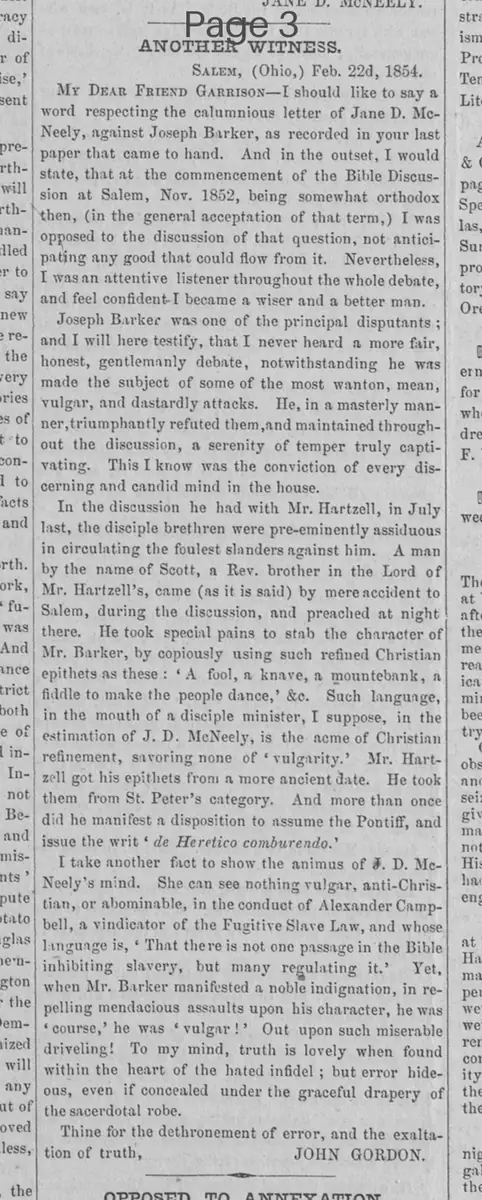
ANOTHER WITNESS.
SALEM, (Ohio,) Feb. 22d, 1854.
My Dear Friend Garrison—I should like to say a word respecting the calumnious letter of Jane D. McNeely, against Joseph Barker, as recorded in your last paper that came to hand. And in the outset, I would state, that at the commencement of the Bible Discussion at Salem, Nov. 1852, being somewhat orthodox then, (in the general acceptation of that term,) I was opposed to the discussion of that question, not anticipating any good that could flow from it. Nevertheless, I was an attentive listener throughout the whole debate, and feel confident—I became a wiser and a better man.
Joseph Barker was one of the principal disputants; and I will here testify, that I never heard a more fair, honest, gentlemanly debate, notwithstanding he was made the subject of some of the most wanton, mean, vulgar, and dastardly attacks. He, in a masterly manner, triumphantly refuted them, and maintained throughout the discussion, a serenity of temper truly captivating. This I know was the conviction of every discerning and candid mind in the house.
In the discussion he had with Mr. Hartzell, in July last, the disciple brethren were pre-eminently assiduous in circulating the foulest slanders against him. A man by the name of Scott, a Rev. brother in the Lord of Mr. Hartzell's, came (as it is said) by mere accident to Salem, during the discussion, and preached at night there. He took special pains to stab the character of Mr. Barker, by copiously using such refined Christian epithets as these: A fool, a knave, a mountebank, a fiddle to make the people dance,' &c. Such language, in the mouth of a disciple minister, I suppose, in the estimation of J. D. McNeely, is the acme of Christian refinement, savoring none of 'vulgarity.' Mr. Hartzell got his epithets from a more ancient date. He took them from St. Peter's category. And more than once did he manifest a disposition to assume the Pontiff, and issue the writ 'de Heretico comburendo.'
I take another fact to show the animus of J. D. McNeely's mind. She can see nothing vulgar, anti-Christian, or abominable, in the conduct of Alexander Campbell, a vindicator of the Fugitive Slave Law, and whose language is, 'That there is not one passage in the Bible inhibiting slavery, but many regulating it.' Yet, when Mr. Barker manifested a noble indignation, in repelling mendacious assaults upon his character, he was 'coarse,' he was 'vulgar!' Out upon such miserable driveling! To my mind, truth is lovely when found within the heart of the hated infidel; but error hideous, even if concealed under the graceful drapery of the sacerdotal robe.
Thine for the dethronement of error, and the exaltation of truth,
JOHN GORDON.
SALEM, (Ohio,) Feb. 22d, 1854.
My Dear Friend Garrison—I should like to say a word respecting the calumnious letter of Jane D. McNeely, against Joseph Barker, as recorded in your last paper that came to hand. And in the outset, I would state, that at the commencement of the Bible Discussion at Salem, Nov. 1852, being somewhat orthodox then, (in the general acceptation of that term,) I was opposed to the discussion of that question, not anticipating any good that could flow from it. Nevertheless, I was an attentive listener throughout the whole debate, and feel confident—I became a wiser and a better man.
Joseph Barker was one of the principal disputants; and I will here testify, that I never heard a more fair, honest, gentlemanly debate, notwithstanding he was made the subject of some of the most wanton, mean, vulgar, and dastardly attacks. He, in a masterly manner, triumphantly refuted them, and maintained throughout the discussion, a serenity of temper truly captivating. This I know was the conviction of every discerning and candid mind in the house.
In the discussion he had with Mr. Hartzell, in July last, the disciple brethren were pre-eminently assiduous in circulating the foulest slanders against him. A man by the name of Scott, a Rev. brother in the Lord of Mr. Hartzell's, came (as it is said) by mere accident to Salem, during the discussion, and preached at night there. He took special pains to stab the character of Mr. Barker, by copiously using such refined Christian epithets as these: A fool, a knave, a mountebank, a fiddle to make the people dance,' &c. Such language, in the mouth of a disciple minister, I suppose, in the estimation of J. D. McNeely, is the acme of Christian refinement, savoring none of 'vulgarity.' Mr. Hartzell got his epithets from a more ancient date. He took them from St. Peter's category. And more than once did he manifest a disposition to assume the Pontiff, and issue the writ 'de Heretico comburendo.'
I take another fact to show the animus of J. D. McNeely's mind. She can see nothing vulgar, anti-Christian, or abominable, in the conduct of Alexander Campbell, a vindicator of the Fugitive Slave Law, and whose language is, 'That there is not one passage in the Bible inhibiting slavery, but many regulating it.' Yet, when Mr. Barker manifested a noble indignation, in repelling mendacious assaults upon his character, he was 'coarse,' he was 'vulgar!' Out upon such miserable driveling! To my mind, truth is lovely when found within the heart of the hated infidel; but error hideous, even if concealed under the graceful drapery of the sacerdotal robe.
Thine for the dethronement of error, and the exaltation of truth,
JOHN GORDON.
What sub-type of article is it?
Persuasive
Reflective
Ethical Moral
What themes does it cover?
Religion
Morality
Social Issues
What keywords are associated?
Joseph Barker
Bible Debate
Slander
Christian Vulgarity
Fugitive Slave Law
Alexander Campbell
Jane D Mcneely
What entities or persons were involved?
John Gordon
My Dear Friend Garrison
Letter to Editor Details
Author
John Gordon
Recipient
My Dear Friend Garrison
Main Argument
joseph barker conducted himself fairly and gentlemanly in religious debates despite vulgar attacks, while his christian opponents used slanderous language and showed hypocrisy, such as alexander campbell's defense of slavery.
Notable Details
Bible Discussion At Salem, Nov. 1852
Debate With Mr. Hartzell, July 1853
Rev. Scott's Epithets: Fool, Knave, Mountebank
Alexander Campbell's Quote On Bible And Slavery
Reference To 'De Heretico Comburendo'