Thank you for visiting SNEWPapers!
Sign up free
Editorial
November 28, 1805
Alexandria Daily Advertiser
Alexandria, Virginia
What is this article about?
An anonymous correspondent from the National Intelligencer advocates for legislative action to establish a turnpike road between Alexandria and Georgetown, highlighting dangers of current roads, benefits to commerce and agriculture, and quoting Dr. Anderson on equitable funding via tolls to shift burden from poor to wealthy.
Clipping
OCR Quality
95%
Excellent
Full Text
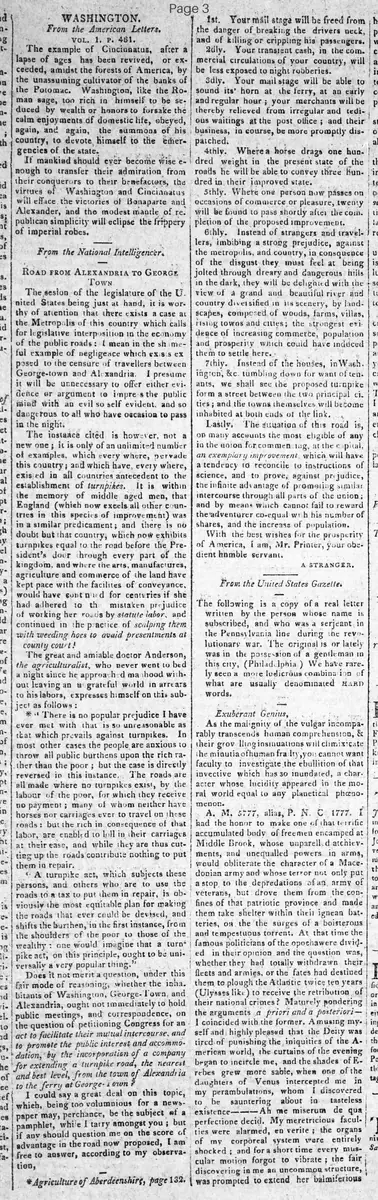
From the National Intelligencer.
Road from Alexandria to George Town
The session of the legislature of the United States being just at hand, it is worthy of attention that there exists a case at the Metropolis of this country which calls for legislative interposition in the economy of the public roads: I mean in the shameful example of negligence which exists exposed to the censure of travellers between George-town and Alexandria. I presume it will be unnecessary to offer either evidence or argument to impress the public mind with an evil so self evident. and so dangerous to all who have occasion to pass in the night.
The instance cited is however, not a new one: it is only of an unlimited number of examples, which every where, pervade this country; and which have, every where, existed in all countries antecedent to the establishment of turnpikes. It is within the memory of middle aged men, that England (which now excels all other countries in this species of improvement) was in a similar predicament; and there is no doubt but that country, which now exhibits turnpikes equal to the road before the President's door through every part of the kingdom. and where the arts, manufactures, agriculture and commerce of the land have kept pace with the facilities of conveyance, would have continued for centuries if she had adhered to the mistaken prejudice of working her roads by statute labor, and continued in the practice of scalping them with weeding hoes to avoid presentments at county court!
The great and amiable doctor Anderson, the agriculturalist, who never went to bed a night since he approached manhood without leaving an ungrateful world in arrears to his labors, expresses himself on this subject as follows:
"There is no popular prejudice I have ever met with that is so unreasonable as that which prevails against turnpikes. In most other cases the people are anxious to throw all public burthens upon the rich rather than the poor; but the case is directly reversed in this instance. The roads are all made where no turnpikes exist, by the labour of the poor, for which they receive no payment; many of whom neither have horses nor carriages ever to travel on these roads: but the rich in consequence of that labor, are enabled to loll in their carriages at their ease, and while they are thus cutting up the roads contribute nothing to put them in repair.
A turnpike act, which subjects these persons, and others who are to use the roads to a tax to put them in repair. is obviously the most equitable plan for making the roads that ever could be devised, and shifts the burthen, in the first instance, from the shoulders of the poor to those of the wealthy: one would imagine that a turnpike act, on this principle, ought to be universally a very popular thing."
Does it not merit a question, under this fair mode of reasoning, whether the inhabitants of Washington, George-Town, and Alexandria, ought not immediately to hold public meetings, and correspondence, on the question of petitioning Congress for an act to facilitate their mutual intercourse, and to promote the public interest and accommodation, by the incorporation of a company for extending a turnpike road, the nearest and best level, from the town of Alexandria to the ferry at George-town?
I could say a great deal on this topic, which, being too voluminous for a newspaper may, perchance, be the subject of a pamphlet, while I tarry amongst you; but if any should question me on the score of advantage in the road now proposed, I am free to answer, according to my observation,
* Agriculture of Aberdeenshire, page 132.
1st. Your mail stage will be freed from the danger of breaking the drivers neck, and of killing or crippling his passengers.
2dly. Your transient cash, in the commercial circulations of your country, will be less exposed to night robberies.
3dly. Your mailstage will be able to sound its horn at the ferry, at an early and regular hour; your merchants will be thereby relieved from irregular and tedious waitings at the post office; and their business, in course, be more promptly dispatched.
4thly. Whereas a horse drags one hundred weight in the present state of the roads he will be able to convey three hundred in their improved state.
5thly. Where one person now passes on occasions of commerce or pleasure, twenty will be found to pass shortly after the completion of the proposed improvement.
6thly. Instead of strangers and travellers, imbibing a strong prejudice, against the metropolis, and country, in consequence of the disgust they must feel at being jolted through dreary and dangerous hills in the dark, they will be delighted with the view of a grand and beautiful river and country diversified in its scenery, by landscapes, composed of woods, farms, villas, rising towns and cities; the strongest evidence of increasing commerce, population and prosperity which could have induced them to settle here.
7thly. Instead of the houses in Washington, &c. tumbling down for want of tenants, we shall see the proposed turnpike form a street between the two principal cities: and the towns themselves will become inhabited at both ends of the link.
Lastly. The situation of this road is, on many accounts the most eligible of any in the union for commencing, at the capital, an exemplary improvement, which will have a tendency to reconcile to instructions of science, and to prove, against prejudice, the infinite advantage of promoting similar intercourse through all parts of the union; and by means which cannot fail to reward the adventurer as equal with his number of shares, and the increase of population.
With the best wishes for the prosperity of America, I am, Mr. Printer, your obedient humble servant.
A STRANGER.
Road from Alexandria to George Town
The session of the legislature of the United States being just at hand, it is worthy of attention that there exists a case at the Metropolis of this country which calls for legislative interposition in the economy of the public roads: I mean in the shameful example of negligence which exists exposed to the censure of travellers between George-town and Alexandria. I presume it will be unnecessary to offer either evidence or argument to impress the public mind with an evil so self evident. and so dangerous to all who have occasion to pass in the night.
The instance cited is however, not a new one: it is only of an unlimited number of examples, which every where, pervade this country; and which have, every where, existed in all countries antecedent to the establishment of turnpikes. It is within the memory of middle aged men, that England (which now excels all other countries in this species of improvement) was in a similar predicament; and there is no doubt but that country, which now exhibits turnpikes equal to the road before the President's door through every part of the kingdom. and where the arts, manufactures, agriculture and commerce of the land have kept pace with the facilities of conveyance, would have continued for centuries if she had adhered to the mistaken prejudice of working her roads by statute labor, and continued in the practice of scalping them with weeding hoes to avoid presentments at county court!
The great and amiable doctor Anderson, the agriculturalist, who never went to bed a night since he approached manhood without leaving an ungrateful world in arrears to his labors, expresses himself on this subject as follows:
"There is no popular prejudice I have ever met with that is so unreasonable as that which prevails against turnpikes. In most other cases the people are anxious to throw all public burthens upon the rich rather than the poor; but the case is directly reversed in this instance. The roads are all made where no turnpikes exist, by the labour of the poor, for which they receive no payment; many of whom neither have horses nor carriages ever to travel on these roads: but the rich in consequence of that labor, are enabled to loll in their carriages at their ease, and while they are thus cutting up the roads contribute nothing to put them in repair.
A turnpike act, which subjects these persons, and others who are to use the roads to a tax to put them in repair. is obviously the most equitable plan for making the roads that ever could be devised, and shifts the burthen, in the first instance, from the shoulders of the poor to those of the wealthy: one would imagine that a turnpike act, on this principle, ought to be universally a very popular thing."
Does it not merit a question, under this fair mode of reasoning, whether the inhabitants of Washington, George-Town, and Alexandria, ought not immediately to hold public meetings, and correspondence, on the question of petitioning Congress for an act to facilitate their mutual intercourse, and to promote the public interest and accommodation, by the incorporation of a company for extending a turnpike road, the nearest and best level, from the town of Alexandria to the ferry at George-town?
I could say a great deal on this topic, which, being too voluminous for a newspaper may, perchance, be the subject of a pamphlet, while I tarry amongst you; but if any should question me on the score of advantage in the road now proposed, I am free to answer, according to my observation,
* Agriculture of Aberdeenshire, page 132.
1st. Your mail stage will be freed from the danger of breaking the drivers neck, and of killing or crippling his passengers.
2dly. Your transient cash, in the commercial circulations of your country, will be less exposed to night robberies.
3dly. Your mailstage will be able to sound its horn at the ferry, at an early and regular hour; your merchants will be thereby relieved from irregular and tedious waitings at the post office; and their business, in course, be more promptly dispatched.
4thly. Whereas a horse drags one hundred weight in the present state of the roads he will be able to convey three hundred in their improved state.
5thly. Where one person now passes on occasions of commerce or pleasure, twenty will be found to pass shortly after the completion of the proposed improvement.
6thly. Instead of strangers and travellers, imbibing a strong prejudice, against the metropolis, and country, in consequence of the disgust they must feel at being jolted through dreary and dangerous hills in the dark, they will be delighted with the view of a grand and beautiful river and country diversified in its scenery, by landscapes, composed of woods, farms, villas, rising towns and cities; the strongest evidence of increasing commerce, population and prosperity which could have induced them to settle here.
7thly. Instead of the houses in Washington, &c. tumbling down for want of tenants, we shall see the proposed turnpike form a street between the two principal cities: and the towns themselves will become inhabited at both ends of the link.
Lastly. The situation of this road is, on many accounts the most eligible of any in the union for commencing, at the capital, an exemplary improvement, which will have a tendency to reconcile to instructions of science, and to prove, against prejudice, the infinite advantage of promoting similar intercourse through all parts of the union; and by means which cannot fail to reward the adventurer as equal with his number of shares, and the increase of population.
With the best wishes for the prosperity of America, I am, Mr. Printer, your obedient humble servant.
A STRANGER.
What sub-type of article is it?
Infrastructure
What keywords are associated?
Turnpike Road
Alexandria Georgetown
Road Improvement
Public Works
Economic Benefits
Agriculturalist Anderson
What entities or persons were involved?
Congress
Doctor Anderson
Inhabitants Of Washington
George Town
Alexandria
A Stranger
Editorial Details
Primary Topic
Proposal For Turnpike Road From Alexandria To Georgetown
Stance / Tone
Strong Advocacy For Turnpike Improvement
Key Figures
Congress
Doctor Anderson
Inhabitants Of Washington
George Town
Alexandria
A Stranger
Key Arguments
Current Roads Between Georgetown And Alexandria Are Negligently Maintained And Dangerous, Especially At Night.
Historical Precedent In England Shows Turnpikes Led To Superior Roads And Economic Growth.
Dr. Anderson Argues Turnpikes Equitably Shift Road Maintenance Burden From Poor Laborers To Wealthy Users.
Inhabitants Should Petition Congress For A Turnpike Company To Facilitate Intercourse And Public Interest.
Benefits Include Safer Mail Travel, Reduced Robberies, Prompt Business, Tripled Transport Capacity, Increased Traffic, Positive Impressions On Travelers, Urban Development, And National Exemplary Improvement.