Thank you for visiting SNEWPapers!
Sign up free
Editorial
July 6, 1793
The Kentucky Gazette
Lexington, Fayette County, Kentucky
What is this article about?
An anonymous editorial by 'A BRITON' urges citizens of Kentucky to reform the state's sanguinary criminal code, advocating replacement of capital punishments with solitary confinement and hard labor for most crimes, emphasizing humanity, justice, and policy effectiveness over current ineffective severity.
Clipping
OCR Quality
98%
Excellent
Full Text
Fellow Citizens.
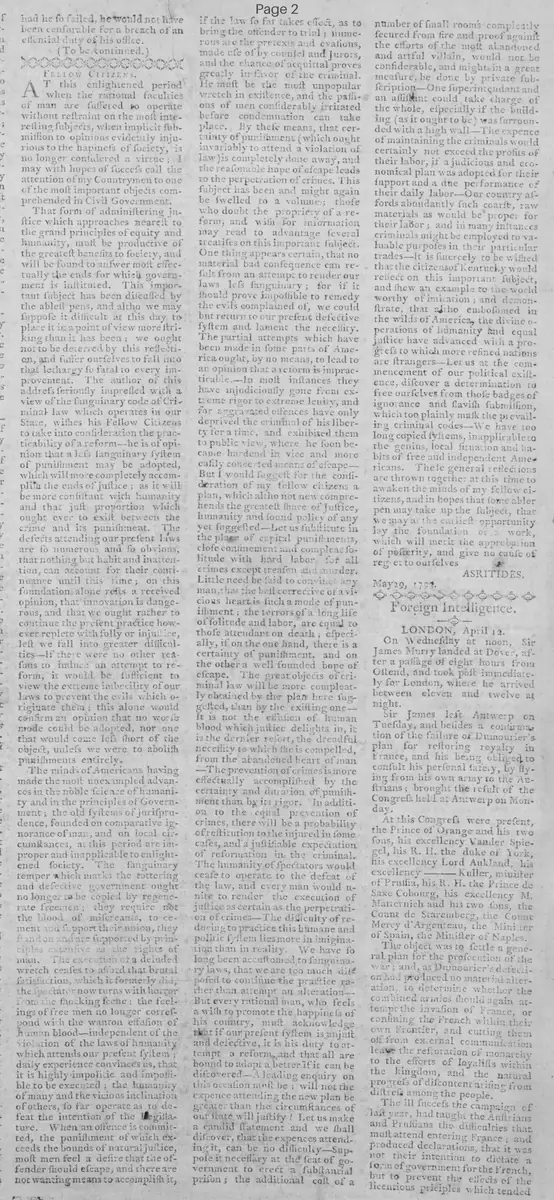
At this enlightened period when the rational faculties of man are suffered to operate without restraint on the most interesting subjects, when implicit submission to opinions evidently injurious to the happiness of society, is no longer considered a virtue ; I may with hopes of success call the attention of my Countrymen to one of the most important objects comprehended in Civil Government. That form of administering justice which approaches nearest to the grand principles of equity and humanity, must be productive of the greatest benefits to society, and will be found to answer most effectually the ends for which government is instituted. This important subject has been discussed by the ablest pens, and altho we may suppose it difficult at this day to place it in a point of view more striking than it has been; we ought not to be deterred by this reflection, and suffer ourselves to fall into that lethargy so fatal to every improvement. The author of this address seriously impressed with a view of the sanguinary code of Criminal law which operates in our State, wishes his Fellow Citizens to take into consideration the practicability of a reform--he is of opinion that a less sanguinary system of punishment may be adopted, which will more completely accomplish the ends of justice; as it will be more consistent with humanity and that just proportion which ought ever to exist between the crime and its punishment. The defects attending our present laws are so numerous and so obvious, that nothing but habit and inattention, can account for their continuance until this time; on this foundation alone rests a received opinion, that innovation is dangerous, and that we ought rather to continue the present practice however replete with folly or injustice, lest we fall into greater difficulties--If there were no other reasons to induce an attempt to reform, it would be sufficient to view the extreme imbecility of our laws to prevent the evils which originate them; this alone would confirm an opinion that no worse mode could be adopted, nor one that would come less short of the object, unless we were to abolish punishments entirely. The minds of Americans having made the most unexampled advances in the noble science of humanity and in the principles of Government; the old systems of jurisprudence, founded on comparative ignorance of man, and on local circumstances, at this period are improper and inapplicable to enlightened society. The sanguinary temper which marks the tottering and defective government ought no longer to be copied by regenerate freemen; they require not the blood of miscreants, to cement and support their union, they stand on and are supported by principles extensive as the rights of man. The execution of a deluded wretch ceases to afford that brutal satisfaction, which it formerly did, the spectator now turns with horror from the shocking scene; the feelings of free men no longer correspond with the wanton effusion of human blood--independent of the violation of the laws of humanity which attends our present system; daily experience convinces us, that it is highly impolitic and impossible to be executed; the humanity of many and the vicious inclination of others, so far operate as to defeat the intention of the Legislature. When an offence is committed, the punishment of which exceeds the bounds of natural justice, most men feel a desire that the offender should escape, and there are not wanting means to accomplish it, if the law so far takes effect, as to bring the offender to trial; numerous are the pretexts and evasions, made use of by counsel and Jurors, and the chance of acquittal proves greatly in favor of the criminal. He must be the most unpopular wretch in existence, and the passions of men considerably irritated before condemnation can take place. By these means, that certainty of punishment (which ought invariably to attend a violation of law) is completely done away, and the reasonable hope of escape leads to the perpetration of crimes. This subject has been and might again be swelled to a volume; those who doubt the propriety of a reform, and wish for information may read to advantage several treatises on this important subject. One thing appears certain, that no material bad consequence can result from an attempt to render our laws less sanguinary; for if it should prove impossible to remedy the evils complained of, we could but return to our present defective system and lament the necessity. The partial attempts which have been made in some parts of America ought, by no means, to lead to an opinion that a reform is impracticable.--In most instances they have injudiciously gone from extreme rigor to extreme lenity, and for aggravated offences have only deprived the criminal of his liberty for a time, and exhibited them to public view, where he soon became hardened in vice and more easily concerted means of escape-- But I would suggest for the consideration of my fellow citizens a plan, which altho not new comprehends the greatest share of justice, humanity and sound policy of any yet suggested--Let us substitute in the place of capital punishments, close confinement and compleat solitude with hard labor for all crimes except treason and murder. Little need be said to convince any man, that the best corrective of a vicious heart is such a mode of punishment; the terrors of a long life of solitude and labor, are equal to those attendant on death ; especially, if on the one hand, there is a certainty of punishment, and on the other a well founded hope of escape. The great objects of criminal law will be more compleatly obtained by the plan here suggested, than by the existing one-- It is not the effusion of human blood which justice delights in, it is the dernier resort, the dreadful necessity to which she is compelled, from the abandoned heart of man --The prevention of crimes is more effectually accomplished by the certainty and duration of punishment than by its rigor. In addition to the equal prevention of crimes, there will be a probability of restitution to the injured in some cases, and a justifiable expectation of reformation in the criminal. The humanity of spectators would cease to operate to the defeat of the law, and every man would unite to render the execution of justice as certain as the perpetration of crimes--The difficulty of reducing to practice this humane and politic system lies more in imagination than in reality. We have so long been accustomed to sanguinary laws, that we are too much disposed to continue the practice rather than attempt an alteration-- But every rational man, who feels a wish to promote the happiness of his country, must acknowledge that if our present system is unjust and defective, it is his duty to attempt a reform_and that all are bound to adopt a better if it can be discovered--A leading enquiry on this occasion must be ; will not the expence attending the new plan be greater than the circumstances of our state will justify ? Let us make a candid statement and we shall discover, that the expences attending it, can be no difficulty--Suppose it necessary at the seat of government to erect a substantial prison; the additional cost of a number of small rooms compleatly secured from fire and proof against the efforts of the most abandoned and artful villain, would not be considerable, and might in a great measure. be done by private subscription--One superintendent and an assistant could take charge of the whole, especially if the building (as it ought to be) was surrounded with a high wall--The expence of maintaining the criminals would certainly not exceed the profits of their labor, if a judicious and economical plan was adopted for their support and a due performance of their daily labor--Our country affords abundantly such coarse, raw materials as would be proper for their labor; and in many instances criminals might be employed to valuable purposes in their particular trades--It is sincerely to be wished that the citizens of Kentucky would reflect on this important subject, and shew an example to the world worthy of imitation; and demonstrate, that altho embosomed in the wilds of America, the divine operations of humanity and equal justice have advanced with a progress to which more refined nations are strangers--Let us at the commencement of our political existence, discover a determination to free ourselves from those badges of ignorance and slavish submission, which too plainly mask the prevailing criminal codes--We have too long copied systems, inapplicable to the genius, local situation and habits of free and independent Americans. These general reflections are thrown together at this time to awaken the minds of my fellow citizens, and in hopes that some abler pen may take up the subject, that we may at the earliest opportunity lay the foundation of a work, which will merit the approbation of posterity, and give no cause of regret to ourselves
A BRITON.
At this enlightened period when the rational faculties of man are suffered to operate without restraint on the most interesting subjects, when implicit submission to opinions evidently injurious to the happiness of society, is no longer considered a virtue ; I may with hopes of success call the attention of my Countrymen to one of the most important objects comprehended in Civil Government. That form of administering justice which approaches nearest to the grand principles of equity and humanity, must be productive of the greatest benefits to society, and will be found to answer most effectually the ends for which government is instituted. This important subject has been discussed by the ablest pens, and altho we may suppose it difficult at this day to place it in a point of view more striking than it has been; we ought not to be deterred by this reflection, and suffer ourselves to fall into that lethargy so fatal to every improvement. The author of this address seriously impressed with a view of the sanguinary code of Criminal law which operates in our State, wishes his Fellow Citizens to take into consideration the practicability of a reform--he is of opinion that a less sanguinary system of punishment may be adopted, which will more completely accomplish the ends of justice; as it will be more consistent with humanity and that just proportion which ought ever to exist between the crime and its punishment. The defects attending our present laws are so numerous and so obvious, that nothing but habit and inattention, can account for their continuance until this time; on this foundation alone rests a received opinion, that innovation is dangerous, and that we ought rather to continue the present practice however replete with folly or injustice, lest we fall into greater difficulties--If there were no other reasons to induce an attempt to reform, it would be sufficient to view the extreme imbecility of our laws to prevent the evils which originate them; this alone would confirm an opinion that no worse mode could be adopted, nor one that would come less short of the object, unless we were to abolish punishments entirely. The minds of Americans having made the most unexampled advances in the noble science of humanity and in the principles of Government; the old systems of jurisprudence, founded on comparative ignorance of man, and on local circumstances, at this period are improper and inapplicable to enlightened society. The sanguinary temper which marks the tottering and defective government ought no longer to be copied by regenerate freemen; they require not the blood of miscreants, to cement and support their union, they stand on and are supported by principles extensive as the rights of man. The execution of a deluded wretch ceases to afford that brutal satisfaction, which it formerly did, the spectator now turns with horror from the shocking scene; the feelings of free men no longer correspond with the wanton effusion of human blood--independent of the violation of the laws of humanity which attends our present system; daily experience convinces us, that it is highly impolitic and impossible to be executed; the humanity of many and the vicious inclination of others, so far operate as to defeat the intention of the Legislature. When an offence is committed, the punishment of which exceeds the bounds of natural justice, most men feel a desire that the offender should escape, and there are not wanting means to accomplish it, if the law so far takes effect, as to bring the offender to trial; numerous are the pretexts and evasions, made use of by counsel and Jurors, and the chance of acquittal proves greatly in favor of the criminal. He must be the most unpopular wretch in existence, and the passions of men considerably irritated before condemnation can take place. By these means, that certainty of punishment (which ought invariably to attend a violation of law) is completely done away, and the reasonable hope of escape leads to the perpetration of crimes. This subject has been and might again be swelled to a volume; those who doubt the propriety of a reform, and wish for information may read to advantage several treatises on this important subject. One thing appears certain, that no material bad consequence can result from an attempt to render our laws less sanguinary; for if it should prove impossible to remedy the evils complained of, we could but return to our present defective system and lament the necessity. The partial attempts which have been made in some parts of America ought, by no means, to lead to an opinion that a reform is impracticable.--In most instances they have injudiciously gone from extreme rigor to extreme lenity, and for aggravated offences have only deprived the criminal of his liberty for a time, and exhibited them to public view, where he soon became hardened in vice and more easily concerted means of escape-- But I would suggest for the consideration of my fellow citizens a plan, which altho not new comprehends the greatest share of justice, humanity and sound policy of any yet suggested--Let us substitute in the place of capital punishments, close confinement and compleat solitude with hard labor for all crimes except treason and murder. Little need be said to convince any man, that the best corrective of a vicious heart is such a mode of punishment; the terrors of a long life of solitude and labor, are equal to those attendant on death ; especially, if on the one hand, there is a certainty of punishment, and on the other a well founded hope of escape. The great objects of criminal law will be more compleatly obtained by the plan here suggested, than by the existing one-- It is not the effusion of human blood which justice delights in, it is the dernier resort, the dreadful necessity to which she is compelled, from the abandoned heart of man --The prevention of crimes is more effectually accomplished by the certainty and duration of punishment than by its rigor. In addition to the equal prevention of crimes, there will be a probability of restitution to the injured in some cases, and a justifiable expectation of reformation in the criminal. The humanity of spectators would cease to operate to the defeat of the law, and every man would unite to render the execution of justice as certain as the perpetration of crimes--The difficulty of reducing to practice this humane and politic system lies more in imagination than in reality. We have so long been accustomed to sanguinary laws, that we are too much disposed to continue the practice rather than attempt an alteration-- But every rational man, who feels a wish to promote the happiness of his country, must acknowledge that if our present system is unjust and defective, it is his duty to attempt a reform_and that all are bound to adopt a better if it can be discovered--A leading enquiry on this occasion must be ; will not the expence attending the new plan be greater than the circumstances of our state will justify ? Let us make a candid statement and we shall discover, that the expences attending it, can be no difficulty--Suppose it necessary at the seat of government to erect a substantial prison; the additional cost of a number of small rooms compleatly secured from fire and proof against the efforts of the most abandoned and artful villain, would not be considerable, and might in a great measure. be done by private subscription--One superintendent and an assistant could take charge of the whole, especially if the building (as it ought to be) was surrounded with a high wall--The expence of maintaining the criminals would certainly not exceed the profits of their labor, if a judicious and economical plan was adopted for their support and a due performance of their daily labor--Our country affords abundantly such coarse, raw materials as would be proper for their labor; and in many instances criminals might be employed to valuable purposes in their particular trades--It is sincerely to be wished that the citizens of Kentucky would reflect on this important subject, and shew an example to the world worthy of imitation; and demonstrate, that altho embosomed in the wilds of America, the divine operations of humanity and equal justice have advanced with a progress to which more refined nations are strangers--Let us at the commencement of our political existence, discover a determination to free ourselves from those badges of ignorance and slavish submission, which too plainly mask the prevailing criminal codes--We have too long copied systems, inapplicable to the genius, local situation and habits of free and independent Americans. These general reflections are thrown together at this time to awaken the minds of my fellow citizens, and in hopes that some abler pen may take up the subject, that we may at the earliest opportunity lay the foundation of a work, which will merit the approbation of posterity, and give no cause of regret to ourselves
A BRITON.
What sub-type of article is it?
Crime Or Punishment
Legal Reform
What keywords are associated?
Penal Reform
Sanguinary Laws
Solitary Confinement
Hard Labor
Criminal Justice
Humanity In Punishment
Kentucky Reform
What entities or persons were involved?
Kentucky Legislature
A Briton
Editorial Details
Primary Topic
Reform Of Sanguinary Criminal Laws In Kentucky
Stance / Tone
Advocacy For Humane Penal Reform
Key Figures
Kentucky Legislature
A Briton
Key Arguments
Current Sanguinary Laws Are Inhumane And Ineffective
Reform To Solitary Confinement And Hard Labor For Most Crimes Except Treason And Murder
Certainty And Duration Of Punishment Prevent Crime Better Than Severity
Public Sympathy Leads To Acquittals Under Harsh Laws
Reform Allows For Restitution And Criminal Reformation
Costs Of New System Can Be Managed Through Labor And Subscriptions