Thank you for visiting SNEWPapers!
Sign up free
Editorial
October 27, 1855
The Daily Union
Washington, District Of Columbia
What is this article about?
The Washington Union editorial responds to John Van Buren's letter defending the New York 'soft' Democrats' platform opposing slavery extension. It criticizes the resolution for conflicting with national Democratic principles, the Nebraska bill, and party unity, amid the upcoming New York state election.
Clipping
OCR Quality
98%
Excellent
Full Text
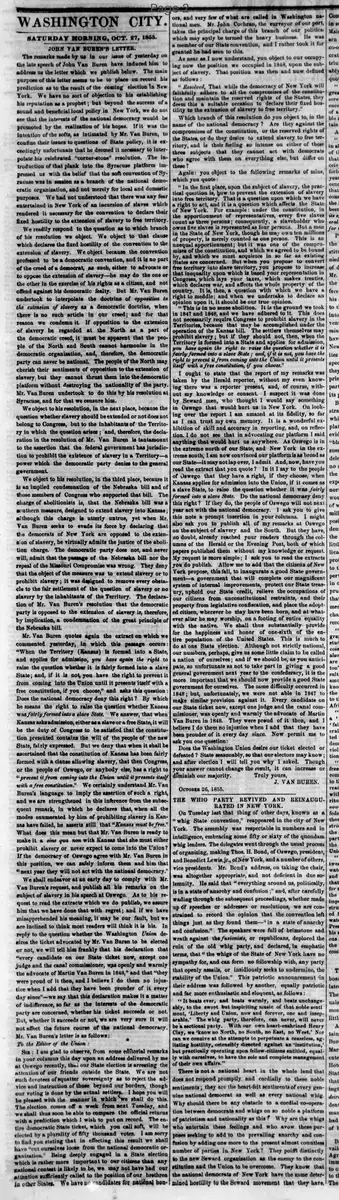
WASHINGTON CITY.
SATURDAY MORNING, OCT. 27, 1855.
JOHN VAN BUREN'S LETTER.
The remarks made by us in our issue of yesterday on the late speech of John Van Buren have induced him to address us the letter which we publish below. The main purpose of this letter seems to be to place on record his prediction as to the result of the coming election in New York. We have no sort of objection to his establishing his reputation as a prophet; but beyond the success of a sound and beneficial local policy in New York, we do not see that the interests of the national democracy would be promoted by the realization of his hopes. If it was the intention of the softs, as intimated by Mr. Van Buren, to confine their issues to questions of State policy, it is exceedingly unfortunate that he deemed it necessary to interpolate his celebrated "corner-stone" resolution. The introduction of that plank into the Syracuse platform impressed us with the belief that the soft convention of Syracuse was in session as a branch of the national democratic organization, and not merely for local and domestic purposes. We had not understood that there was any fear entertained in New York of an incursion of slaves which rendered it necessary for the convention to declare their fixed hostility to the extension of slavery to free territory.
We readily respond to the question as to which branch of his resolution we object. We object to that clause which declares the fixed hostility of the convention to the extension of slavery. We object because the convention professed to be a democratic convention, and it is no part of the creed of a democrat, as such, either to advocate or to oppose the extension of slavery—he may do the one or the other in the exercise of his rights as a citizen, and not offend against his democratic fealty. But Mr. Van Buren undertook to interpolate the doctrine of opposition to the extension of slavery as a democratic doctrine, when there is no such article in our creed; and for that reason we condemn it. If opposition to the extension of slavery be regarded at the North as a part of the democratic creed, it must be apparent that the people of the North and South cannot harmonize in the democratic organization, and, therefore, the democratic party can never be national. The people of the North may cherish their sentiments of opposition to the extension of slavery, but they cannot thrust them into the democratic platform without destroying the nationality of the party.
Mr. Van Buren undertook to do this by his resolution at Syracuse, and for that we censure him.
We object to his resolution, in the next place, because the question whether slavery should be extended or not does not belong to Congress, but to the inhabitants of the Territory in which the question arises; and, therefore, the declaration in the resolution of Mr. Van Buren is tantamount to the assertion that the federal government has jurisdiction to prohibit the existence of slavery in a Territory—a power which the democratic party denies to the general government.
We object to his resolution, in the third place, because it is an implied condemnation of the Nebraska bill and of those members of Congress who supported that bill. The charge of abolitionists is, that the Nebraska bill was a southern measure, designed to extend slavery into Kansas; although this charge is utterly untrue, yet when Mr. Van Buren seeks to evade its force by declaring that the democrats of New York are opposed to the extension of slavery, he virtually admits the justice of the abolition charge. The democratic party does not, and never will, admit that the passage of the Nebraska bill nor the repeal of the Missouri Compromise was wrong. They deny that the object of the measure was to extend slavery or to prohibit slavery; it was designed to remove every obstacle to the fair settlement of the question of slavery or no slavery by the inhabitants of the Territory. The declaration of Mr. Van Buren's resolution that the democratic party is opposed to the extension of slavery is, therefore, by implication, a condemnation of the great principle of the Nebraska bill.
Mr. Van Buren quotes again the extract on which we commented yesterday, in which this passage occurs:
"When the Territory (Kansas) is formed into a State, and applies for admission, you have again the right to raise the question whether it is fairly formed into a slave State; and, if it is not, you have the right to prevent it from coming into the Union until it presents itself with a free constitution, if you choose," and asks this question: Does the national democracy deny this right? By which he means the right to raise the question whether Kansas was fairly formed into a slave State. We answer, that when Kansas asks admission, either as a slave or a free State, it will be the duty of Congress to be satisfied that the constitution presented contains the will of the people of the new State, fairly expressed. But we deny that when it shall be ascertained that the constitution of Kansas has been fairly formed with a clause allowing slavery, that then Congress or the people of Oswego, or anybody else, has a right to "prevent it from coming into the Union until it presents itself with a free constitution." We certainly understand Mr. Van Buren's language to imply the assertion of such a right, and we are strengthened in this inference from the subsequent remark, in which he declares that, when all the modes enumerated by him of prohibiting slavery in Kansas have failed, he asserts still that "Kansas must be free."
What does this mean but that Mr. Van Buren is ready to make it a sine qua non with Kansas that she must either prohibit slavery or never expect to come into the Union?
If the democracy of Oswego agree with Mr. Van Buren in this position, we can safely inform them and him that "next year they will not act with the national democracy."
We shall endeavor at an early day to comply with Mr. Van Buren's request, and publish all his remarks on the subject of slavery in his speech at Oswego. As to his request to read the extracts which we do publish, we assure him that we have done that with regret; and if we have misapprehended his meaning, it may be our fault, but we are inclined to think most readers will think it is his. In reply to the question whether the Washington Union desires the ticket advocated by Mr. Van Buren to be elected or not, we will tell him frankly that his declaration that "every candidate on our State ticket now, except one judge and the canal commissioner, was openly and warmly the advocate of Martin Van Buren in 1848," and that "they were proud of it then, and I believe I do them no injustice when I add that they have been prouder of it every day since"—we say that this declaration makes it a matter of indifference, so far as the interests of the democratic party are concerned, whether his ticket succeeds or not.
But, whether it succeeds or not, we are very sure it will not affect the future course of the national democracy.
Mr. Van Buren's letter is as follows:
To the Editor of the Union:
Sir: I am glad to observe, from some editorial remarks in your columns this day upon an address delivered by me at Oswego recently, that our State election is arresting the attention of our friends outside the State. We are not such devotees of squatter sovereignty as to reject the advice and instruction of those beyond our borders, though our voting is done by the actual settlers. I hope you will be pleased with the manner in which we shall do this.
The election comes off a week from next Tuesday, and we shall thus soon be able to compare the official returns with a prediction which I wish to put on record. The entire democratic State ticket, which you call soft, will be elected by a plurality of fifty thousand votes. I am sorry to find you stating that in effecting this result we shall have "cut ourselves loose from the national democratic organization." Being deeply engaged in a State election which is rather more important to our citizens than any national contest is likely to be, we may not have had our attention sufficiently called to the position of our brethren in other States. We have no candidates or national honors, and very few of what are called in Washington national men. Mr. John Cochran, the surveyor of our port, takes the principal charge of this branch of our politics which may aptly be termed the heavy business. He was a member of our State convention, and I rather took it for granted he had seen to this.
As near as I now understand, you object to our occupying now the position we occupied in 1848, upon the subject of slavery. That position was then and now defined as follows:
"Resolved, That while the democracy of New York will faithfully adhere to all the compromises of the constitution and maintain the reserved rights of the States, they deem this a suitable occasion to declare their fixed hostility to the extension of slavery to free territory."
Which branch of this resolution do you object to, in the name of the national democracy? Are they against the compromises of the constitution, or the reserved rights of the States, or do they desire to extend slavery to free territory, and is their feeling so intense on either of these three subjects that they cannot act with democrats who agree with them on everything else, but differ on these?
Again: you object to the following remarks of mine, which you quote:
"In the first place, upon the subject of slavery, the practical question is, how to prevent the extension of slavery into free territory. That is a question upon which we have a right to act, and it is a question which affects the State of New York. For example: under the constitution, in the apportionment of representatives, every five slaves count as three persons; consequently, a slaveholder who owns five slaves is represented as four persons. But a man in the State of New York, though he may own ten millions of property, is merely counted as one person.
This is an unequal apportionment; but it was one of the compromises of the constitution, and which we agreed to be bound by, and which we must acquiesce in so far as existing States are concerned. But when you propose to convert free territory into slave territory, you propose to increase that inequality upon which is based your representation in Congress, which lays your taxes, which makes treaties, which declares war, and affects the whole property of the country.
It is, then, a question with which we have a right to meddle and when we undertake to declare an opinion upon it, it should be our true opinion.
"This is in no sense abolition. It is the ground we took in 1847 and 1848, and we have adhered to it. This does not necessarily require Congress to prohibit slavery in the Territories, because that may be accomplished under the operation of the Kansas bill.
The settlers themselves may prohibit slavery; but if they should not, then, when the Territory is formed into a State and applies for admission, you have again the right to raise the question whether it is fairly formed into a slave State; and, if it is not, you have the right to prevent it from coming into the Union until it presents itself with a free constitution, if you choose."
I ought to state that the report of my remarks was taken by the Herald reporter, without my even knowing there was a reporter present, and, of course, without my knowledge or consent. I suspect it was done by Seward men, who thought I would say something in Oswego that would hurt us in New York. On looking over the report I am amazed at its fidelity, so far as I can trust my own memory. It is a wonderful exhibition of skill and accuracy in reporting, and, on reflection, I do not see that in advocating our platform I said anything that would hurt us anywhere. As Oswego is in the extreme north of our State, and New York in the extreme south, I am now convinced our platform is as broad as our State—it may not lap over, I admit. And, now, have you read the extract that you quote? In it I say to the people of Oswego that they have a right, if they choose, when Kansas applies for admission into the Union, if it comes as a slave State, to raise the question whether it was fairly formed into a slave State. Do the national democracy deny this right? If they do, the people of Oswego will not next year act with the national democracy. I ask you to give this note a prompt insertion in your columns. I might also ask you to publish all of my remarks at Oswego on the subject of slavery and the South. But they have, no doubt, already reached your readers through the columns of the Herald or the Evening Post, both of which papers published them without my knowledge or request.
My request is more simple; I ask you to read the extracts you do publish. Allow me to add that the citizens of New York propose, this fall, to inaugurate a good State government—a government that will complete our magnificent system of internal improvements, protect our State treasury, uphold our State credit, relieve the occupations of our citizens from unconstitutional restraints, and their property from legislative confiscation, and place the adopted citizen, wherever he may have been born, and at whatever altar he may worship, on a footing of entire equality with the native. We shall thus substantially provide for the happiness and honor of one-sixth of the entire population of the United States. This is much to do at one State election. Although not strictly national our numbers, perhaps, give us some little claim to be called a nation of ourselves; and if we should be, as you anticipate, so unfortunate as not to take part in giving a good general government next year to the confederacy, it is the more important that we should now provide a good State government for ourselves. The same difficulty occurred in 1848; but, unfortunately, we were not able in 1847 to make similar provision against it. Every candidate on our State ticket now, except one judge and the canal commissioner, was openly and warmly the advocate of Martin Van Buren in 1848. They were proud of it then, and I believe I do them no injustice when I add that they have been prouder of it every day since. Now permit me to ask you one question:
Does the Washington Union desire our ticket elected or defeated? State seasonably, so that our electors may know; and after election I will tell you why I asked. Though your answer cannot change the result, it can increase or diminish our majority.
Truly yours,
J. VAN BUREN.
October 26, 1855.
SATURDAY MORNING, OCT. 27, 1855.
JOHN VAN BUREN'S LETTER.
The remarks made by us in our issue of yesterday on the late speech of John Van Buren have induced him to address us the letter which we publish below. The main purpose of this letter seems to be to place on record his prediction as to the result of the coming election in New York. We have no sort of objection to his establishing his reputation as a prophet; but beyond the success of a sound and beneficial local policy in New York, we do not see that the interests of the national democracy would be promoted by the realization of his hopes. If it was the intention of the softs, as intimated by Mr. Van Buren, to confine their issues to questions of State policy, it is exceedingly unfortunate that he deemed it necessary to interpolate his celebrated "corner-stone" resolution. The introduction of that plank into the Syracuse platform impressed us with the belief that the soft convention of Syracuse was in session as a branch of the national democratic organization, and not merely for local and domestic purposes. We had not understood that there was any fear entertained in New York of an incursion of slaves which rendered it necessary for the convention to declare their fixed hostility to the extension of slavery to free territory.
We readily respond to the question as to which branch of his resolution we object. We object to that clause which declares the fixed hostility of the convention to the extension of slavery. We object because the convention professed to be a democratic convention, and it is no part of the creed of a democrat, as such, either to advocate or to oppose the extension of slavery—he may do the one or the other in the exercise of his rights as a citizen, and not offend against his democratic fealty. But Mr. Van Buren undertook to interpolate the doctrine of opposition to the extension of slavery as a democratic doctrine, when there is no such article in our creed; and for that reason we condemn it. If opposition to the extension of slavery be regarded at the North as a part of the democratic creed, it must be apparent that the people of the North and South cannot harmonize in the democratic organization, and, therefore, the democratic party can never be national. The people of the North may cherish their sentiments of opposition to the extension of slavery, but they cannot thrust them into the democratic platform without destroying the nationality of the party.
Mr. Van Buren undertook to do this by his resolution at Syracuse, and for that we censure him.
We object to his resolution, in the next place, because the question whether slavery should be extended or not does not belong to Congress, but to the inhabitants of the Territory in which the question arises; and, therefore, the declaration in the resolution of Mr. Van Buren is tantamount to the assertion that the federal government has jurisdiction to prohibit the existence of slavery in a Territory—a power which the democratic party denies to the general government.
We object to his resolution, in the third place, because it is an implied condemnation of the Nebraska bill and of those members of Congress who supported that bill. The charge of abolitionists is, that the Nebraska bill was a southern measure, designed to extend slavery into Kansas; although this charge is utterly untrue, yet when Mr. Van Buren seeks to evade its force by declaring that the democrats of New York are opposed to the extension of slavery, he virtually admits the justice of the abolition charge. The democratic party does not, and never will, admit that the passage of the Nebraska bill nor the repeal of the Missouri Compromise was wrong. They deny that the object of the measure was to extend slavery or to prohibit slavery; it was designed to remove every obstacle to the fair settlement of the question of slavery or no slavery by the inhabitants of the Territory. The declaration of Mr. Van Buren's resolution that the democratic party is opposed to the extension of slavery is, therefore, by implication, a condemnation of the great principle of the Nebraska bill.
Mr. Van Buren quotes again the extract on which we commented yesterday, in which this passage occurs:
"When the Territory (Kansas) is formed into a State, and applies for admission, you have again the right to raise the question whether it is fairly formed into a slave State; and, if it is not, you have the right to prevent it from coming into the Union until it presents itself with a free constitution, if you choose," and asks this question: Does the national democracy deny this right? By which he means the right to raise the question whether Kansas was fairly formed into a slave State. We answer, that when Kansas asks admission, either as a slave or a free State, it will be the duty of Congress to be satisfied that the constitution presented contains the will of the people of the new State, fairly expressed. But we deny that when it shall be ascertained that the constitution of Kansas has been fairly formed with a clause allowing slavery, that then Congress or the people of Oswego, or anybody else, has a right to "prevent it from coming into the Union until it presents itself with a free constitution." We certainly understand Mr. Van Buren's language to imply the assertion of such a right, and we are strengthened in this inference from the subsequent remark, in which he declares that, when all the modes enumerated by him of prohibiting slavery in Kansas have failed, he asserts still that "Kansas must be free."
What does this mean but that Mr. Van Buren is ready to make it a sine qua non with Kansas that she must either prohibit slavery or never expect to come into the Union?
If the democracy of Oswego agree with Mr. Van Buren in this position, we can safely inform them and him that "next year they will not act with the national democracy."
We shall endeavor at an early day to comply with Mr. Van Buren's request, and publish all his remarks on the subject of slavery in his speech at Oswego. As to his request to read the extracts which we do publish, we assure him that we have done that with regret; and if we have misapprehended his meaning, it may be our fault, but we are inclined to think most readers will think it is his. In reply to the question whether the Washington Union desires the ticket advocated by Mr. Van Buren to be elected or not, we will tell him frankly that his declaration that "every candidate on our State ticket now, except one judge and the canal commissioner, was openly and warmly the advocate of Martin Van Buren in 1848," and that "they were proud of it then, and I believe I do them no injustice when I add that they have been prouder of it every day since"—we say that this declaration makes it a matter of indifference, so far as the interests of the democratic party are concerned, whether his ticket succeeds or not.
But, whether it succeeds or not, we are very sure it will not affect the future course of the national democracy.
Mr. Van Buren's letter is as follows:
To the Editor of the Union:
Sir: I am glad to observe, from some editorial remarks in your columns this day upon an address delivered by me at Oswego recently, that our State election is arresting the attention of our friends outside the State. We are not such devotees of squatter sovereignty as to reject the advice and instruction of those beyond our borders, though our voting is done by the actual settlers. I hope you will be pleased with the manner in which we shall do this.
The election comes off a week from next Tuesday, and we shall thus soon be able to compare the official returns with a prediction which I wish to put on record. The entire democratic State ticket, which you call soft, will be elected by a plurality of fifty thousand votes. I am sorry to find you stating that in effecting this result we shall have "cut ourselves loose from the national democratic organization." Being deeply engaged in a State election which is rather more important to our citizens than any national contest is likely to be, we may not have had our attention sufficiently called to the position of our brethren in other States. We have no candidates or national honors, and very few of what are called in Washington national men. Mr. John Cochran, the surveyor of our port, takes the principal charge of this branch of our politics which may aptly be termed the heavy business. He was a member of our State convention, and I rather took it for granted he had seen to this.
As near as I now understand, you object to our occupying now the position we occupied in 1848, upon the subject of slavery. That position was then and now defined as follows:
"Resolved, That while the democracy of New York will faithfully adhere to all the compromises of the constitution and maintain the reserved rights of the States, they deem this a suitable occasion to declare their fixed hostility to the extension of slavery to free territory."
Which branch of this resolution do you object to, in the name of the national democracy? Are they against the compromises of the constitution, or the reserved rights of the States, or do they desire to extend slavery to free territory, and is their feeling so intense on either of these three subjects that they cannot act with democrats who agree with them on everything else, but differ on these?
Again: you object to the following remarks of mine, which you quote:
"In the first place, upon the subject of slavery, the practical question is, how to prevent the extension of slavery into free territory. That is a question upon which we have a right to act, and it is a question which affects the State of New York. For example: under the constitution, in the apportionment of representatives, every five slaves count as three persons; consequently, a slaveholder who owns five slaves is represented as four persons. But a man in the State of New York, though he may own ten millions of property, is merely counted as one person.
This is an unequal apportionment; but it was one of the compromises of the constitution, and which we agreed to be bound by, and which we must acquiesce in so far as existing States are concerned. But when you propose to convert free territory into slave territory, you propose to increase that inequality upon which is based your representation in Congress, which lays your taxes, which makes treaties, which declares war, and affects the whole property of the country.
It is, then, a question with which we have a right to meddle and when we undertake to declare an opinion upon it, it should be our true opinion.
"This is in no sense abolition. It is the ground we took in 1847 and 1848, and we have adhered to it. This does not necessarily require Congress to prohibit slavery in the Territories, because that may be accomplished under the operation of the Kansas bill.
The settlers themselves may prohibit slavery; but if they should not, then, when the Territory is formed into a State and applies for admission, you have again the right to raise the question whether it is fairly formed into a slave State; and, if it is not, you have the right to prevent it from coming into the Union until it presents itself with a free constitution, if you choose."
I ought to state that the report of my remarks was taken by the Herald reporter, without my even knowing there was a reporter present, and, of course, without my knowledge or consent. I suspect it was done by Seward men, who thought I would say something in Oswego that would hurt us in New York. On looking over the report I am amazed at its fidelity, so far as I can trust my own memory. It is a wonderful exhibition of skill and accuracy in reporting, and, on reflection, I do not see that in advocating our platform I said anything that would hurt us anywhere. As Oswego is in the extreme north of our State, and New York in the extreme south, I am now convinced our platform is as broad as our State—it may not lap over, I admit. And, now, have you read the extract that you quote? In it I say to the people of Oswego that they have a right, if they choose, when Kansas applies for admission into the Union, if it comes as a slave State, to raise the question whether it was fairly formed into a slave State. Do the national democracy deny this right? If they do, the people of Oswego will not next year act with the national democracy. I ask you to give this note a prompt insertion in your columns. I might also ask you to publish all of my remarks at Oswego on the subject of slavery and the South. But they have, no doubt, already reached your readers through the columns of the Herald or the Evening Post, both of which papers published them without my knowledge or request.
My request is more simple; I ask you to read the extracts you do publish. Allow me to add that the citizens of New York propose, this fall, to inaugurate a good State government—a government that will complete our magnificent system of internal improvements, protect our State treasury, uphold our State credit, relieve the occupations of our citizens from unconstitutional restraints, and their property from legislative confiscation, and place the adopted citizen, wherever he may have been born, and at whatever altar he may worship, on a footing of entire equality with the native. We shall thus substantially provide for the happiness and honor of one-sixth of the entire population of the United States. This is much to do at one State election. Although not strictly national our numbers, perhaps, give us some little claim to be called a nation of ourselves; and if we should be, as you anticipate, so unfortunate as not to take part in giving a good general government next year to the confederacy, it is the more important that we should now provide a good State government for ourselves. The same difficulty occurred in 1848; but, unfortunately, we were not able in 1847 to make similar provision against it. Every candidate on our State ticket now, except one judge and the canal commissioner, was openly and warmly the advocate of Martin Van Buren in 1848. They were proud of it then, and I believe I do them no injustice when I add that they have been prouder of it every day since. Now permit me to ask you one question:
Does the Washington Union desire our ticket elected or defeated? State seasonably, so that our electors may know; and after election I will tell you why I asked. Though your answer cannot change the result, it can increase or diminish our majority.
Truly yours,
J. VAN BUREN.
October 26, 1855.
What sub-type of article is it?
Partisan Politics
Slavery Abolition
Constitutional
What keywords are associated?
Slavery Extension
Democratic Platform
New York Election
Nebraska Bill
Party Unity
John Van Buren
Kansas Admission
What entities or persons were involved?
John Van Buren
Washington Union
New York Democrats
Syracuse Convention
Nebraska Bill
Martin Van Buren
Editorial Details
Primary Topic
Critique Of John Van Buren's Opposition To Slavery Extension In Democratic Platform
Stance / Tone
Defense Of National Democratic Unity Against Northern Anti Extension Faction
Key Figures
John Van Buren
Washington Union
New York Democrats
Syracuse Convention
Nebraska Bill
Martin Van Buren
Key Arguments
Opposition To Slavery Extension Is Not Part Of Democratic Creed
Slavery Question Belongs To Territorial Inhabitants, Not Congress
Van Buren's Resolution Condemns Nebraska Bill Principles
Inserting Anti Extension Plank Destroys National Party Harmony
Congress Must Admit Fairly Formed States Regardless Of Slavery Status