Thank you for visiting SNEWPapers!
Sign up free
Literary
August 23, 1827
Martinsburg Gazette And Public Advertiser
Martinsburg, Berkeley County, West Virginia
What is this article about?
An extract from a journal describing a voyage to Canton, noting fireworks and illuminations as offerings to the Devil, Chinese gambling habits, visits to merchants' hongs, lack of Sabbath observance, New Year holidays, and prevalent diseases among seamen at Whampoa due to marshy lands.
Clipping
OCR Quality
98%
Excellent
Full Text
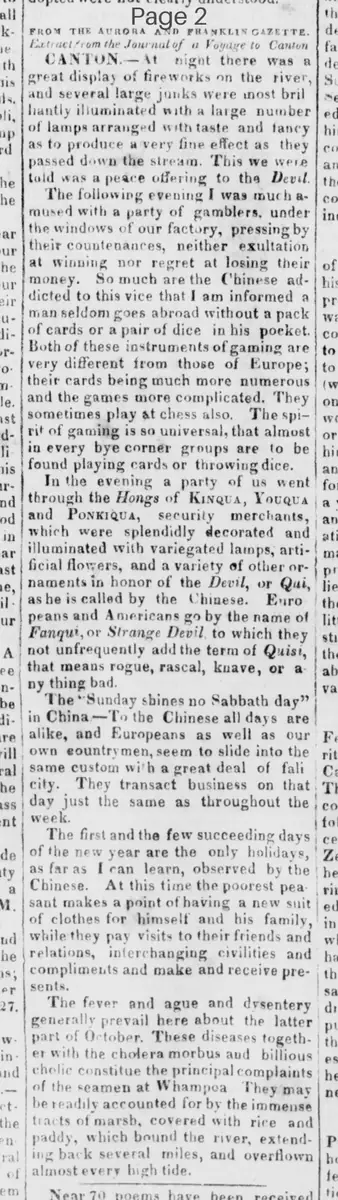
FROM THE AURORA AND FRANKLIN GAZETTE.
Extract from the Journal of a Voyage to Canton
CANTON.--At night there was a great display of fireworks on the river, and several large junks were most brilliantly illuminated with a large number of lamps arranged with taste and fancy as to produce a very fine effect as they passed down the stream. This we were told was a peace offering to the Devil
The following evening I was much amused with a party of gamblers, under the windows of our factory, pressing by their countenances, neither exultation at winning nor regret at losing their money. So much are the Chinese addicted to this vice that I am informed a man seldom goes abroad without a pack of cards or a pair of dice in his pocket
Both of these instruments of gaming are very different from those of Europe; their cards being much more numerous and the games more complicated. They sometimes play at chess also. The spirit of gaming is so universal, that almost in every bye corner groups are to be found playing cards or throwing dice.
In the evening a party of us went through the Hongs of Kinqua, Youqua and Ponqua, security merchants, which were splendidly decorated and illuminated with variegated lamps, artificial flowers, and a variety of other ornaments in honor of the Devil, or Qui, as he is called by the Chinese. Europeans and Americans go by the name of Fanqui, or Strange Devil to which they not unfrequently add the term of Quisi, that means rogue, rascal, knave, or any thing bad.
The Sunday shines no Sabbath day in China--To the Chinese all days are alike, and Europeans as well as our own countrymen, seem to slide into the same custom with a great deal of facility. They transact business on that day just the same as throughout the week.
The first and the few succeeding days of the new year are the only holidays, as far as I can learn, observed by the Chinese. At this time the poorest peasant makes a point of having a new suit of clothes for himself and his family, while they pay visits to their friends and relations, interchanging civilities and compliments and make and receive presents.
The fever and ague and dysentery generally prevail here about the latter part of October. These diseases together with the cholera morbus and bilious cholic constitute the principal complaints of the seamen at Whampoa They may be readily accounted for by the immense tracts of marsh, covered with rice and paddy, which bound the river, extending back several miles, and overflown almost every high tide
Extract from the Journal of a Voyage to Canton
CANTON.--At night there was a great display of fireworks on the river, and several large junks were most brilliantly illuminated with a large number of lamps arranged with taste and fancy as to produce a very fine effect as they passed down the stream. This we were told was a peace offering to the Devil
The following evening I was much amused with a party of gamblers, under the windows of our factory, pressing by their countenances, neither exultation at winning nor regret at losing their money. So much are the Chinese addicted to this vice that I am informed a man seldom goes abroad without a pack of cards or a pair of dice in his pocket
Both of these instruments of gaming are very different from those of Europe; their cards being much more numerous and the games more complicated. They sometimes play at chess also. The spirit of gaming is so universal, that almost in every bye corner groups are to be found playing cards or throwing dice.
In the evening a party of us went through the Hongs of Kinqua, Youqua and Ponqua, security merchants, which were splendidly decorated and illuminated with variegated lamps, artificial flowers, and a variety of other ornaments in honor of the Devil, or Qui, as he is called by the Chinese. Europeans and Americans go by the name of Fanqui, or Strange Devil to which they not unfrequently add the term of Quisi, that means rogue, rascal, knave, or any thing bad.
The Sunday shines no Sabbath day in China--To the Chinese all days are alike, and Europeans as well as our own countrymen, seem to slide into the same custom with a great deal of facility. They transact business on that day just the same as throughout the week.
The first and the few succeeding days of the new year are the only holidays, as far as I can learn, observed by the Chinese. At this time the poorest peasant makes a point of having a new suit of clothes for himself and his family, while they pay visits to their friends and relations, interchanging civilities and compliments and make and receive presents.
The fever and ague and dysentery generally prevail here about the latter part of October. These diseases together with the cholera morbus and bilious cholic constitute the principal complaints of the seamen at Whampoa They may be readily accounted for by the immense tracts of marsh, covered with rice and paddy, which bound the river, extending back several miles, and overflown almost every high tide
What sub-type of article is it?
Journey Narrative
Essay
What themes does it cover?
Commerce Trade
Social Manners
What keywords are associated?
Canton Voyage
Chinese Customs
Gaming Addiction
Devil Worship
New Year Holidays
Whampoa Diseases
Literary Details
Title
Extract From The Journal Of A Voyage To Canton
Subject
Observations In Canton During A Trading Voyage
Key Lines
This We Were Told Was A Peace Offering To The Devil
So Much Are The Chinese Addicted To This Vice That I Am Informed A Man Seldom Goes Abroad Without A Pack Of Cards Or A Pair Of Dice In His Pocket
Europeans And Americans Go By The Name Of Fanqui, Or Strange Devil To Which They Not Unfrequently Add The Term Of Quisi, That Means Rogue, Rascal, Knave, Or Any Thing Bad.
The Sunday Shines No Sabbath Day In China To The Chinese All Days Are Alike
The Fever And Ague And Dysentery Generally Prevail Here About The Latter Part Of October.