Thank you for visiting SNEWPapers!
Sign up free
The Virginia Gazette
Williamsburg, Virginia
What is this article about?
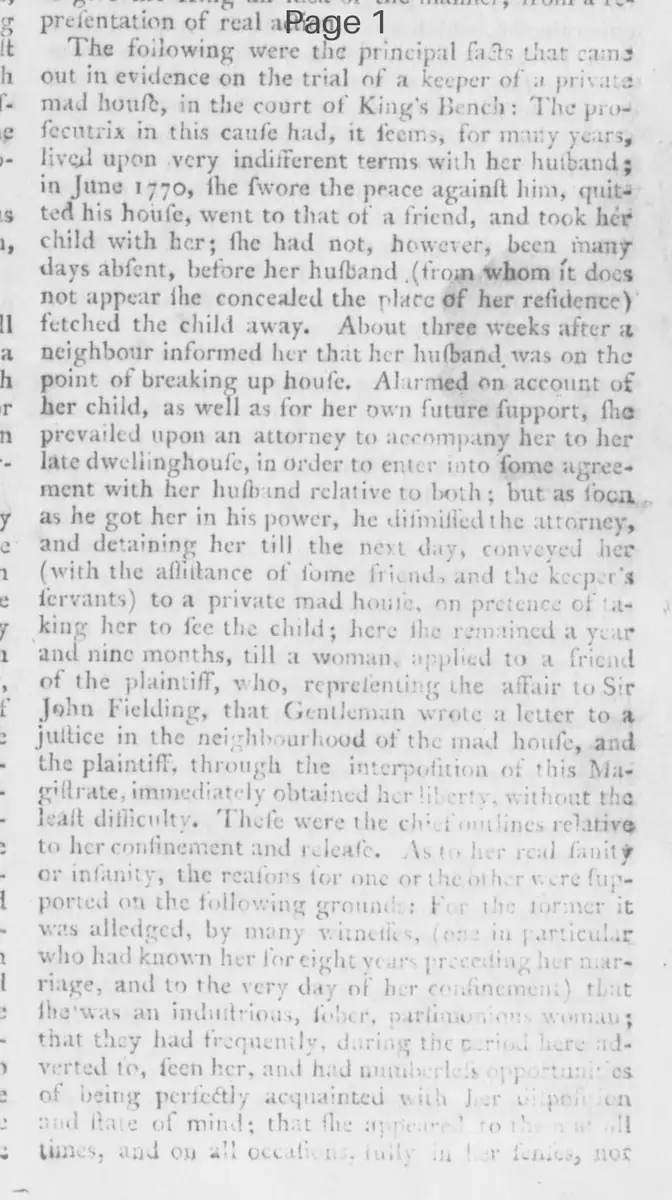
In a King's Bench trial, evidence showed a woman was confined for 21 months in a private madhouse by her husband on false insanity claims after leaving him in June 1770. Witnesses confirmed her sanity; jury convicted husband and keeper, with judgment pending next term.
Merged-components note: Continuation of the trial of the mad house keeper across pages 1 and 2; sequential reading order and same topic.
Clippings
1 of 2
OCR Quality
Full Text
She never betrayed one single symptom more, than she did at present, of any state of lunacy, idiocy, or want of sound understanding. The justice and the woman who made the discovery, deposed to the same effect, as far as fell within their knowledge. On the other hand, above a dozen witnesses positively swore that they always looked upon her as a mad woman; some of them, when interrogated by the opposite council, what they meant by this general description, answered, she was mad or worse, or was such a person as no honest man would live with, while others insisted positively on her insanity, and assigned some one or all of these reasons: that she was indiscriminately jealous of every woman with whom her husband had any intercourse in the way of business, &c. that she refused to eat with her husband, though he kept an extreme good table for one in his circumstances, yet pretended to be starved; that her fits of jealousy, rage, and madness, were continued without interval; that whatever woman came in her way was sure to suffer from her the most reproachful language, if not to be beaten or assaulted by her; that she frequently insisted that her husband was married to two or three other men's wives; that she charged him publicly with the commission of the most atrocious crimes, improbable in their nature, and of notorious falsity; that she went in all her neighbourhood under the appellation of the mad woman; and, that she frequently came home surrounded by crowds of boys, whom her unaccountable behaviour had collected as she passed along the streets.
After the evidence was finally closed, the jury found the husband and the keeper of the madhouse guilty, and the court is to pass judgment on them the beginning of next term.
What sub-type of article is it?
What keywords are associated?
What entities or persons were involved?
Foreign News Details
Event Date
June 1770
Key Persons
Outcome
jury found the husband and the keeper of the madhouse guilty, and the court is to pass judgment on them the beginning of next term
Event Details
The prosecutrix lived on poor terms with her husband; in June 1770, she swore the peace against him, left with her child, but he took the child. She sought agreement via attorney, but husband detained her and confined her in a private madhouse for a year and nine months under pretense of seeing the child. Released via Sir John Fielding's intervention. Witnesses for sanity described her as industrious and sound; opposing witnesses claimed madness based on jealousy, rage, and odd behaviors. Jury convicted husband and keeper.