Thank you for visiting SNEWPapers!
Sign up free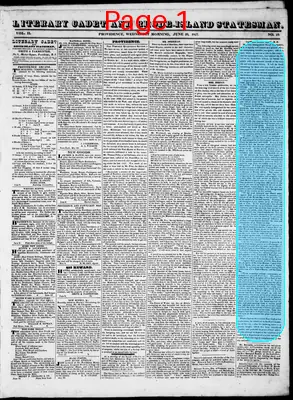
Literary Cadet And Rhode Island Statesman
Providence, Providence County, Rhode Island
What is this article about?
Biographical sketch of Captain Basil Hall, RN, born 1788, detailing his naval career, travels to Mediterranean, India, China, South America, writings, and family anecdote involving Paul Jones's raid.
Clipping

OCR Quality
Full Text
This very distinguished Naval Commander,
who is equally well known as a gallant sailor.
an enterprising traveller, navigator, and emi-
nent writer, is now on a visit to this country;
and his appearance here, has induced the Ed-
itor of the New-York Albion, to furnish the
public with the annexed sketch of his early
life and subsequent history. It will be found
interesting by those who may read it, and we
commend it to the perusal of such of our read-
ers, as are curious to become acquainted with
the histories of those who have signalized them-
selves in the service of the world:
"Captain Basil Hall was born in the year
1788, and is the son of Sir James Hall, Baron-
et, late President of the Royal Society of Ed-
in burgh. In 1802 he entered his Majesty's
service, and was upwards of five years on the
Mediterranean
coast. In 1808 he received his first epaulet,
and served as a lieutenant upwards of six years,
three of which were in India. During this lat-
ter period he twice travelled over the peninsula
of Hindostan, traversed a great part of Java,
and visited many of the numerous groups of
the oriental Archipelago.
"Captain Hall's love for travelling and ob-
servation, was in the year 1816 further grati-
fied by his appointment to the Lyra, ten gun
brig, which had been ordered to accompany
the Alceste frigate with the Embassy to China,
under Lord Amherst. During his Lordship's
stay at Canton the two vessels visited the Loo
choo islands, and Captain Hall, on his return
to England, published his well known and ex-
cellent work on that group. Towards the close
of 1817, the Lords of the Admiralty testified
their approbation of Captain Hall's services,
by advancing him to the rank of post captain,
on the occasion of the Lyra being paid off.
"In 1820, having obtained the command of
his Majesty's ship Conway, of 28 guns, Captain
H. was ordered to the South-American station,
where he remained until 1823. It was in this
situation that he became more particularly
known to the American navigators of that part
of the world. At the period alluded to, the
whole of that country was in a state of great
confusion and disorder—the Spanish power
was not extinct—in fact, the war raged in
many parts with unmitigated fury, and required
all the energy and activity of the commanders
of the neutral squadrons to preserve their re-
spective flags from the hostile assaults of the
belligerents. It is most gratifying to say, that
on all occasions of difficulty. Captain Hall sup-
ported the honor and interests of his country
as became a British officer. Nay, more, so
satisfied was every foreigner upon that coast
of Captain Hall's judgment and integrity, that
he was often the sole arbiter in disputes in
which British subjects were no way concerned.
They preferred leaving their differences to the
prompt decision of an unprejudiced and intelli-
gent officer, rather than to the slow and im-
perfect courts of judicature, in the disorganized
state of the country at that period.
"Of the most enlarged and liberal mind,
Captain Hall restricted not the powerful pro-
tection of the British flag to the exclusive use
of the subjects of his own country. Unprotect-
ed strangers of any nation never invoked his
aid in vain. To the Americans it has always
been understood he was particularly kind and
courteous, and it has recently been stated that
upon one occasion, when Captain Ridgely of
the United States ship Constellation, then on
that station, found it necessary to proceed from
one part of the coast to another, he requested
Captain Hall to use his personal influence in
settling a serious dispute between the crew and
commander of an American ship.—
"During his term of three years' service on
the South-American station, Captain Hall vis-
ited Brazil and Buenos Ayres on the east, and
the whole coast from Conception to California
on the west, when he collected the materials
for publishing his work, so extensively and de-
servedly known, on that interesting portion of
the western hemisphere.
"Besides the works alluded to. Captain Hall
has written various papers in the Philosophical
Transactions and other Journals; on the Geolo-
gy of the Cape of Good Hope, on a Comet dis-
covered at Valparaiso, and on the Chain Cable,
&c.—also, the three first volumes of that new
and popular work, Constable's Miscellany.—
The first article in the last Quarterly Review
is also, we suspect, from the pen of this officer.
"Captain Hall married, in 1825, Miss Hun-
ter, daughter of Sir John Hunter, Consul-Gen-
eral in Spain, who, we are pleased to learn,
intends to accompany her husband during the
entire tour of the United States, and the Cana-
das.
"There is another curious circumstance at-
tached to Captain Hall's history. His mother,
Lady Helen Hall, daughter of the Earl of Sel-
kirk, was actually in the house at St. Mary's
Isle and sitting at the tea-table when the place
was surrounded by the crew of Paul Jones's ship,
and she remembers distinctly the whole par-
ticulars, and the delicacy with which the la-
dies were treated by Paul's officers. It is well
known that Paul Jones bought up, with his
own money, the whole of the plate which was
taken away, and sent it back to Lady Selkirk.
It was not, however, till upwards of twelve
years afterward that the boxes reached the
Isle; and upon opening them a curious proof
was afforded that they had never once been
touched. for at the bottom of the tea pot which
had been on the table at the time, there was
found a hard mass of dried leaves, just as they
had been at the moment the plate was carried
away.
Whilst Captain Hall was in New-York a few
weeks since, he submitted to the Fire Commis-
sioners of the city, a plan for throwing water to a
greater height, which has been considered
feasible, and probable to prove of vast utility.
For this attempt to improve the condition of so
important a department of a public institution,
Captain Hall was highly complimented by the
city authorities.
What sub-type of article is it?
What themes does it cover?
What keywords are associated?
What entities or persons were involved?
Where did it happen?
Story Details
Key Persons
Location
Mediterranean, India, China, South America, United States
Event Date
Born In 1788
Story Details
Captain Basil Hall, born 1788, son of Sir James Hall, entered naval service in 1802, served in Mediterranean, India, commanded Lyra to China in 1816, published on Loo Choo islands, promoted 1817, commanded Conway in South America 1820-1823, acted as arbiter in disputes, collected materials for book on western hemisphere, wrote various scientific papers, married 1825, family anecdote of Paul Jones raid, visited New York with fire improvement plan.