Thank you for visiting SNEWPapers!
Sign up free
Literary
April 15, 1799
The Gazette
Portland, Cumberland County, Maine
What is this article about?
An essay extolling the virtues of order in personal, family, and societal life, illustrated by examples of indolent and disorderly individuals, including a negligent farmer who turns to political agitation against taxes and government.
Clipping
OCR Quality
88%
Good
Full Text
From the Haverhill Federal Gazette
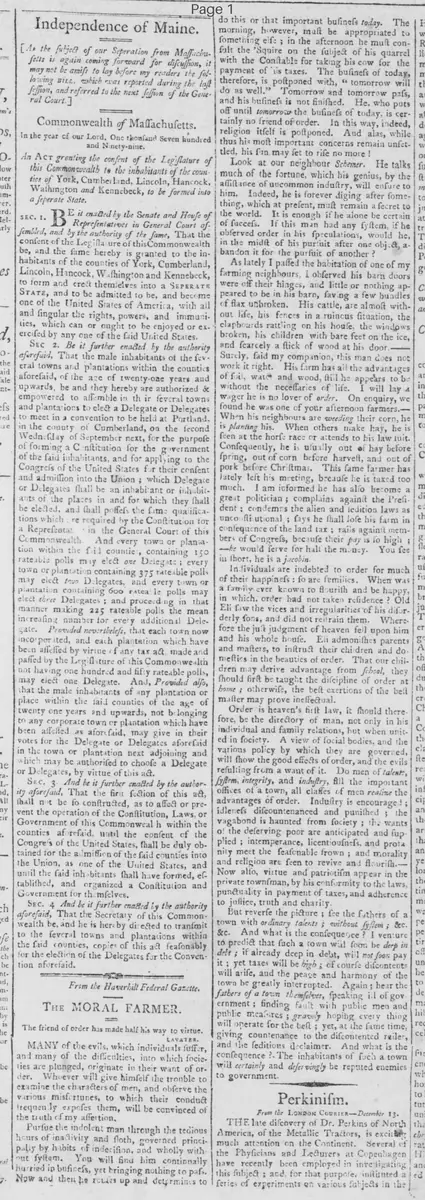
THE MORAL FARMER.
The friend of order has made half his way to virtue.
LAVATER.
MANY of the evils, which individuals suffer,
and many of the difficulties, into which societies
are plunged, originate in their want of order. Whoever will give himself the trouble to
examine the characters of men, and observe the
various misfortunes, to which their conduct
frequently exposes them, will be convinced of
the truth of my assertion.
Pursue the indolent man through the tedious
hours of inactivity and sloth, governed principally
by habits of indecision, and wholly without
system. You will find him continually
hurried in business, yet bringing nothing to pass.
Now and then he rises up and determines to
do this or that important business today. The
morning, however, must be appropriated to
something else; in the afternoon he must consult
the 'Squire on the subject of his quarrel
with the Constable for taking his cow for the
payment of his taxes. The business of today,
therefore, is postponed with, "tomorrow will
do as well." Tomorrow and tomorrow pass,
and his business is not finished. He, who puts
off until tomorrow the business of today, is certainly
no friend of order. In this way, indeed,
religion itself is postponed. And alas, while
thus his most important concerns remain unsettled,
his sun may set to rise no more!
Look at our neighbour Schemer. He talks
much of the fortune, which his genius, by the
assistance of uncommon industry, will ensure to
him. Indeed, he is forever digging after something,
which at present, must remain a secret to
the world. It is enough if he alone be certain
of success. If this man had any system, if he
observed order in his speculations, would he,
in the midst of his pursuit after one object, abandon
it for the pursuit of another?
As lately I passed the habitation of one of my
farming neighbours, I observed his barn doors
were off their hinges, and little or nothing appeared
to be in his barn, having a few bundles
of flax unbroken. His cattle, are almost without
life. his fences in a ruinous situation, the
clapboards rattling on his house, the windows
broken, his children with bare feet on the ice,
and scarcely a stick of wood at his door.—
Surely, said my companion, this man does not
work it right. His farm has all the advantages
of soil, water and wood, still he appears to be
without the necessaries of life. I will lay a
wager he is no lover of order. On enquiry, we
found he was one of your afternoon farmers.—
When his neighbours are weeding their corn, he
is planting his. When others make hay, he is
seen at the horse race or attends to his law suit.
Consequently, he is usually out of hay before
spring, out of corn before harvest, and out of
pork before Christmas. This same farmer has
lately left his meeting, because he is taxed too
much. I am informed he has also become a
great politician; complains against the President:
condemns the alien and sedition laws as
unconstitutional; says he shall lose his farm in
consequence of the land tax; rails against members
of Congress, because their pay is too high;
—he would serve for half the money. You see
in short, he is a jacobin.
Individuals are indebted to order for much
of their happiness: so are families. When was
a family ever known to flourish and be happy,
in which, order had not taken residence? Old
Eli saw the vices and irregularities of his disorderly
sons. and did not restrain them. Wherefore the just judgment of heaven fell upon him
and his whole house. Eli admonishes parents
and masters, to instruct their children and domestics
in the beauties of order. That our children
may derive advantage from school, they
should first be taught the discipline of order at
home: otherwise, the best exertions of the best
master may prove ineffectual.
Order is heaven's first law, it should therefore
be the directory of man, not only in his
individual and family relations, but when united
in society. A view of social bodies, and the
various policy by which they are governed,
will show the good effects of order, and the evils
resulting from a want of it. Do men of talent,
system, integrity, and industry, fill the important
offices of a town, all classes of men realize the
advantages of order. Industry is encouraged;
idleness discountenanced and punished; the
vagabond is hunted from society; the wants
of the deserving poor are anticipated and supplied;
intemperance, licentiousness, and profanity
meet the execrable frown; and morality
and religion are seen to revive and flourish.—
Now also, virtue and patriotism appear in the
private townsman, by his conformity to the laws,
punctuality in payment of taxes, and adherence
to justice, truth and charity.
But reverse the picture; see the fathers of a
town with ordinary talents; without system; &c.
&c. And what is the consequence? I venture
to predict that such a town will soon be deep in
debt; if already deep in debt, will not soon pay
it; yet taxes will be high; of course discontents
will arise, and the peace and harmony of the
town be greatly interrupted. Again; hear the
fathers of a town themselves, speaking ill of government;
finding fault with public men and
public measures; gravely hoping every thing
will operate for the best; yet, at the same time,
giving countenance to the discontented railer,
and the seditious declaimer. And what is the
consequence?. The inhabitants of such a town
will certainly and deservedly be reputed enemies
to government.
THE MORAL FARMER.
The friend of order has made half his way to virtue.
LAVATER.
MANY of the evils, which individuals suffer,
and many of the difficulties, into which societies
are plunged, originate in their want of order. Whoever will give himself the trouble to
examine the characters of men, and observe the
various misfortunes, to which their conduct
frequently exposes them, will be convinced of
the truth of my assertion.
Pursue the indolent man through the tedious
hours of inactivity and sloth, governed principally
by habits of indecision, and wholly without
system. You will find him continually
hurried in business, yet bringing nothing to pass.
Now and then he rises up and determines to
do this or that important business today. The
morning, however, must be appropriated to
something else; in the afternoon he must consult
the 'Squire on the subject of his quarrel
with the Constable for taking his cow for the
payment of his taxes. The business of today,
therefore, is postponed with, "tomorrow will
do as well." Tomorrow and tomorrow pass,
and his business is not finished. He, who puts
off until tomorrow the business of today, is certainly
no friend of order. In this way, indeed,
religion itself is postponed. And alas, while
thus his most important concerns remain unsettled,
his sun may set to rise no more!
Look at our neighbour Schemer. He talks
much of the fortune, which his genius, by the
assistance of uncommon industry, will ensure to
him. Indeed, he is forever digging after something,
which at present, must remain a secret to
the world. It is enough if he alone be certain
of success. If this man had any system, if he
observed order in his speculations, would he,
in the midst of his pursuit after one object, abandon
it for the pursuit of another?
As lately I passed the habitation of one of my
farming neighbours, I observed his barn doors
were off their hinges, and little or nothing appeared
to be in his barn, having a few bundles
of flax unbroken. His cattle, are almost without
life. his fences in a ruinous situation, the
clapboards rattling on his house, the windows
broken, his children with bare feet on the ice,
and scarcely a stick of wood at his door.—
Surely, said my companion, this man does not
work it right. His farm has all the advantages
of soil, water and wood, still he appears to be
without the necessaries of life. I will lay a
wager he is no lover of order. On enquiry, we
found he was one of your afternoon farmers.—
When his neighbours are weeding their corn, he
is planting his. When others make hay, he is
seen at the horse race or attends to his law suit.
Consequently, he is usually out of hay before
spring, out of corn before harvest, and out of
pork before Christmas. This same farmer has
lately left his meeting, because he is taxed too
much. I am informed he has also become a
great politician; complains against the President:
condemns the alien and sedition laws as
unconstitutional; says he shall lose his farm in
consequence of the land tax; rails against members
of Congress, because their pay is too high;
—he would serve for half the money. You see
in short, he is a jacobin.
Individuals are indebted to order for much
of their happiness: so are families. When was
a family ever known to flourish and be happy,
in which, order had not taken residence? Old
Eli saw the vices and irregularities of his disorderly
sons. and did not restrain them. Wherefore the just judgment of heaven fell upon him
and his whole house. Eli admonishes parents
and masters, to instruct their children and domestics
in the beauties of order. That our children
may derive advantage from school, they
should first be taught the discipline of order at
home: otherwise, the best exertions of the best
master may prove ineffectual.
Order is heaven's first law, it should therefore
be the directory of man, not only in his
individual and family relations, but when united
in society. A view of social bodies, and the
various policy by which they are governed,
will show the good effects of order, and the evils
resulting from a want of it. Do men of talent,
system, integrity, and industry, fill the important
offices of a town, all classes of men realize the
advantages of order. Industry is encouraged;
idleness discountenanced and punished; the
vagabond is hunted from society; the wants
of the deserving poor are anticipated and supplied;
intemperance, licentiousness, and profanity
meet the execrable frown; and morality
and religion are seen to revive and flourish.—
Now also, virtue and patriotism appear in the
private townsman, by his conformity to the laws,
punctuality in payment of taxes, and adherence
to justice, truth and charity.
But reverse the picture; see the fathers of a
town with ordinary talents; without system; &c.
&c. And what is the consequence? I venture
to predict that such a town will soon be deep in
debt; if already deep in debt, will not soon pay
it; yet taxes will be high; of course discontents
will arise, and the peace and harmony of the
town be greatly interrupted. Again; hear the
fathers of a town themselves, speaking ill of government;
finding fault with public men and
public measures; gravely hoping every thing
will operate for the best; yet, at the same time,
giving countenance to the discontented railer,
and the seditious declaimer. And what is the
consequence?. The inhabitants of such a town
will certainly and deservedly be reputed enemies
to government.
What sub-type of article is it?
Essay
What themes does it cover?
Moral Virtue
Political
Social Manners
What keywords are associated?
Order
Virtue
Farmer
Society
Politics
Morality
Taxes
Jacobin
Literary Details
Title
The Moral Farmer.
Subject
On The Importance Of Order In Personal, Family, And Societal Life
Form / Style
Prose Essay With Moral And Political Instruction
Key Lines
The Friend Of Order Has Made Half His Way To Virtue.
He, Who Puts Off Until Tomorrow The Business Of Today, Is Certainly No Friend Of Order.
You See In Short, He Is A Jacobin.
Order Is Heaven's First Law, It Should Therefore Be The Directory Of Man.
The Inhabitants Of Such A Town Will Certainly And Deservedly Be Reputed Enemies To Government.