Thank you for visiting SNEWPapers!
Sign up free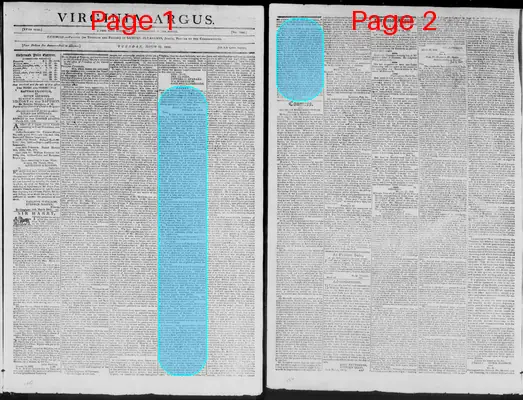
Virginia Argus
Richmond, Virginia
What is this article about?
In a February 16, 1808, letter to Massachusetts Governor James Sullivan, U.S. Senator Timothy Pickering warns constituents of the dangers posed by the recent embargo act, criticizing its rushed passage without sufficient information or justification, amid fears of unnecessary war with Britain over issues like the Chesapeake incident.
Merged-components note: This is a continuous letter from Senator Timothy Pickering to his constituents on the embargo and national affairs, starting on page 1 and continued on page 2; relabeled from editorial and story to better fit letter_to_editor.
Clippings

1 of 2
OCR Quality
Full Text
From the honorable Timothy Pickering, a
senator of the United States from the
state of Massachusetts, exhibiting to his
constituents a view of imminent danger
of an unnecessary and ruinous war--
Addressed to his excellency James Sul-
livan, governor of the said state.
CITY OF WASHINGTON,
February 16, 1808.
SIR,
In the even current of ordinary
times, an address from a senator in con-
gress to his constituents might be dispensed
with. In such times, the proceedings
of the executive and legislature of the U.
States, exhibited in their public acts, might
be sufficient. But the present singular
condition of our country, when its most in-
teresting concerns, wrapt up in mystery,
excited universal alarm, requires me to be
no longer silent. Perhaps I am liable to
censure, at such a crisis, for not sooner
presenting, to you and them, such a view
of our national affairs as my official situ-
ation has placed in my power. I now ad-
dress it to you, sir, as the proper organ of
communication to the legislature.
The attainment of TRUTH is ever desi-
rable: and I cannot permit myself to doubt
that the statement I now make must be
acceptable to all who have an agency in
directing the affairs, and who are guardians
of the interests of our commonwealth,
which so materially depends on the mea-
sures of the government of the nation.--
At the same time I am aware of the jea-
lousy with which, in these unhappy days
of party dissentions, my communications
may, by some of my constituents be re-
ceived. Of this I will not complain: while
I earnestly wish the same jealousy to be
extended towards all public men. Yet I
may claim some share of attention and cre-
dit--that share which is due to the man
who defies the world to point, in the whole
course of a long and public life, at one
instance of deception, at a single departure
from TRUTH.
The EMBARGO demands the first notice.
For perhaps no act of the national govern-
ment has ever produced so much solicitude,
or spread such universal alarm. Because
all naturally conclude, that a measure preg-
nant with incalculable mischief to all clas-
ses of our fellow citizens, would not have
been proposed by the president, and adopt-
ed by congress, but for causes deeply af-
fecting the interests and safety of the na-
tion. It must have been under the influence
of this opinion that the legislative bodies of
some states have expressed their appro-
bation of the embargo, either explicitly,
or by implication.
The following were all the papers laid be-
fore the president before congress, as the grounds
of the embargo.
1. The proclamation of the king of Great
Britain, requiring the return of his subjects
the seamen especially, from foreign coun-
tries, to aid, in this hour of peculiar danger,
in the defence of their own. But it
being an acknowledged principle, that every nation has a right to the service of its
subjects in time of war, that proclamation
could not furnish the slightest ground for
an embargo.
2. The extract of a letter from the grand
judge Regnier to the French attorney ge-
neral for the council of prizes. This con-
tained a partial interpretation of the impe-
rial blockading decree of Nov. 21. 1806.
This decree, indeed, and its interpretation,
present flagrant violations of our neutral
rights, and of the existing treaty between
the United States and France: but still,
the execution of that decree could not
(from the small number of French cruizers)
extensively interrupt our trade.
These two papers were public.
3. The letter from our minister, Mr.
Armstrong, to Mr. Champagny, the French
minister of foreign affairs: and
4. Mr. Champagny's answer. Both these
ought, in form or substance, also to have
been public. The latter would have fur-
nished to our nation some idea of the views
and expectations of France. But both
were withdrawn by the president, to be
deposited among other executive secrets:
while neither presented any new ground to
justify an embargo.
In the senate, these papers were referred
to a committee. The committee quickly
reported a bill for laying an embargo, a-
greeably to the president's proposal. This
was done a first, a second and a third time
and passed; and all in the short compass
of about four hours! A little time was re-
peatedly asked, to obtain further informa-
tion, and to consider a measure of such
moment, of such universal concern: but
these requests were denied. We were
hurried into the passage of the bill, as if
there was danger of its being rejected, if
we were allowed time to obtain further in-
formation, and deliberately consider the
subject. For to that time our vessels were
freely sailing on foreign voyages; and in a
national point of view, the departure of
half a dozen or a dozen more, while we
were inquiring into the necessity or expe-
diency of the embargo, was of little mo-
ment. Or if the danger to our vessels, sea-
men and merchandize had been so extreme
as not to admit of one day's delay, ought
not that extreme danger to have been exhi-
bited to congress? The Constitution,
which requires the president "to give to
congress information of the state of the union," certainly meant, not partial, but
complete information on the subject of his
communication, so far as he possessed it.
And when it enjoins him "to recommend
to their consideration such measures as he
shall judge necessary and expedient,"
is as certainly intended that those recom-
mendations should be bottomed on informa-
tion communicated not on facts withheld
and locked up in the executive cabinet.
Had the public safety been at stake, or any
great public good been presented to our
view, but which we should be lost by a moment's
delay, there would have been some apology
for dispatch though none for acting
without due information. In truth, this
measure appeared to me then, as it still
does, and as it appears to the public, with-
out a sufficient motive; without a legiti-
mate object. Hence, the general enquiry:
"For what is the embargo laid?" And
I challenge any man not in the secrets of the
executive to tell. I know, sir, that the
president said the papers above mentioned
"shewed that great and increasing dangers
threatened our vessels, our seamen and our
merchandize: but I also know, that they
exhibited no new dangers; none of which
our merchants and seamen were not ap-
prised. The British proclamation had ma-
ny days before been published in the news-
papers [the copy laid before us by the pre-
sident had been cut out of a news-
paper;] and so had the substance if not the
words of Regnier's letter. Yet they had
excited little concern among merchants and
seamen, the preservation of whose persons
and property was the professed object of
the president's recommendation of an em-
bargo. The merchants and seamen could
accurately estimate the dangers of conti-
nuing their commercial operations: of
which dangers, indeed the actual premi-
ums of insurance were a satisfactory gauge.
Those premiums had very little increased;
by the British proclamation not a cent:
and by the French decree so little as not to
stop commercial enterprises. The great
number of vessels loading or loaded and
prepared for sea; the exertions every where
made, on the first rumor of the embargo,
to dispatch them: demonstrate the presi-
dent's dangers to be imaginary--to have
been assumed Or if great and real dan-
ges, unknown to commercial men, were
impending, or sure to fall, how desirable
was it to have had them officially declared
and published! This would have produced
a voluntary embargo, and prevented every
complaint. Besides, the dangers clearly
defined and understood, the public mind
would not have been disquieted with ima-
ginary fears, the more tormenting because
uncertain.
It is true that considerable numbers of
vessels were collected in our ports, and
many held in suspense: not, however, from
any new dangers which appeared; but from
the mysterious conduct of our first magistrate after
the attack on the Chesapeake; and from
the painful apprehension that the course
the president was pursuing would termi-
nate in war The National Intelligencer
(usually considered as the executive news-
paper) gave the alarm; and it was echoed
through the United States. War, probable
or inevitable war, was the constant theme
of the newspapers, and of the conversa-
tions, as was reported, of persons supposed
to be best informed of executive designs.
Yet amid this din of war no adequate pre-
parations were seen making to meet it.
The order to detach a hundred thousand
militia to fight the British navy (for there
was no appearance of an enemy in any o-
ther shape) was so completely absurd, as
to excite, with men of common sense, no
other emotion than ridicule. Not the sha-
dow of a reason that could operate on the
mind of a man of common understanding,
can be offered in its justification. The re-
fusal of the British officer to receive the
frigate Chesapeake as a PRIZE, when ten-
dered by her commander, is a demonstra-
tion that the attack upon her was exclu-
sively for the purpose of taking their des-
terters; and not intended as the commence-
ment of a war between the two nations.
The president knew that the British had
no invading army to land on our shores;
and the detached militia would be useless,
except against land forces. Why then was
this order for the militia given? The na-
ture of the case, and the actual state
of things, authorize the inference, that its im-
mediate, if not its only object, was to in-
crease the public alarm, to aggravate the
public resentment against Great Britain,
to excite a war spirit; and in the height
of this artificial fever of the public mind,
which was to be made known in G. Britain,
to renew the demands on her government;
in the poor expectation of extorting, in that
state of things, concessions or points which
she had always considered as her rights,
and which at all times and under all cir-
cumstances, she had uniformly refused to
relinquish. The result of the subse-
quent negotiation at London has so wholly
confounded the president's expec-
tation, how perfectly useless, all this parade
of war. While no well informed man can
doubted that the British government would
make suitable reparation for the attack on
the Chesapeake. The president himself,
in his proclamation, had placed
the affair on that footing: A rupture be-
tween the two nations, "and equally
opposed to the interests of both." It is to
the assurance of the mutability dispo-
sition on the part of the British government,
in the midst of which outrage was com-
mitted. In this light, the subject cannot
at present itself to that government,
strengthen the motive, to an honorable reparation for the wrong which has been
done."
And it is now well known that such reparation
might have been promptly obtained in
London, had the president's instructions to
Mr. Monroe been compatible to such an ad.
justment. He was required not to negotiate
on this single transient act (which when once
adjusted was forever settled) but in connexion
with another claim of long standing, and, to
say the least, of doubtful right;—to wit, the
exemption from impressment of British sea-
men found on board American merchant ves-
sels. To remedy the evil arising from its ex-
ercise, by which our own citizens were some-
times impressed, the attention of our govern-
ment, under every administration, had been
earnestly engaged: while no man who regards
the truth, will question the disposition of the
British government to adopt any arrangement
that will secure to Great Britain the services
of her own subjects.—And now, when the unex-
ampled situation of this country (left alone to
maintain the conflict with France, and her
numerous dependent states—left alone to
withstand the power which menaces the
liberties of the world) rendered the aid of all
her allies more than ever needful: there
was no reasonable ground to expect that she
would yield the right to take them when found
on board the merchant vessels of any nation.—
Thus to insist on her yielding this point, and
inseparably to connect it with the adjustment of the
Chesapeake. It is tantamount to a determination
not to negotiate at all.
To be continued.
What sub-type of article is it?
What themes does it cover?
What keywords are associated?
What entities or persons were involved?
Letter to Editor Details
Author
Timothy Pickering
Recipient
His Excellency James Sullivan, Governor Of The Said State
Main Argument
the embargo was enacted without sufficient justification or transparency, rushed through congress based on inadequate and public information, leading to unnecessary alarm and potential war, while real dangers to commerce were minimal and already known.
Notable Details