Thank you for visiting SNEWPapers!
Sign up free
Story
April 18, 1959
Kodiak Mirror
Kodiak, Alaska
What is this article about?
C. L. Anderson, Alaska Fish and Game director, sees faint hope in Soviet proposal to limit Japanese high-seas salmon fishing, amid concerns over Bristol Bay red salmon depletion due to intermingling stocks and international convention challenges. Hearings in Juneau, April 1, 1959.
Clipping
OCR Quality
98%
Excellent
Full Text
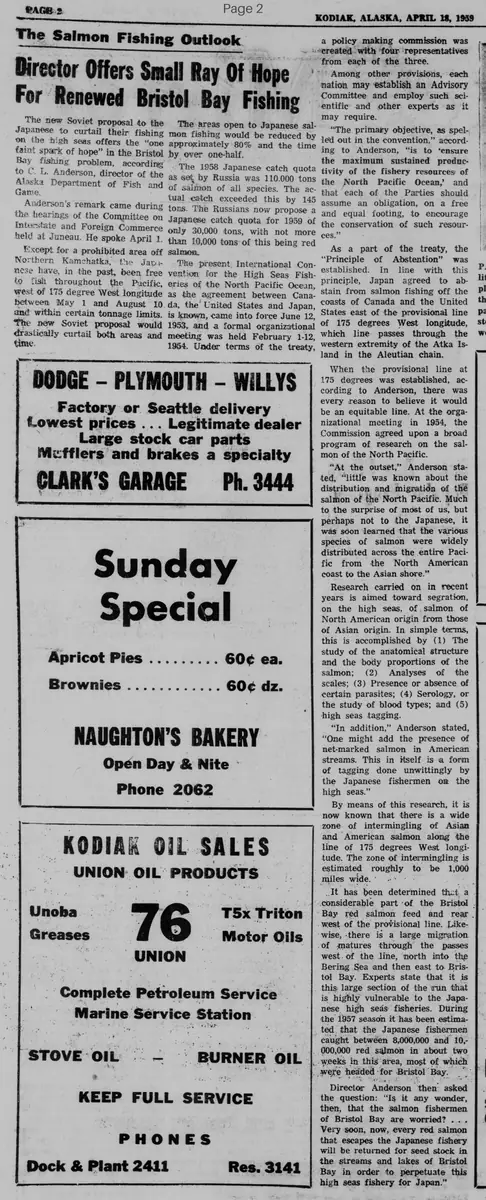
Director Offers Small Ray Of Hope
For Renewed Bristol Bay Fishing
The new Soviet proposal to the Japanese to curtail their fishing on the high seas offers the "one faint spark of hope" in the Bristol Bay fishing problem, according to C. L. Anderson, director of the Alaska Department of Fish and Game.
Anderson's remark came during the hearings of the Committee on Interstate and Foreign Commerce held at Juneau. He spoke April 1.
Except for a prohibited area off Northern Kamchatka, the Japanese have, in the past, been free to fish throughout the Pacific, west of 175 degree West longitude between May 1 and August 10 and within certain tonnage limits.
The new Soviet proposal would drastically curtail both areas and time.
The areas open to Japanese salmon fishing would be reduced by approximately 80% and the time by over one-half.
The 1958 Japanese catch quota as set by Russia was 110,000 tons of salmon of all species. The actual catch exceeded this by 145 tons. The Russians now propose a Japanese catch quota for 1959 of only 30,000 tons, with not more than 10,000 tons of this being red salmon.
The present International Convention for the High Seas Fisheries of the North Pacific Ocean, as the agreement between Canada, the United States and Japan, is known, came into force June 12, 1953, and a formal organizational meeting was held February 1-12, 1954. Under terms of the treaty,
KODIAK ALASKA, APRIL 18, 1959
a policy making commission was created with four representatives from each of the three.
Among other provisions, each nation may establish an Advisory Committee and employ such scientific and other experts as it may require.
"The primary objective, as spelled out in the convention," according to Anderson, "is to 'ensure the maximum sustained productivity of the fishery resources of the North Pacific Ocean,' and that each of the Parties should assume an obligation, on a free and equal footing, to encourage the conservation of such resources."
As a part of the treaty, the "Principle of Abstention" was established. In line with this principle, Japan agreed to abstain from salmon fishing off the coasts of Canada and the United States east of the provisional line of 175 degrees West longitude, which line passes through the western extremity of the Atka Island in the Aleutian chain.
When the provisional line at 175 degrees was established, according to Anderson, there was every reason to believe it would be an equitable line. At the organizational meeting in 1954, the Commission agreed upon a broad program of research on the salmon of the North Pacific.
"At the outset," Anderson stated, little was known about the distribution and migration of the salmon of the North Pacific. Much to the surprise of most of us, but perhaps not to the Japanese, it was soon learned that the various species of salmon were widely distributed across the entire Pacific from the North American coast to the Asian shore."
Research carried on in recent years is aimed toward segregation, on the high seas, of salmon of North American origin from those of Asian origin. In simple terms, this is accomplished by (1) The study of the anatomical structure and the body proportions of the salmon; (2) Analyses of the scales; (3) Presence or absence of certain parasites; (4) Serology, or the study of blood types; and (5) high seas tagging.
"In addition," Anderson stated, "One might add the presence of net-marked salmon in American streams. This in itself is a form of tagging done unwittingly by the Japanese fishermen on the high seas."
By means of this research, it is now known that there is a wide zone of intermingling of Asian and American salmon along the line of 175 degrees West longitude. The zone of intermingling is estimated roughly to be 1,000 miles wide.
It has been determined that a considerable part of the Bristol Bay red salmon feed and rear west of the provisional line. Likewise, there is a large migration of matures through the passes west of the line, north into the Bering Sea and then east to Bristol Bay. Experts state that it is this large section of the run that is highly vulnerable to the Japanese high seas fisheries. During the 1957 season it has been estimated that the Japanese fishermen caught between 8,000,000 and 10,000,000 red salmon in about two weeks in this area, most of which were headed for Bristol Bay.
Director Anderson then asked the question: "Is it any wonder, then, that the salmon fishermen of Bristol Bay are worried? ...
Very soon, now, every red salmon that escapes the Japanese fishery will be returned for seed stock in the streams and lakes of Bristol Bay in order to perpetuate this high seas fishery for Japan."
For Renewed Bristol Bay Fishing
The new Soviet proposal to the Japanese to curtail their fishing on the high seas offers the "one faint spark of hope" in the Bristol Bay fishing problem, according to C. L. Anderson, director of the Alaska Department of Fish and Game.
Anderson's remark came during the hearings of the Committee on Interstate and Foreign Commerce held at Juneau. He spoke April 1.
Except for a prohibited area off Northern Kamchatka, the Japanese have, in the past, been free to fish throughout the Pacific, west of 175 degree West longitude between May 1 and August 10 and within certain tonnage limits.
The new Soviet proposal would drastically curtail both areas and time.
The areas open to Japanese salmon fishing would be reduced by approximately 80% and the time by over one-half.
The 1958 Japanese catch quota as set by Russia was 110,000 tons of salmon of all species. The actual catch exceeded this by 145 tons. The Russians now propose a Japanese catch quota for 1959 of only 30,000 tons, with not more than 10,000 tons of this being red salmon.
The present International Convention for the High Seas Fisheries of the North Pacific Ocean, as the agreement between Canada, the United States and Japan, is known, came into force June 12, 1953, and a formal organizational meeting was held February 1-12, 1954. Under terms of the treaty,
KODIAK ALASKA, APRIL 18, 1959
a policy making commission was created with four representatives from each of the three.
Among other provisions, each nation may establish an Advisory Committee and employ such scientific and other experts as it may require.
"The primary objective, as spelled out in the convention," according to Anderson, "is to 'ensure the maximum sustained productivity of the fishery resources of the North Pacific Ocean,' and that each of the Parties should assume an obligation, on a free and equal footing, to encourage the conservation of such resources."
As a part of the treaty, the "Principle of Abstention" was established. In line with this principle, Japan agreed to abstain from salmon fishing off the coasts of Canada and the United States east of the provisional line of 175 degrees West longitude, which line passes through the western extremity of the Atka Island in the Aleutian chain.
When the provisional line at 175 degrees was established, according to Anderson, there was every reason to believe it would be an equitable line. At the organizational meeting in 1954, the Commission agreed upon a broad program of research on the salmon of the North Pacific.
"At the outset," Anderson stated, little was known about the distribution and migration of the salmon of the North Pacific. Much to the surprise of most of us, but perhaps not to the Japanese, it was soon learned that the various species of salmon were widely distributed across the entire Pacific from the North American coast to the Asian shore."
Research carried on in recent years is aimed toward segregation, on the high seas, of salmon of North American origin from those of Asian origin. In simple terms, this is accomplished by (1) The study of the anatomical structure and the body proportions of the salmon; (2) Analyses of the scales; (3) Presence or absence of certain parasites; (4) Serology, or the study of blood types; and (5) high seas tagging.
"In addition," Anderson stated, "One might add the presence of net-marked salmon in American streams. This in itself is a form of tagging done unwittingly by the Japanese fishermen on the high seas."
By means of this research, it is now known that there is a wide zone of intermingling of Asian and American salmon along the line of 175 degrees West longitude. The zone of intermingling is estimated roughly to be 1,000 miles wide.
It has been determined that a considerable part of the Bristol Bay red salmon feed and rear west of the provisional line. Likewise, there is a large migration of matures through the passes west of the line, north into the Bering Sea and then east to Bristol Bay. Experts state that it is this large section of the run that is highly vulnerable to the Japanese high seas fisheries. During the 1957 season it has been estimated that the Japanese fishermen caught between 8,000,000 and 10,000,000 red salmon in about two weeks in this area, most of which were headed for Bristol Bay.
Director Anderson then asked the question: "Is it any wonder, then, that the salmon fishermen of Bristol Bay are worried? ...
Very soon, now, every red salmon that escapes the Japanese fishery will be returned for seed stock in the streams and lakes of Bristol Bay in order to perpetuate this high seas fishery for Japan."
What sub-type of article is it?
Historical Event
Curiosity
What themes does it cover?
Misfortune
Justice
Survival
What keywords are associated?
Bristol Bay Fishing
Japanese Salmon Quota
Soviet Proposal
North Pacific Convention
Red Salmon Migration
High Seas Research
What entities or persons were involved?
C. L. Anderson
Where did it happen?
Bristol Bay, Alaska; North Pacific Ocean; Juneau
Story Details
Key Persons
C. L. Anderson
Location
Bristol Bay, Alaska; North Pacific Ocean; Juneau
Event Date
1959 04 18
Story Details
C. L. Anderson highlights Soviet proposal limiting Japanese salmon fishing as hope for Bristol Bay amid research revealing intermingled stocks vulnerable to Japanese catches, challenging 1953 international convention's abstinence principle.