Thank you for visiting SNEWPapers!
Sign up free
Gazette Of The United States, & Philadelphia Daily Advertiser
Philadelphia, Philadelphia County, Pennsylvania
What is this article about?
U.S. House of Representatives session on May 7: memorials from Massachusetts against war with France; resolutions for troop increases; Pinckney defends his conduct on foreign presents; lengthy debate on making a direct land tax permanent for defense funding, with votes rejecting multi-year duration and other amendments.
Merged-components note: This is a continuation of the detailed transcript of the House of Representatives debate from May 7, spanning across pages 1 and 2, forming a single coherent story on congressional proceedings.
Clippings
1 of 2
OCR Quality
Full Text
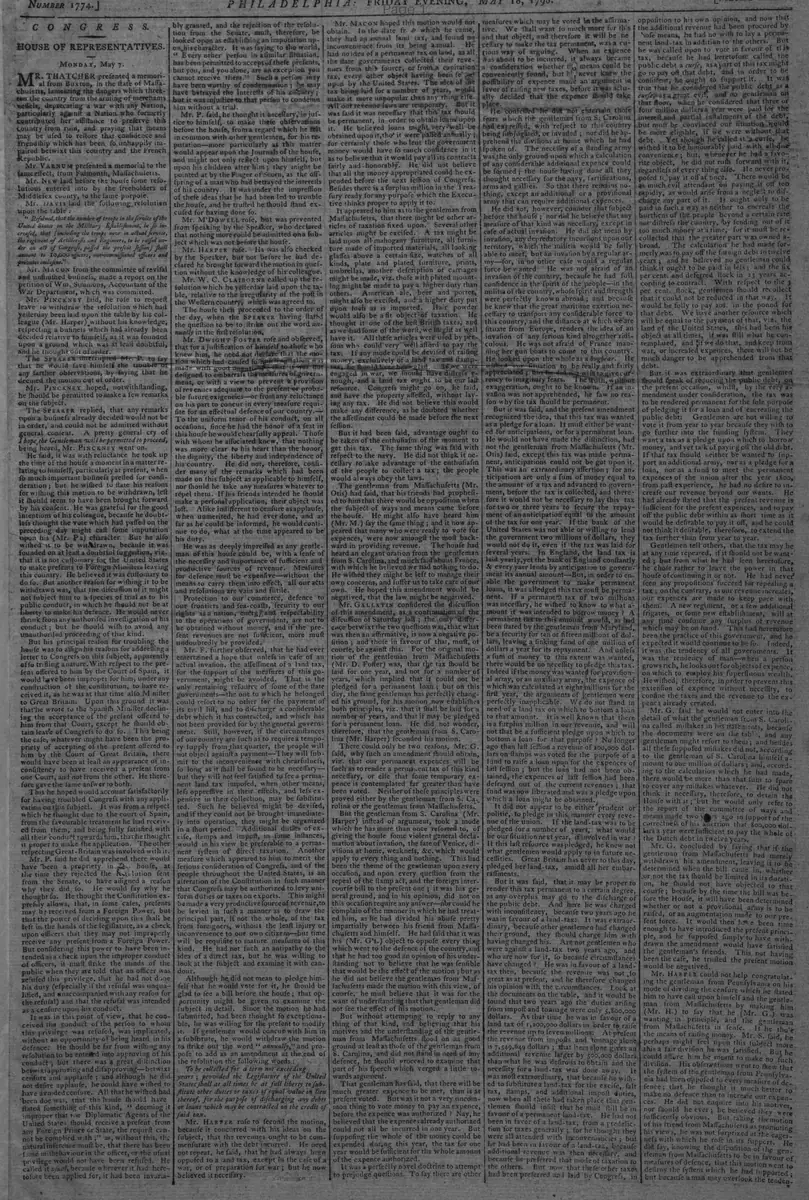
HOUSE OF REPRESENTATIVES.
MONDAY, May 7.
Mr. THATCHER presented a memorial from Buxton, in the state of Massachusetts, lamenting the dangers which threaten the country from the arming of merchant vessels, deprecating a war with any Nation, particularly against a Nation who formerly contributed her assistance to preserve this country from ruin, and praying that means may be used to restore that confidence and friendship which has been so unhappily impaired betwixt this country and the French Republic.
Mr. VARNUM presented a memorial to the same effect, from Falmouth, Massachusetts.
Mr. Sewall laid before the house some resolutions entered into by the freeholders of Middlesex county, to the same purpose.
Mr. DAVIS laid the following resolution upon the table:
"Resolved, that the number of troops in the service of the United States on the Military Establishment, be so increased, that (including the troops now in actual service, the regiment of Artillerists and Engineers, to be raised under an act of Congress, passed the present session) shall amount to 10,000 officers, non-commissioned officers and privates inclusive."
Mr. Macon from the committee of revision and unfinished business, made a report on the petition of Wm. Simmons, Accountant of the War Department, which was committed.
Mr. Pinckney said, he rose to request leave to withdraw the resolution which had yesterday been laid upon the table by his colleague (Mr. Harper) without his knowledge, respecting a business which had already been decided relative to himself, as it was founded upon a ground which was at least doubtful, and he thought out of order.
The Speaker interrupted Mr. P. to say that he would save himself the trouble of any farther observations, by saying that he deemed the motion out of order.
Mr. Pinckney hoped, notwithstanding, he should be permitted to make a few remarks on the subject.
The Speaker replied, that any remarks upon a business already decided would not be in order, and could not be admitted without general consent. A pretty general cry of "I hope the Gentleman will be permitted to proceed," being heard, Mr. Pinckney went on.
He said, it was with reluctance he took up the time of the house a moment in a matter relating to himself, particularly at present, when so much important business pressed for consideration; but he wished to state his reasons for wishing this motion to be withdrawn, lest it should seem to have been brought forward by his consent. He was grateful for the good intentions of his colleague, because he doubtless thought the vote which had passed on the preceding day might cast some imputation upon his (Mr. P.'s) character. But he also wished it to be withdrawn, because it was founded on at least a doubtful suggestion, viz. that it is not customary for the United States to make presents to Foreign Ministers leaving this country. He believed it was customary to do so. But another reason for wishing it to be withdrawn was, that the discussion of it might not subject him to a species of trial as to his public conduct, in which he should not be at liberty to make his defence. He would never shrink from any authorised investigation of his conduct; but he should wish to avoid any unauthorised proceeding of that kind.
But his principal reason for troubling the house was to assign his reasons for addressing a letter to Congress on this subject, apparently of so trifling a nature. With respect to the present offered to him by the Court of Spain, it would have been improper for him, under any construction of the constitution, to have received it, as he was at that time also Minister to Great Britain. Upon this ground it was that he wrote to the Spanish Minister declining the acceptance of the present offered to him from that Court, except he should obtain leave of Congress to do so. This being the case, whatever might have been the propriety of accepting of the present offered to him by the Court of Great Britain, there would have been at least an appearance of inconsistency to have received a present from one Court, and not from the other. He therefore gave the same answer to both.
This he hoped would account satisfactorily for having troubled Congress with any application on this subject. It was from a respect which he thought due to the court of Spain, from the favourable treatment he had received from them, and being fully satisfied with all their conduct towards him, that he thought it proper to make the application. The other respecting Great-Britain was involved with it.
Mr. P. said he did apprehend there would have been a propriety in the house, at the time they rejected the bill resolution sent from the Senate, to have assigned a reason why they did so. He would say why he thought so. He thought the Constitution expressly allows, that, in some cases, presents may be received from a Foreign Power, but that the power of deciding upon this shall be left in the hands of the legislature, as a check upon officers that they may not improperly receive any present from a Foreign Power.
But considering this power to have been intended as a check upon the improper conduct of officers, it must strike the minds of the public when they are told that an officer was refused this privilege, that he had not done his duty (especially if the refusal was unqualified, and unaccompanied with any reason for the refusal) and that the refusal was intended as a censure upon his conduct.
It was in this point of view, that he conceived the conduct of the person to whom this privilege was refused, was implicated, without an opportunity of being heard in his defence. He should be far from wishing any resolution to be entered into approving of his conduct; but there was a great distinction betwixt approving and disapproving—betwixt censure and applause; and although he did not desire applause, he could have wished to have avoided censure. All that he wished had been done was, that the house should have stated something of this kind, "deeming it improper that the Diplomatic Agents of the United States should receive a present from any Foreign Prince or State, the request cannot be complied with;" as, without this, the natural inference must be, that there has been some misbehaviour in the officer, or the usual privilege would not have been refused. He called it usual, because wherever it had heretofore been applied for, it had been invariably granted, and the rejection of the resolution from the Senate, must, therefore, be looked upon as establishing an imputation upon his character. It was saying to the world, "Every other person in a similar situation, has been permitted to accept of these presents, but you, and you alone, are an exception you cannot receive them." Such a person may have been worthy of condemnation; he may have betrayed the interests of his country; but it was injustice to that person to condemn him without a trial.
Mr. P. said, he thought it necessary, in justice to himself, to make these observations before the house, from a regard which he felt in common with other gentlemen, for his reputation—more particularly as this matter would appear upon the Journals of the house, and might not only reflect upon himself, but upon his children after him; they might be pointed at by the Finger of Scorn, as the offspring of a man who had betrayed the interests of his country. It was under the impression of these ideas that he had been led to trouble the house. and he trusted he should stand excused for having done so.
Mr. M'DOWELL rose, but was prevented from speaking by the Speaker, who declared that nothing more could be admitted on a subject which was not before the house.
Mr. HARPER rose. He was also checked by the Speaker, but not before he had declared he brought forward the motion in question without the knowledge of his colleague.
Mr. W. C. CLAIBORNE called up the resolution which he yesterday laid upon the table, relative to the irregularity of the post in the Western country, which was agreed to.
The house then proceeded to the order of the day, when the Speaker having stated the question to be to strike out the word "annually" in the first resolution,
Mr. Dwight Foster rose and observed, that for a justification of himself to those who knew him, he need not declare that the motion which had caused so much agitation was made with good intent; that it was not designed to embarrass the measures of government, or with a view to prevent a provision of revenues adequate to the present or probable future exigencies or from any reluctance on his part to concur in every measure requisite for an effectual defence of our country.
To the uniform tenor of his conduct, on all occasions, since he had the honor of a seat in this house he would cheerfully appeal. Those with whom he associated knew, that nothing was more clear to his heart than the honor, the dignity, the liberty and independence of his country. He did not, therefore, consider many of the remarks which had been made on this subject as applicable to himself, nor should he take any measures whatever to repel them. If his friends intended he should make a personal application, their object was lost. Alike indifferent to censure as applause, when unmerited, he had ever done, and as far as he could be informed, he would continue to do, what at the time appeared to be his duty.
He was as deeply impressed as any gentleman of this house could be, with a sense of the necessity and importance of sufficient and productive sources of revenue. Measures for defence must be expensive—without the means to carry them into effect, all our acts and resolutions are vain and futile. Protection to our commerce, defence to our frontiers and sea-coasts, security to our rights as a nation, energy, and respectability to the operations of government, are not to be obtained without money, and if the present revenues are not sufficient, more must undoubtedly be provided.
Mr. F. further observed, that he had ever entertained a hope that unless in case of an actual invasion, the assessment of a land tax, for the support of the measures of this government, might be avoided. That is the only remaining resource of some of the state governments—the one to which he belonged could resort to no other for the payment of its civil list, and to discharge a considerable debt which it has contracted, and which has not been provided for by the general government. Still, however, if the circumstances of our country are such as to require a temporary supply from that quarter, the people will not object against a payment—They will submit to the inconvenience with cheerfulness, so long as it shall be found to be necessary—but they will not feel satisfied to see a permanent land tax imposed, when other means, less oppressive in their effects, and less expensive in their collection, may be substituted. Such he believed might be devised, and if they could not be brought immediately into operation, they might be organized in a short period. Additional duties of excise, stamps and import, in some instances, would in his view be preferable to a permanent system of direct taxation. Another measure which appeared to him to merit the serious consideration of Congress, and of the people throughout the United States, is an alteration of the Constitution in such manner that Congress may be authorized to levy uniform duties or taxes on exports. This might be made a very productive source of revenue, to be levied in such a manner as to draw the principal part, if not the whole, of the tax from foreigners, without the least injury or inconvenience to our own citizens—but time will be requisite to mature measures of this kind. He had not such an antipathy to the idea of a direct tax, but he was willing to look at the subject and examine it with candour.
Although he did not mean to pledge himself that he would vote for it, he should be glad to see a bill before the house; that opportunity might be given to examine the subject in detail. Since the motion he had submitted, had been thought so exceptionable, he was willing for the present to modify it. If gentlemen would concur with him in a substitute, he would withdraw the motion to strike out the word "annually," and propose to add as an amendment at the end of the resolution the following words:
To be collected for a term not exceeding [number] years; provided the Legislature of the United States shall at all times be at full liberty to substitute other duties or taxes of equal value in lieu thereof, for the purpose of discharging any debts or loans which may be contracted on the credit of said tax.
Mr. HARPER rose to second the motion, because it concurred with his ideas on the subject, that the revenues ought to be commensurate with the debt incurred. He need not repeat, he said, that he had always been opposed to a land tax, except in the case of a war, or of preparation for war; but he now believed it necessary.
Mr. Macon hoped this motion would not obtain. In the state from which he came, they had an annual land tax, and found no inconvenience from its being annual. He had no idea of a permanent tax on land, as all the state governments collected their revenues from this source, or from a capitation tax, every other object having been seized upon by the United States. The idea of no tax being laid for a number of years, would make it more unpopular than any thing else. All our revenue laws are temporary. But it was said it was necessary that this tax should be permanent, in order to obtain loans upon it. He believed loans might very well be obtained upon it, tho' it were passed annually; for certainly those who lent the government money would have so much confidence in it as to believe that it would pay all its contracts fairly and honorably. He did not believe that all the money appropriated could be expended before the next session of Congress. Besides there is a surplus million in the Treasury ready for any purpose which the Executive thinks proper to apply it to.
It appeared to him as to the gentleman from Massachusetts, that there might be other articles of taxation fixed upon. Several other articles might be excis'd. A tax might be laid upon all mahogany furniture, all furniture made of imported materials, all looking glasses above a certain size, watches of all kinds, plate and plated furniture, prints, umbrellas, another description of carriages might be made, viz. those with plated mounting might be made to pay a higher duty than others. American ale, beer and porter, might also be excis'd, and a higher duty put upon such as is imported. Hair powder would also be a fit object of taxation He thought it one of the best British taxes, and as we had some of the worst, we might as well have it. All these articles were used by persons who could very well afford to pay the tax. If any mode could be devised of raising money, exclusively of a land tax and stamp-tax, he should have been glad. If we were engaged in war, we should have distress enough, and a land tax ought to be our last resource. Congress might go on, he said, and have the property assessed, without laying any tax. He did not believe this would make any difference, as he doubted whether the assessment could be made before the next session.
But it had been said, advantage ought to be taken of the enthusiasm of the moment to get this tax. The same thing was said with respect to the navy. He did not think it necessary to take advantage of the enthusiasm of the people to collect a tax; the people would always obey the laws.
The gentleman from Massachusetts (Mr. Otis) had said, that his friends had prophesied to him that there would be opposition when the subject of ways and means came before the house. He might also have heard him (Mr. M.) say the same thing; and it now appeared that many who were ready to vote for expenses, were now amongst the most backward in providing revenue. The house had heard an elegant oration from the gentleman from S. Carolina, and much said about France, with which he believed we had nothing to do. He wished they might be left to manage their own concerns, and suffer us to take care of our own. He hoped this amendment would be negatived, that the law might be negatived.
Mr. GALLATIN considered the discussion of this amendment, as a continuation of the discussion of Saturday last; the only difference betwixt the two questions was, that what was then an affirmative, is now a negative position; and those in favour of that, must, of course, be against this. For the original motion of the gentleman from Massachusetts (Mr. D. Foster) was, that the tax should be laid for one year, and not for a number of years, which implied that it could not be pledged for a permanent loan; but on this day, the same gentleman has perfectly changed his ground, for his motion now establishes both principles, viz. that it shall be laid for a number of years, and that it may be pledged for a permanent loan. He did not wonder, therefore, that the gentleman from S. Carolina (Mr. Harper) seconded his motion.
There could only be two reasons, Mr. G. said, why such an amendment should obtain, viz. that our permanent expenses will be such as to render a permanent tax of this kind necessary, or else that some temporary expense is contemplated far greater than have been voted. Neither of these principles were proved either by the gentleman from S. Carolina or the gentleman from Massachusetts.
But the gentleman from S. Carolina (Mr. Harper) instead of argument, took a mode which he has more than once resorted to, of giving the house some violent general declaration about invasion, the fate of Venice, divisions at home, weakness, &c, which would apply to every thing and nothing. This had been the theme of the gentleman upon every occasion, and upon every question from the repeal of the stamp act, and the foreign intercourse bill to the present one; it was his general ground, and in his opinion, did not on this occasion require any answer—nor could he complain of the manner in which he had treated him, as he had divided his abuse pretty impartially between his friend from Massachusetts and himself. He had said that it was his (Mr. G's.) object to oppose every thing which went to the defence of the country, and that he had too good an opinion of his understanding not to believe that he was sensible that would be the effect of the motion; but as he did not believe the gentleman from Massachusetts made the motion with this view, of course, he must believe that it was for the want of understanding that that gentleman did not see the effect of his motion.
But without attempting to reply to any thing of that kind, and believing that his motives and the understanding of the gentleman from Massachusetts stood on as good ground at least as those of the gentleman from S. Carolina, and did not stand in need of any defence, he should proceed to examine that part of his speech which verged a little towards argument.
That gentleman has said, that there will be much greater expense to be met, than is at present voted. But was it not a very uncommon thing to vote money to pay an expense, before the expense was authorized? Nay, he believed that the expenses already authorized could not all be incurred in one year. But supposing the whole of the money could be expended during this year, the tax for one year would be sufficient for the whole amount of the expense authorized.
It was a perfectly novel doctrine to attempt to prejudge questions. To say there are other measures which may be voted in the affirmative. We shall want much more for this and that object, and therefore it will be necessary to make the tax permanent, was a curious way of arguing.
When an expense was about to be incurred, it always became a consideration whether the means could be conveniently found, but he never knew the possibility of expense make an argument in favor of raising new taxes, before it was actually decided that the expense should take place.
He confessed he did not entertain those fears which the gentleman from S. Carolina had expressed, with respect to this country being subjugated, or invaded; nor did he apprehend the divisions at home which he had spoken of. The necessity of a standing army was the only ground upon which a calculation of any considerable additional expense could be formed; the house having done all they thought necessary for the navy, fortifications, arms and galleys. So that there remains nothing, except an additional or a provisional army that can require additional expenses.
He did not, however, consider that subject before the house; nor did he believe that any measure of that kind was necessary, except in case of actual invasion. He did not mean by invasion, any depredatory incursions upon our territory, which the militia would be fully able to meet, but an invasion by a regular army—for, in no other case would a regular force be wanted. He was not afraid of an invasion of the country, because he had full confidence in the spirit of the people—in the militia of the country, whose spirit and strength were perfectly known abroad; and because he knew that the great maritime exertion necessary to transport any considerable force to this country, and the distance at which we are situate from Europe, renders the idea of an invasion of any serious kind altogether ridiculous. He was not afraid of France manning her gun boats to come to this country. He looked upon the whole as a bugbear. He wished our situation to be really and fairly appreciated; but he did not wish to give currency to imaginary fears. The truth, without exaggeration, ought to be known. If an invasion was not apprehended, he saw no reason why the tax should be permanent.
But it was said, and the present amendment recognized the idea, that this tax was wanted as a pledge for a loan. It must either be wanted for anticipations, or for a permanent loan. He would not have made the distinction, had not the gentleman from Massachusetts (Mr. Otis) said, except this tax was made permanent, anticipations could not be got upon it.
This was an extraordinary assertion; for anticipations are only a sum of money equal to the amount of a tax and advanced to government, before the tax is collected, and therefore it would not be necessary to lay this tax for two or three years to secure the repayment of an anticipation equal to the amount of the tax for one year. If the bank of the United States was not able or willing to lend the government two millions of dollars, they would not do it, even if the tax was laid for several years. In England, the land tax is laid yearly, yet the bank of England constantly & every year lends by anticipation to government its annual amount—But, in order to enable the government to make permanent loans, it was alledged this tax must be permanent. If a permanent tax of two millions was necessary, he wished to know to what amount it was intended to borrow money? A permanent tax to this amount would, as had been stated by the gentleman from Maryland, be a security for ten or fifteen millions of dollars, leaving a sinking fund of one million of dollars a year for its repayment. And unless a sum of money to this extent was wanted, there would be no necessity to pledge this tax.
Indeed if the money was wanted for provisional army, or an auxiliary army, the expense of which was calculated at eight millions for the first year, the arguments of gentlemen were perfectly inapplicable. We do not stand in need of a land tax on which to bottom a loan to that amount. It is well known that there is a surplus million in our revenue, and will not that be a sufficient pledge upon which to bottom a loan for that purpose? No longer ago than last session a revenue of 200,000 dollars on stamps was voted for the purpose of a fund to raise a loan upon for the expenses of last session; but the loan had not been obtained, the expenses of last session had been defrayed out of the current revenues; that fund was now liberated and was a pledge upon which a loan might be obtained.
It did not appear to be either prudent or politic, to pledge in this manner every revenue of the union. If the land-tax was to be pledged for a number of years, what would be our situation next year, if involved in war? If this last resource was pledged, he knew not what gentlemen would apply to in future necessities. Great Britain has never to this day, pledged her land-tax, amidst all her embarrassments.
But it was said, that it may be proper to render this tax permanent to a certain degree, as any overplus may go to the discharge of the public debt. And here he was charged with inconsistency, because two years ago he was in favour of a land-tax: It was extraordinary, because other gentlemen had changed their ground, they should charge him with having changed his. Are not gentlemen who were against a land-tax two years ago, and who are now for it, so because circumstances have changed?. He was in favour of a land-tax then, because the revenue was not so great as at present, and he therefore changed his opinion with the circumstances. Look at the documents on the table, and it would be found that two years ago the duties arising from import and tonnage were only 5,800,000 dollars. At that time he was in favour of a land tax of 1,200,000 dollars in order to raise the revenue up to seven millions: At present the revenue from imports and tonnage alone is 7,549,649 dollars; that item alone gives an additional revenue larger by 500,000 dollars than what he was desirous to obtain and the necessity for a land-tax was done away. It was most extraordinary, that because he wished to substitute a land-tax for the excise, all tax, stamps, and additional impost duties, now when all these had taken place that gentlemen should insist that he must still be in favour of a permanent land-tax. He had not been in favor of a land-tax, from a predilection for taxes generally; for he thought they were all attended with inconveniencies; but he had been in favour of a land-tax, because additional revenue was then necessary, and because he preferred that mode of taxation to the others. But now that these other taxes had been preferred and laid by Congress, in opposition to his own opinion, and now that the additional revenue had been procured by those means, he had no wish to lay a permanent land-tax in addition to the others. But he was called upon to vote in favour of this tax, because he had heretofore called the public debt a curse, as a part of this tax might go to pay off that debt, and in order to be consistent, he ought to support it.
It was true that he considered the public debt as a curse, as a great evil, and no gentleman on that floor, when he considered that three or four million dollars a year were paid for the interest and partial instalments of the debt, but must be convinced our situation would be more eligible, if we were without that debt. Yet though he called it a curse, he wished it to be honourably paid with all due convenience; but, whenever he had a favorite object, he did not rush forward with it, regardless of every thing else. He never proposed to pay it off at once. There would be as much evil attendant on paying it off too rapidly, as would arise from a neglect to discharge any part of it. It ought only to be paid in such a way as neither to increase the burthens of the people beyond a certain rate nor distress the country, by sending out of it too much money at a time, for it must be recollected that the greater part was owned abroad. The calculation he had made formerly was to pay off the foreign debt in twelve years; and he believed no gentleman could think it ought to be paid in less; and the six per cent. and deferred stock in 23 years according to contract. With respect to the 3 per cent. stock, gentlemen should recollect that it could not be reduced in that way. It would be folly to pay 20s. in the pound for that debt. We have another resource which will be equal to the payment of that, viz. the land of the United States, this had been his object at all times, it was still what he contemplated, and if we do that, and keep from war, or increased expenses, there will not be much danger to be apprehended from that debt.
But it was extraordinary that gentlemen should speak of reducing the public debt, on the present occasion, whilst, by the very amendment under consideration, the tax was to be rendered permanent for the sole purpose of pledging it for a loan and of increasing the public debt: Gentlemen are not willing to vote it from year to year because they wish to go further into the funding system. They want a tax as a pledge upon which to borrow money, and yet talk of paying off the old debt. If that tax should neither be wanted to support an additional army, nor as a pledge for a loan, nor as a fund to meet the permanent expenses of the union after the year 1800, from past experience, he had no desire to increase our revenue beyond our wants. He had already stated that the present revenue is sufficient for the present expenses, and to pay off the public debt within as short time as it would be desirable to pay it off, and he could not think it desirable, therefore, to extend the tax further than from year to year.
Gentlemen tell others, that the tax may be at any time repealed, if it should not be wanted; but from what he had seen heretofore, he chose rather to leave the power in that house of continuing it or not. He had never seen any propositions' succeed for repealing a tax; on the contrary, as our revenue increases, our expenses are made to keep pace with them. A new regiment, or a few additional frigates, or some new establishment, will at any time consume any surplus of revenue which may be on hand. This had heretofore been the practice of this government, and he expected it would continue to be so. Indeed, it was the tendency of all governments. It was the tendency of man—when a person grows rich, he looks out for objects of expense, on which to employ his superfluous wealth.
He wished, therefore, in order to prevent this extension of expense without necessity, to confine the taxes and the revenue to the expenses already created.
Mr. G. said he would not enter into the detail of what the gentleman from S. Carolina called mistakes in his statements, because the documents were on the table, and any gentleman might resort to them; and besides all these supposed mistakes did not, according to the gentleman of S. Carolina himself amount to one million of dollars; and, according to the calculation which he had made, there would be more than that sum to spare to cover any mistakes whatever. He did not think it necessary, therefore, to detain the House with it; but he would only refer to the report of the committee of ways and means made two days ago in support of the correctness of his assertion that 800,000 dollars a year were sufficient to pay the whole of the Dutch debt in twelve years.
Mr. G. concluded by saying that if the gentleman from Massachusetts had merely withdrawn his amendment, leaving it to be determined when the bill came in, whether or not the tax should be limited in its duration, he should not have objected to that course; because by the time the bill was before the House, it will have been determined whether or not a provisional army is to be raised, or an augmentation made to our present force. It would then have been time enough to have introduced the present principle, and he supposed simply to have withdrawn the amendment would have satisfied the gentleman's friends. This not having been the case, he trusted the present motion would be negatived.
Mr. Harper could not help congratulating the gentleman from Pennsylvania on his mode of dividing the censure which he stated him to have cast upon himself and the gentleman from Massachusetts by making him (Mr. H.) to say that he (Mr. G.) was wanting in principle, and the gentleman from Massachusetts in sense. If he tho't this a fair division he was satisfied. But he could assure him he meant to make no such division. His observations went to shew that the system of the gentleman from Pennsylvania had been opposed to every measure of defence; that he thought it much better to make no defence than to increase our expenses. He did not enquire into his motives, nor should he ever; he believed they were sufficiently obvious. But taking the motion of his friend from Massachusetts as promoting his views, he was not surprised at the eagerness with which he rose in its support. He did say, knowing the disposition of the gentleman from Massachusetts to be in favour of measures of defence, that this motion went to destroy the system which he had supported; but because a man may overlook the tendency
By the want of a motion, does it follow that he is a blockhead? Certainly not.
The foundation of the speech of the gentleman from Pennsylvania was laid on the supposition that there could be no increase of expense in our government, except from the raising of a provisional army, or an increase of the present army. But is this a true state of the fact? Were the 80,000 militia ordered to be held in readiness to produce no expense? The gentleman had all along spoken of militia as if they could be called into service without expense. Did not he know, that when they were called out, there would be the expense of camps, tents, pay, and all the expenses of a regular army, except the enlistment and bounty paid to soldiers, that he could not see any great difference in expense betwixt calling out the militia, or raising an army, except in the article of bounty, as he had mentioned. He therefore apprehended that the calling of these militia into service might be attended with an expense of twenty millions of dollars, and the President may, next week, if he thinks proper, call any number of them into service.
The next argument of the gentleman is equally fallacious. Admitting that government may have occasion for loans, yet the surplus million of revenue in the Treasury would be a sufficient bottom for them. But was it certain that we should have no other expenses besides that of providing for additional military force? Could it be said no more money would be wanted under the 6th article of the British treaty? He recollected when that subject was under debate, that a gentleman from Virginia had said, it would produce an expense of fifteen millions of dollars. He never believed any such sum would be wanted. 300,000 dollars had already been appropriated, and he supposed the whole expense might amount to betwixt two and three millions.
And yet the gentleman from Pennsylvania was willing the revenue of the country should depend upon its present (in case of war) uncertain resources. And this was the basis to be offered to monied men, as a security for their money. It was in vain to say how much more than the two millions would be wanted. He believed it was the intention to fill the blank in this amendment with two or three years, and then, if we had not had occasion to incur any extraordinary expenses, or make any heavy loans, the tax would come to an end. But suppose this amendment is rejected, and the bill is confined to one year's duration, it will in a great measure defeat the purpose of the bill.
As to the declaration which the gentleman from Pennsylvania stated him as using, he would assure him that he should not cease to call the attention of the House to the dangers of the country, and though he might continue to administer anodynes as much as he pleased, he would be doomed to hear him, whilst he was a member of that House, warn them against the effects of his oporifics. Mr. H. again adverted to the situation of Europe, and to the probability of an attack upon this country, which he said the gentleman from Pennsylvania might call declamation, but which he called truth. He hoped, however, the attack would not be made; and if not, the expense would not be incurred. If the law passed with a principle similar to this amendment, he believed a loan would soon be filled up. He knew it would be done chiefly from patriotic motives; but those who advance money will, notwithstanding, expect to have a solid hope of a reimbursement of their money; and if this should be refused, the country would be left defenseless for want of pecuniary resources. This, he supposed, would be bad economy; and he could not help entering his protest against this system, whatever may be the motives which lead to it.
Mr. FINDLEY said, it was admitted on all hands, that it depended on a contingency whether this tax would be wanted at all. For his own part, he was under no apprehension of any formidable invasion of this country taking place before Congress meets again. If France is desirous of making conquests, there are much preferable objects to this country, nearer home. The difficulties which have so long agitated Europe, are not yet so far settled, as to suffer France to send out any formidable force here. Let the conduct of the French government have been as bad as it can be painted, it cannot be said that it has ever wholly lost sight of its own interest, and it would not be her interest to make an invasion of this country at this time; and therefore there is no necessity for going into measures as if an invading army was immediately expected amongst us.
A land-tax was with him a favorite tax. He had long wished it. He was for adopting it some time ago, and for taking advantage of a low market, to have bought up the public debt. But when he came to enquire into the subject, he found that many of the States had laid direct taxes for the support of their own government. There is now an appearance of necessity for this tax; but being a new tax under the general government, and not likely to be very satisfactory to some parts of the Union, it would be proper to make the law of short duration. Upon constitutional ground, he was against continuing a direct tax longer than two years; every Congress ought to pass a vote upon it, but in the present instance he believed the law would be best passed for one year only.
But it was said this tax must be permanent, as a bottom to loans. This was expressing a distrust of future Congresses, which he thought improper. But it was asserted that neither public institutions nor monied citizens would lend their money on the credit of Congress, without a permanent source of revenue was provided as a security. Are gentlemen justified by experience in this opinion? He believed not. Mr. F. mentioned several instances to shew the contrary, and doubted not the same readiness would again appear in aid of government whenever it wanted it.
Mr. F. was of opinion that if power was given to the President to raise 20,000 men, as a provisional army, they could be got before the next session of Congress. Officers might be appointed, and he had no doubt they would. If these men were not raised, and any occasion should call for military service, the militia, of course, would be resorted to. But was there any reason to believe that more militia would be called out in the course of the year than one year's land-tax would provide for? He could not believe there would. He supposed every gentleman would vote according to the idea he had of the contingency which had been mentioned being likely to take place, or otherwise. Difficulties would always attend the laying of a new tax; and when it should be necessary to lay a direct tax, he would have it for some considerable sum as the expense of collecting would be the same whether it was for a large or a small amount. Though it might prove disagreeable to the people, they will pay it if necessary, and do not disgust the people by giving them an idea that they shall never get rid of the tax.
Gentlemen might again be told, that they refuse to provide any means of defence for the country, that this is a leaf of the same book, &c. But could it be supposed, said Mr. F. that he should mind such charges? Or was it to be credited that the people would believe that he who had been employed in the formation of this government, and in executing it ever since it existed, and who had risked every thing to obtain it, should now refuse to support any measure which was calculated to defend it? It could not. They will not believe these aspersions.
Mr. F. concluded by observing that if this law was not passed for one year, he could confidently rely on future Congresses to renew it, if the situation of the country should require it. It would not hereafter be convenient for him to take any farther share in the public councils, but he should not distrust the wisdom and patriotism of those who might follow him; and to do away the charges continually made against himself and others, that they were not willing to defend the country, he should call the yeas and nays upon every question of defence which came before the House.
Mr. S. SMITH did not like the amendment; but he should vote for it, because if he could not get all he wished, he would get all he could. If the blank was to be filled with two or three years (as had been intimated) it would not go far enough to induce monied men to rely upon it as a permanent security.
There seemed to be no difference of opinion as to the propriety of laying a direct tax; it only seemed to be as to the length of time for which it ought to be laid. He agreed with those gentlemen who assert that money cannot be borrowed, except a permanent fund be provided. But gentlemen say where are your expenses? Certain expenses have been agreed to, which are proposed to be met by a direct tax of two millions; but could it be supposed that the proceeds of this tax could be brought into the Treasury in less than eighteen months? They could not, and something must be done in the mean time to raise the money already voted, whether any war takes place, or not. How was this to be done? By loans alone. But what inducement will there be to monied men to lend money, except a permanent revenue be made the security? You hold out the credit of the United States, which has not heretofore been injured. This is true. But heretofore we have not been engaged in war; we have had nothing to impede our Revenue. But if a war takes place, it is possible our revenue may suffer very materially: and Congress are about to provide a fund, which in the opinion of some will leave no permanency, & in the opinion of others, very little. And would it not require a great degree of patriotism in gentlemen to lend twenty shillings for twenty shillings, when they can go into the market, and purchase them with sixteen. The difference of opinion on this subject, he was convinced, arose from the different pursuits of the members of that house. Certain gentlemen believed monied men would advance money without a permanent tax as a security. He believed the contrary; for however great a confidence they may have in the honour of future Congresses, they would wish to see this Congress do something for their security. He feared gentlemen were not in earnest when they spoke of defending the country. We have men, said he, but we want money. He did not agree with the gentleman from N. Carolina (Mr. Williams) that slaves fought for money, and freemen only for liberty. If he commanded a regiment of Militia, he believed they would expect to be paid, and he could not believe he would term them slaves. Money must be had.
The gentleman from Pennsylvania was afraid of making the Revenue permanent, because as our revenue increased, it had been usual, not to repeal our revenue laws, but to increase our expenses. Whence did he collect this information? Not from the documents on the table; for there he would find that there was an unexpended surplus of one million nine hundred thousand dollars, which were in 1797 applied by the Commissioners of the Sinking Fund to the reduction of the Public Debt. We have, said he, gone on decreasing our expenses. It was true, that our dispute with Algiers, and a war with the Indians, had cost a great deal of money; but when the war with the latter was at an end our expenses were decreased. And now an increase of expense is asked for to repel threatened danger; and gentlemen have voted measures of defence; but now they come to touch the expense they flinch. Men may memorialize and talk about defence as long as they please, it will avail nothing, without money.
But gentlemen say, before we raise money, let us wait to see whether it will be necessary. They might as well say, "let us wait till we are devoured," which would be the case if we neglected to raise money until our enemy was at the door.
But gentlemen call for a statement of expenses. He would remind them, that it was proposed to raise a Provisional Army of at least 50,000 men, which would cost four millions dollars a year. It was also proposed that the President should have power to call out 20,000 militia to be trained, and the payment of them must be provided for. It would not be right to leave the President without money. At the time you give him the authority to raise, and call out men, you must give him the means of paying them. He knew better than some other gentlemen, because he knew the difficulty attendant on the raising of money.
Mr. OTIS said, the gentleman last up had anticipated some of the observations which he intended to have made; but he would suggest a few remarks in favour of the present motion.
The gentleman from Pennsylvania (Mr. Gallatin) had used arguments to shew, that no tax of this sort is necessary. He should not reply to any arguments of this sort, because the committee have already decided upon the quantity and principle of the tax. But, if he was under the necessity of answering such observations, he would refer to the gentleman's own book, (which however he had not yet read, but meant to read) and because the Secretary of the Treasury and the Committee of Ways and Means, had recommended a direct tax as the only source which could be depended upon for a permanent revenue.
But it had been said, no invasion could be expected to take place. His opinion was, however, though the danger might not be very great, it ought to be guarded against. In a certain part of the country at least, he believed there was considerable danger: Indeed the house has voted considerable sums for defence, and there remains, according to the report of the committee of Ways and Means, a balance unprovided for, of 1,396,705 dollars, for the meeting of which the committee have recommended a land tax of two millions. And if the tax was voted, it ought to be voted in such a way as that the money may be raised; and he thought the gentleman from Pennsylvania had taken a greater latitude in his observations than he complained of in the gentleman from S. Carolina who had held up a picture before their eyes, of which the house ought continually to be reminded. He had already stated that this money must be borrowed, and that it could not be got, if the tax was laid in the usual way.
A man who has money to lend will not part with it without a certainty of being repaid. It had been said, that it was not improbable that the enemy might make a landing in some of the southern states. Suppose they were to do so, and keep possession of a part of the country for some time, the present tax could not be drawn from thence. Monied men would take such an event into their calculation, because the other parts of the country would not be liable to make up the deficiency. In such a case, the creditor would have nothing to depend upon but the faith of government, and he might as well depend upon that in the first instance as to lend his money upon an uncertain security. There would also be the expense of collection to be deducted, which he supposed would not be less than 10 per cent. Considering all these circumstances, if he was the Director of a Bank, or had money to lend, he would not lend more than one million upon this two million tax. The gentleman from Pennsylvania had said, that Great Britain never mortgaged her land tax for a number of years, though he acknowledged they annually anticipated it. No man, Mr. O. said, would lend his money without considering the risk he ran in doing so, and he thought it was much less in England than in this country at this time. The principle which he wished to engraft in the bill was, that the tax should be continued until the money which had been borrowed upon it should be repaid. Not that he was in favour of a land tax. He should himself pay as large a proportion of this tax as any man whose property was not larger than his; because of his little fortune, a greater part was in land than in any thing else. He was therefore interested in preventing the tax. If it were to pass, however, he wished it to be effectual.
Mr. VARNUM hoped the motion under consideration would be negatived. The gentleman from Maryland (Mr. S. Smith) gave two reasons on Saturday, against striking out the word annually. One was that it was necessary the tax should have some permanency, in order that money might be borrowed upon it, and another that it might be a substitute for indirect taxes. That gentleman allowed, and he perfectly agreed with him in opinion, that in case of war, the defalcation in our revenue he did not suppose would be large, and that in our present situation he had no idea of a defalcation. If then, a defalcation of our revenue was not to be expected, he thought he should be able to make it appear, that the proposed tax is not necessary at all; and, of course, that it will not be right to pass it for more than one year. But the gentleman from Maryland says the people ought to be relieved from Indirect Taxes, because for every 12 per cent duty the consumer pays 27. Does that gentleman wish then that the merchant should be deprived of a profit of 15 per cent, on the duties which he now pays? If so, this might be very well effected, without doing away the duty, and substituting a land tax in its place, by the merchants lowering the price of their goods 15 per cent!
But the gentleman added another reason, for passing the law for a number of years, viz. that this tax might be at any time repealed. But, although this house might consent to a repeal of this tax, it was by no means certain that the other house would consent to its repeal. Indeed, it was his opinion, that if this tax was established as a permanent tax, that the people of this country would not be relieved from it for many years. Many objects, he had no doubt, would be found out, by gentlemen ever fruitful in this respect, upon which to expend any surplus which might arise from this tax.
The gentleman from S. Carolina, on Saturday, brought into view our situation with respect to France, and our liability to an attack from that nation. He alluded to the conversation which took place betwixt our envoys and X. Y. & Z. and thence inferred that it was probable this country would be attacked by France. He could not say that all the propositions made by these unauthorized persons were not from the Directory; but there was no evidence of this, and therefore he could not believe it, especially as the Agents themselves declared they were not. He thought, therefore, if we wished to preserve peace with France, that we ought not to be too forward in believing that all which was said by X. Y. and Z. was authorized by the French government. He hoped it would prove to be the contrary, and that when the Directory shall discover what has been done, they will punish these persons for their conduct.
The gentleman from S. Carolina had frequently introduced to the view of the house the situation of Switzerland, Venice, Spain, Holland, and other countries. As to himself he had no idea of espousing the cause of those countries; it was sufficient in his opinion that we defended our own. In doing this, he would go as far as any man, but he did not wish to go to Venice or to Rome to fight in the cause of the Pope. What was meant by observations like these, but to prepare the minds of the people for a situation of things which that gentleman expected and wished for? And if gentlemen did not come into all his views, he immediately charges them with not being willing to defend their country; with being slow to protect their wives and their children. He should have supposed that men who had left their families, and fought for their country for eight years together, would now feel the necessity of defending their wives and children, as much as that gentleman who never had either. But it appeared to him that the gentleman from S. Carolina, in making the observations which he did, departed from the principle established by the committee of ways and means, of which he is the chairman. They have stated that no additional revenue is wanted, except to meet the extraordinary expenses of the present session. Among these extraordinary expenses are 340,000 dollars for fortifications, and for the procuring of cannon, arms, and ammunition 600,000. If the fortifications are once completed, they surely will not want completing a second time; and the appropriation for providing cannon, arms and ammunition could not be considered as an annual expense but merely as an expense for the present year. Was not this also the case with respect to the naval armament? He hoped it was not intended that 950,000 dollars should be appropriated annually for this object. If this should hereafter be determined, Congress would of course provide the means for effecting it.
Mr. V. supposed the calculation of the amount of duty arising from imports and tonnage for the present year, might very safely be taken at the actual receipts of last year, viz.
7,549,649
The duties on domestic manufactures, &c. 575,491
Revenue on the postage of letters 50,000
Fees on letters patent 1,400
Proceeds of that part of the sinking fund which consists of interest and stock purchased or redeemed 89,450
Dividends on 2220 shares of stock of the bank of the United States, calculated at 32 dollars a share 71,040
8,337,037
Take from this sum the ordinary expenditure 6,334,111
There remains a surplus of 1,982,926
But it was stated by the Secretary of the Treasury, that in consequence of the depredations committed upon our trade, there may be a deficiency of revenue in the present year, and upon this probability the committee of ways and means have grounded their report. He should wish to view the subject with candour, and not to deceive himself. He knew that similar observations had been made from year to year, since depredations had been committed upon our commerce by foreign nations, but he also knew that facts had shewn them to be ill founded. In the year 1795, the duty arising from this source was 5,588,961 dollars; in 1796, 6,567,987; and in 1797, 7,549,649 dollars. And he had no doubt the revenue from imports and tonnage for the present year would increase in the same proportion in which it has increased for the three years past, and if so, that alone would produce upwards of eight millions and an half of dollars. Allowing that the imports and tonnage will make
8,500,000
Add the additional imposts laid at the last winter session, and the salt tax of the summer session which at a moderate calculation will amount to 600,000
The stamp tax 200,000
To which add the various other articles of revenue mentioned above, amounting to 787,388
Also add the estimated increase of the internal revenue 15,000
And the whole will amount to 10,212,388
From which deduct the whole expenses of the present year, as stated by the committee of ways and means, viz. 9,808,603
And there will remain a surplus of 403,785
But it was probable that the revenue arising from imports and tonnage would considerably exceed the sum he had mentioned; for, according to the amount of the duties arising from the first quarter of the present year, the revenue from that source alone would amount to ten millions of dollars, in which case the whole revenue may be estimated at 11,112,688 dollars, and would leave a surplus of 1,304,085 dollars.
If this view of the subject was correct it appeared to him if the proposed tax was laid at all, it ought not to be for more than one year. If gentlemen had any thing in view which was not before the house he could not speak to that. But if the United States were under the necessity of borrowing fifteen millions of dollars, there was no necessity for this tax for that purpose, as the surplus million, three hundred thousand dollars accruing annually, was a sufficient security for the payment of the interest on a loan to that amount. He was against continuing the tax for a longer period than one year for another reason. It was to be collected from houses, lands and slaves. This, in the part of the country from whence he came would operate very unjustly. In the state of Massachusetts the people pay annually for the interest of their state debt, expenses of the civil department, county and town charges, support of the poor, highway taxes, and for the support of public schools and ministers of the gospel, a direct tax of between 12 and 13,000 dollars. This tax is collected from polls, and from real and personal estates, with some few exceptions, and it is found that persons holding small farms there, and who have families to bring up, find it difficult to pay these taxes. This additional tax will therefore fall very heavy upon this class of people, as they will principally have to bear the burden, being wholly laid upon houses and the landed property in that quarter of the union. No tax, therefore, could be calculated to excite so much dissatisfaction in that part of the United States as this. The people will certainly pay it, if it be laid, but they will not do it cheerfully. He should, therefore, be against laying the tax for more than one year.
The question was put and negatived 46 to 35.
Mr. D. FOSTER then renewed his motion to strike out the word annually, which was carried, there being 60 votes for it.
The question on the amendment providing for the taking of a new census, was put and carried, there being 57 votes for it.
Mr. RAND moved an amendment which went to strike out the provision which proposes that the tax shall be laid by an uniform rule through all the states, with the view of inserting in its place the following words, "and upon such other estates within each particular state as is taxable according to the established rule of direct taxation in each state."
The motion was negatived, there being 21 votes for it.
The report was referred to the committee of ways and means, to report bills accordingly.
Adjourned.
What sub-type of article is it?
What themes does it cover?
What keywords are associated?
What entities or persons were involved?
Where did it happen?
Story Details
Key Persons
Location
House Of Representatives, United States Congress
Event Date
Monday, May 7
Story Details
Session includes presentation of anti-war memorials from Massachusetts towns; resolution to increase troops to 10,000; report on War Department petition; Pinckney's extended defense against implications of rejecting his request for foreign presents; debate on duration of direct land tax for defense, favoring temporary over permanent; votes strike 'annually', approve new census, reject state-specific tax rules; referred to committee.