Thank you for visiting SNEWPapers!
Sign up free
Alexandria Gazette
Alexandria, Alexandria County, District Of Columbia
What is this article about?
Political opinion piece defending joint stock companies as republican and prosperity-promoting, criticizing Van Buren's opposition and Sub-Treasury system, praising Whig policies for benefiting laborers and commerce in New England and beyond.
Clipping
OCR Quality
Full Text
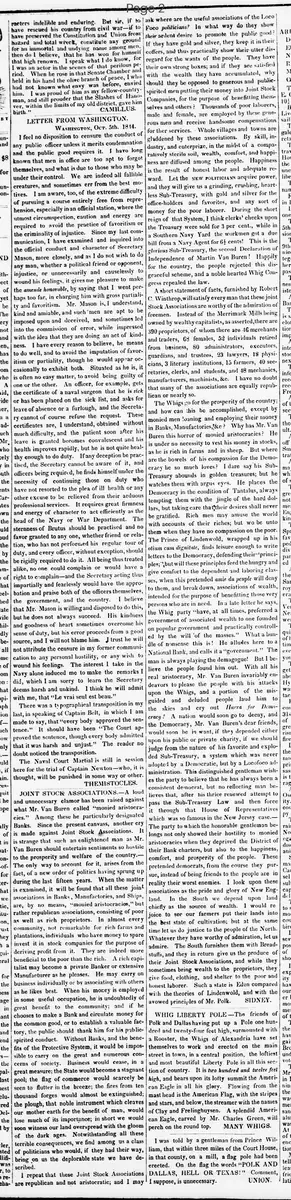
I repeat that these Joint Stock Associations are republican and not aristocratic; and I may ask where are the useful associations of the Loco Foco politicians? In what way do they show their ardent desire to promote the public good? If they have gold and silver, they keep it in their coffers, and thus practically show their utter disregard for the wants of the people. They have their own strong boxes; and if they are satisfied with the wealth they have accumulated, why should they be opposed to generous and public-spirited men putting their money into Joint Stock Companies, for the purpose of benefitting themselves and others? Thousands of poor laborers, male and female, are employed by these generous men and receive handsome compensations for their services.—Whole villages and towns are gladdened by these associations. By skill, industry, and enterprise, in the midst of a comparatively sterile soil, wealth, comfort, and happiness are diffused among the people. Happiness is the result of honest labor and adequate reward. Let the New politicians acquire power, and they will give us a grinding, crushing, heartless Sub-Treasury, with gold and silver for the office-holders and favorites, and any sort of money for the poor laborer. During the short reign of that System, I think clerks' checks upon the Treasury were sold for 3 per cent., while in a Southern Navy Yard the workmen got a due bill from a Navy Agent for 6½ cents! This is the glorious Sub-Treasury, the second Declaration of Independence of Martin Van Buren! Happily for the country, the people rejected this disgraceful scheme, and a noble hearted Whig Congress repealed the law.
A short statement of facts, furnished by Robert C. Winthrop, will satisfy every man that these joint Stock Associations are worthy of the admiration of freemen. Instead of the Merrimack Mills being owned by wealthy capitalists, as asserted, there are 390 proprietors, of whom there are 46 merchants and traders, 63 females, 52 individuals retired from business, 50 administrators, executors, guardians, and trustees, 23 lawyers, 15 physicians, 3 literary institutions, 15 farmers, 40 secretaries, clerks, and students, and 48 mechanics manufacturers, machinists, &c. I have no doubt that many of the associations are equally republican or nearly so.
The Whigs go for the prosperity of the country; and how can this be accomplished, except by monied men owning and employing their money in Banks, Manufactories, &c? Why has Mr. Van Buren this horror of monied aristocracies? He is under no necessity to vest his money in stocks, as he is rich in farms and in sheep. But where are the bowels of his compassion for the Democracy he so much loves? I dare say his Sub-Treasury abounds in golden treasures; but he watches them with argus eyes. He places the Democracy in the condition of Tantalus, always tempting them with the jingle of the hard dollars, but taking care that their desires shall never be gratified. Rich men may amuse the world with accounts of their riches; but wo be unto them when they have no compassion on the poor.
The Prince of Lindenwold, wrapped up in his otium cum dignitate, finds leisure enough to write letters to the Democracy, defending their "principles;" but will these principles feed the hungry and give comfort to the dependent and laboring classes, when this pretended ami du peuple will deny to them, and break down, associations of wealth intended for the purpose of benefitting those very persons who are in need. In a late letter he says, the Whig party "have, at all times, preferred a government of associated wealth to one founded on popular government and practically controlled by the will of the masses." What a bundle of nonsense this is! He alludes here to a National Bank, and calls it a "government." The man is always playing the demagogue! But I believe the people found him out. With all his real aristocracy, Mr. Van Buren invariably endeavors to please the people with his attacks upon the Whigs, and a portion of the misguided and deluded people laud him to the skies and cry out Hurra for Democracy! A nation would soon go to decay, and the Democracy, Mr. Van Buren's dear friends would soon be in want, if they depended either upon his public or private charity, if we should judge from the nature of his favorite and exploded Sub-Treasury, a system which was never adopted by a Democratic, but by a Locofoco administration. This distinguished gentleman wishes the party to believe that he has always been a consistent democrat, but no reflecting man believes that, after his thrice renewed attempt to pass the Sub-Treasury Law and then force it through that House of Representatives which was so famous in the New Jersey case.—The party to which the honorable gentleman belongs not only showed their hostility to monied aristocracies when they deprived the District of their Bank charters, but also to the happiness, comfort, and prosperity of the people. These pretended democrats, from the course they pursue, instead of being friends to the people are in reality their worst enemies. I look upon these associations as the pride and glory of New England. In the South we depend upon land chiefly as the source of wealth. I would rejoice to see our farmers put their lands into the best state of cultivation; but at the same time let us do justice to the people of the North. Whatever they have worthy of admiration, let us admire. The South furnishes them with Bread-stuffs, and they in return give us the produce of their Joint Stock Associations, and while they sometimes bring wealth to the proprietors, they give food, clothing, and shelter to the poor and honest laborer. Such a state is Eden compared with the theories of Lindenwold, and with the avowed principles of Mr. Polk.
SIDNEY.
What sub-type of article is it?
What themes does it cover?
What keywords are associated?
What entities or persons were involved?
Where did it happen?
Story Details
Key Persons
Location
New England, South, Merrimack Mills
Event Date
During The Last Fifteen Years
Story Details
Defense of joint stock associations in banks, manufactories, and ships as republican and beneficial to the poor and society, against criticism from Mr. Van Buren and Locofoco politicians who favor the Sub-Treasury system; highlights employment and prosperity they bring, contrasts with Whig support for economic progress.