Thank you for visiting SNEWPapers!
Sign up free
Story
March 9, 1960
The Sidney Herald
Sidney, Richland County, Montana
What is this article about?
An opinion piece in Q&A format discusses parental responsibility in preventing juvenile delinquency, the impact of broken homes, and argues against secrecy in juvenile courts, citing J. Edgar Hoover's views on publicizing serious offenses.
Clipping
OCR Quality
98%
Excellent
Full Text
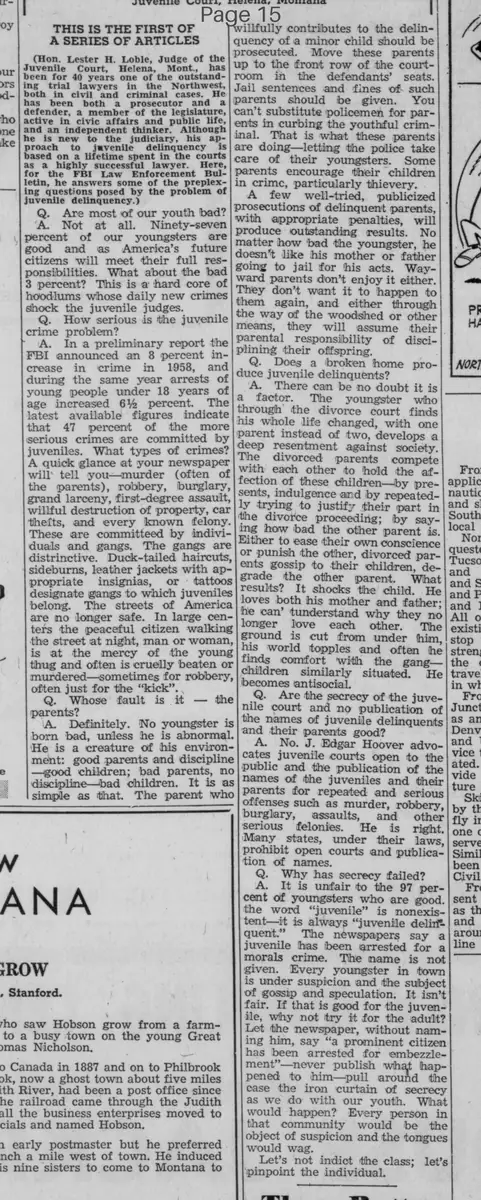
willfully contributes to the delinquency of a minor child should be prosecuted. Move these parents up to the front row of the courtroom in the defendants' seats. Jail sentences and fines of such parents should be given. You can't substitute policemen for parents in curbing the youthful criminal. That is what these parents are doing—letting the police take care of their youngsters. Some parents encourage their children in crime, particularly thievery. A few well-tried, publicized prosecutions of delinquent parents, with appropriate penalties, will produce outstanding results. No matter how bad the youngster, he doesn't like his mother or father going to jail for his acts. Wayward parents don't enjoy it either. They don't want it to happen to them again, and either through the way of the woodshed or other means, they will assume their parental responsibility of disciplining their offspring.
Q. Does a broken home produce juvenile delinquents?
A. There can be no doubt it is a factor. The youngster who through the divorce court finds his whole life changed, with one parent instead of two, develops a deep resentment against society. The divorced parents compete with each other to hold the affection of these children by presents, indulgence and by repeatedly trying to justify their part in the divorce proceeding; by saying how bad the other parent is. Either to ease their own conscience or punish the other, divorced parents gossip to their children, degrade the other parent. What results? It shocks the child. He loves both his mother and father; he can't understand why they no longer love each other. The ground is cut from under him, his world topples and often he finds comfort with the gang—children similarly situated. He becomes antisocial.
Q. Are the secrecy of the juvenile court and no publication of the names of juvenile delinquents and their parents good?
A. No. J. Edgar Hoover advocates juvenile courts open to the public and the publication of the names of the juveniles and their parents for repeated and serious offenses such as murder, robbery, burglary, assaults, and other serious felonies. He is right. Many states, under their laws, prohibit open courts and publication of names.
Q. Why has secrecy failed?
A. It is unfair to the 97 percent of youngsters who are good. The word "juvenile" is nonexistent—it is always "juvenile delinquent." The newspapers say a juvenile has been arrested for a morals crime. The name is not given. Every youngster in town is under suspicion and the subject of gossip and speculation. It isn't fair. If that is good for the juvenile, why not try it for the adult? Let the newspaper, without naming him, say "a prominent citizen has been arrested for embezzlement" never publish what happened to him pull around the case the iron curtain of secrecy as we do with our youth. What would happen? Every person in that community would be the object of suspicion and the tongues would wag.
Let's not indict the class; let's pinpoint the individual.
Q. Does a broken home produce juvenile delinquents?
A. There can be no doubt it is a factor. The youngster who through the divorce court finds his whole life changed, with one parent instead of two, develops a deep resentment against society. The divorced parents compete with each other to hold the affection of these children by presents, indulgence and by repeatedly trying to justify their part in the divorce proceeding; by saying how bad the other parent is. Either to ease their own conscience or punish the other, divorced parents gossip to their children, degrade the other parent. What results? It shocks the child. He loves both his mother and father; he can't understand why they no longer love each other. The ground is cut from under him, his world topples and often he finds comfort with the gang—children similarly situated. He becomes antisocial.
Q. Are the secrecy of the juvenile court and no publication of the names of juvenile delinquents and their parents good?
A. No. J. Edgar Hoover advocates juvenile courts open to the public and the publication of the names of the juveniles and their parents for repeated and serious offenses such as murder, robbery, burglary, assaults, and other serious felonies. He is right. Many states, under their laws, prohibit open courts and publication of names.
Q. Why has secrecy failed?
A. It is unfair to the 97 percent of youngsters who are good. The word "juvenile" is nonexistent—it is always "juvenile delinquent." The newspapers say a juvenile has been arrested for a morals crime. The name is not given. Every youngster in town is under suspicion and the subject of gossip and speculation. It isn't fair. If that is good for the juvenile, why not try it for the adult? Let the newspaper, without naming him, say "a prominent citizen has been arrested for embezzlement" never publish what happened to him pull around the case the iron curtain of secrecy as we do with our youth. What would happen? Every person in that community would be the object of suspicion and the tongues would wag.
Let's not indict the class; let's pinpoint the individual.
What sub-type of article is it?
Crime Story
Family Drama
What themes does it cover?
Crime Punishment
Family
Justice
What keywords are associated?
Juvenile Delinquency
Parental Responsibility
Broken Homes
Juvenile Court Secrecy
Crime Prosecution
What entities or persons were involved?
J. Edgar Hoover
Story Details
Key Persons
J. Edgar Hoover
Story Details
The piece argues for prosecuting parents who contribute to juvenile delinquency, explains how broken homes lead to resentment and antisocial behavior in children, and criticizes juvenile court secrecy, advocating for public trials and name publication for serious offenses as supported by J. Edgar Hoover.