Thank you for visiting SNEWPapers!
Sign up free
Gazette Of The United States And Daily Evening Advertiser
Philadelphia, Philadelphia County, Pennsylvania
What is this article about?
In the U.S. House of Representatives, Mr. Boudinot spoke against a resolution to inquire into reducing salaries of government officers and Congress members, arguing no public clamor exists, compensation barely covers expenses, and cuts would favor the wealthy. He shared personal expense accounts to support his view.
Clipping
OCR Quality
Full Text
HOUSE OF REPRESENTATIVES.
Debate concluded from Saturday's Gazette.
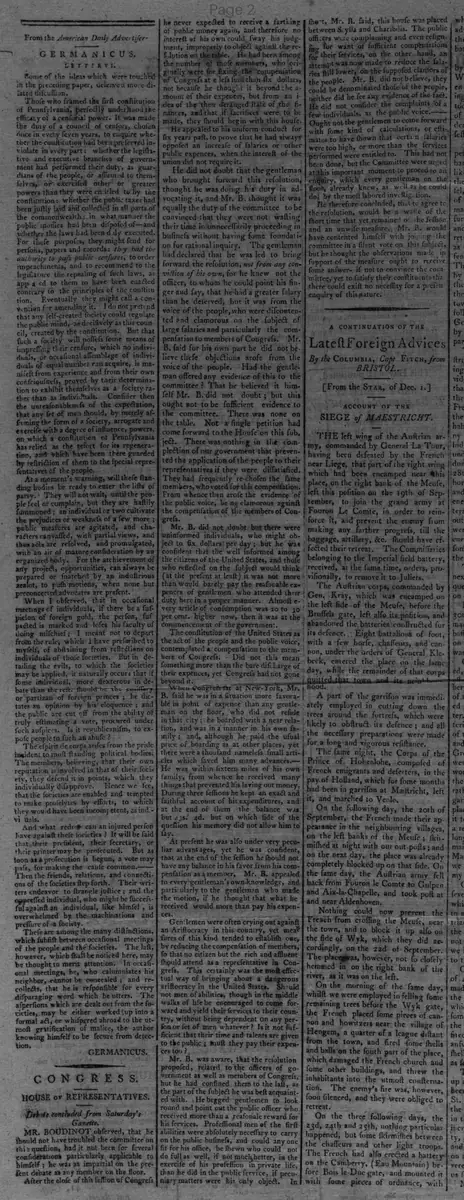
MR. BOUDINOT observed, that he should not have troubled the committee on this question, had it not been for several considerations particularly applicable to himself; he was as impartial on the present debate as any member on the floor. After the close of this session of Congress he never expected to receive a farthing of public money again, and therefore no interest of his own could sway his judgment, improperly to object against the resolution on the table. He had been among the number of those members, who originally were for fixing the compensation of Congress at less than six dollars, not because he thought it beyond the amount of their expenses, but from an idea of the then deranged state of the finances, and that if sacrifices were to be made, they should begin with this house. He appealed to his uniform conduct for six years past, to prove that he had always opposed an increase of salaries or other public expenses, when the interest of the union did not require it.
He did not doubt that the gentleman who brought forward this resolution, thought he was doing his duty in advocating it, and Mr. B. thought it was equally the duty of the committee to be convinced that they were not wasting their time in unnecessarily proceeding in business without having some foundation for rational inquiry. The gentleman had declared that he was led to bring forward the resolution, not from any conviction of his own, for he knew not the officer, to whom he could point his finger and say, that he had a greater salary than he deserved, but it was from the voice of the people, who were discontented and clamorous on the subject of large salaries and particularly the compensation to members of Congress, Mr. B. said for his own part he did not believe these objections arose from the voice of the people. Had the gentleman offered any evidence of this to the committee? That he believed it himself Mr. B. did not doubt: but this ought not to be sufficient evidence to the committee. There was none on the table. Not a single petition had come forward to the House on this subject. There was nothing in the complexion of our government that prevented the application of the people to their representatives if they were dissatisfied. They had frequently re-chosen the same members, who voted for this compensation. From whence then arose the evidence of the public voice, being clamorous against the compensation of the members of Congress.
Mr. B. did not doubt but there were uninformed individuals, who might object to six dollars per day; but he was confident that the well informed among the citizens of the United States, and those who reflected on the subject would think (at the present at least) it was not more than would barely pay the reasonable expenses of gentlemen who attended their duty here in a proper manner. Almost every article of consumption was 20 to 30 per cent. higher now, than it was at the commencement of the government.
The constitution of the United States as the act of the people and the public voice, contemplated a compensation to the members of Congress. Did not this mean something more than the bare discharge of their expenses, yet Congress had not gone beyond it.
When Congress sat at New-York, Mr. B. said he was in a situation more favorable in point of expense than any gentleman on the floor, who did not reside in that city: he boarded with a near relation, and was in a manner in his own family; and, although he paid the usual price of boarding as at other places, yet there were a thousand nameless small articles which saved him many advances. He was within sixteen miles of his own family, from whence he received many things that prevented his laying out money. During three sessions he kept an exact and faithful account of his expenditures, and at the end of them the balance was but 43s. 4d. but on which side of the question his memory did not allow him to say.
At present he was also under very peculiar advantages, yet he was confident, that at the end of the session he should not have any balance in his favor from his compensation as a member, Mr. B. appealed to every gentleman's own knowledge, and particularly to the gentleman who made the motion, if he thought that what he received would more than pay his expenses.
Gentlemen were often crying out against an Aristocracy in this country, yet measures of this kind tended to establish one, by reducing the compensation of members, so that no citizen but the rich and affluent should attend as a representative in Congress. This certainly was the most effectual way of bringing about a dangerous aristocracy in the United States. Should not men of abilities, though in the middle walks of life be encouraged to come forward and yield their services to their country, without being dependent on any person or set of men whatever? Is it not sufficient that their time and talents are given to the public; must they pay their expenses too?
Mr. B. was aware, that the resolution proposed, related to the officers of government as well as members of Congress, but he had confined himself to the latter, as the part of the subject he was best acquainted with. He begged gentlemen to look round and point out the public officer who received more than a reasonable reward for his services. Professional men of the first abilities were absolutely necessary to carry on the public business, and could any one be shown who could not do full as well, if not much better, in the exercise of his profession in private life, than he did in the public service, if pecuniary matters were his only object. In short, Mr. B. said, this house was placed between Scylla and Charybdis. The public officers were complaining and even resigning for want of sufficient compensations for their services, on the other hand, an attempt was now made to reduce the salaries still lower, on the supposed clamors of what could be denominated those of the people, the people. Mr. B. did not believe, they neither did he see any evidence of the fact. He did not consider the complaints of a few individuals, as the public voice. Ought not the gentlemen to come forward with some kind of calculations, or estimates to have shown that certain salaries were too high, or more than the services performed were entitled to. This had not been done, but the Committee were urged at this important moment to proceed to an enquiry, which every gentleman on the floor already knew, as well as he could do, by the most labored investigation. He therefore concluded, that to agree to the resolution, would be a waste of the short time that yet remained of the session and an unwise measure. Mr. B. would have contented himself with joining the committee in a silent vote on this subject but he thought the observations made in support of the measure ought to receive some answer- if not to convince the committee, yet to satisfy their constituents that there could exist no necessity for a present enquiry of this nature.
What sub-type of article is it?
What keywords are associated?
What entities or persons were involved?
Domestic News Details
Key Persons
Outcome
mr. boudinot opposed the resolution, arguing it lacks evidence of public discontent and would waste time; no resolution outcome stated.
Event Details
Mr. Boudinot addressed the House committee, defending the $6 daily compensation for Congress members as barely covering expenses amid rising costs. He dismissed claims of public clamor without petitions or evidence, shared his personal expense accounts showing minimal surplus, warned against creating an aristocracy by limiting service to the wealthy, and urged rejection of the inquiry into salaries as unnecessary.