Thank you for visiting SNEWPapers!
Sign up free
Literary
May 6, 1812
The Rhode Island Republican
Newport, Newport County, Rhode Island
What is this article about?
This essay argues that true divine love requires loving one's neighbor and practicing benevolence, blending religion and morality. It warns against solitude, selfishness, and superficial faith, emphasizing compassionate actions as the true test of Christianity.
Clipping
OCR Quality
98%
Excellent
Full Text
Miscellaneous Selections.
CHARITY.
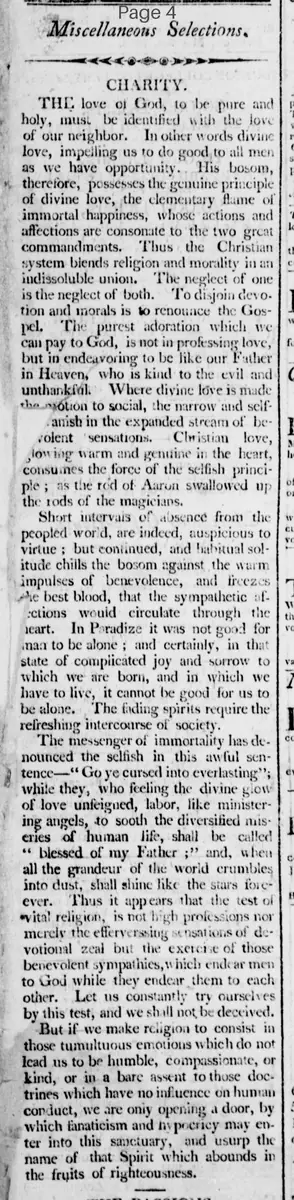
THE love of God, to be pure and holy, must be identified with the love of our neighbor. In other words divine love, impelling us to do good to all men as we have opportunity. His bosom, therefore, possesses the genuine principle of divine love, the elementary flame of immortal happiness, whose actions and affections are consonant to the two great commandments. Thus the Christian system blends religion and morality in an indissoluble union. The neglect of one is the neglect of both. To disjoin devotion and morals is to renounce the Gospel. The purest adoration which we can pay to God, is not in professing love, but in endeavoring to be like our Father in Heaven, who is kind to the evil and unthankful. Where divine love is made the motion to social, the narrow and selfish vanishes in the expanded stream of benevolent sensations. Christian love, glowing warm and genuine in the heart, consumes the force of the selfish principle; as the rod of Aaron swallowed up the rods of the magicians.
Short intervals of absence from the peopled world, are indeed, auspicious to virtue: but continued, and habitual solitude chills the bosom against the warm impulses of benevolence, and freezes the best blood, that the sympathetic affections would circulate through the heart. In Paradise it was not good for man to be alone; and certainly, in that state of complicated joy and sorrow to which we are born, and in which we have to live, it cannot be good for us to be alone. The fading spirits require the refreshing intercourse of society.
The messenger of immortality has denounced the selfish in this awful sentence—"Go ye cursed into everlasting" while they, who feeling the divine glow of love unfeigned, labor, like ministering angels, to sooth the diversified miseries of human life, shall be called "blessed of my Father;" and when all the grandeur of the world crumbles into dust, shall shine like the stars forever. Thus it appears that the test of vital religion, is not high professions nor merely the effervescing sensations of devotional zeal but the exercise of those benevolent sympathies, which endear men to God while they endear them to each other. Let us constantly try ourselves by this test, and we shall not be deceived.
But if we make religion to consist in those tumultuous emotions which do not lead us to be humble, compassionate, or kind, or in a bare assent to those doctrines which have no influence on human conduct, we are only opening a door, by which fanaticism and hypocrisy may enter into this sanctuary, and usurp the name of that Spirit which abounds in the fruits of righteousness.
CHARITY.
THE love of God, to be pure and holy, must be identified with the love of our neighbor. In other words divine love, impelling us to do good to all men as we have opportunity. His bosom, therefore, possesses the genuine principle of divine love, the elementary flame of immortal happiness, whose actions and affections are consonant to the two great commandments. Thus the Christian system blends religion and morality in an indissoluble union. The neglect of one is the neglect of both. To disjoin devotion and morals is to renounce the Gospel. The purest adoration which we can pay to God, is not in professing love, but in endeavoring to be like our Father in Heaven, who is kind to the evil and unthankful. Where divine love is made the motion to social, the narrow and selfish vanishes in the expanded stream of benevolent sensations. Christian love, glowing warm and genuine in the heart, consumes the force of the selfish principle; as the rod of Aaron swallowed up the rods of the magicians.
Short intervals of absence from the peopled world, are indeed, auspicious to virtue: but continued, and habitual solitude chills the bosom against the warm impulses of benevolence, and freezes the best blood, that the sympathetic affections would circulate through the heart. In Paradise it was not good for man to be alone; and certainly, in that state of complicated joy and sorrow to which we are born, and in which we have to live, it cannot be good for us to be alone. The fading spirits require the refreshing intercourse of society.
The messenger of immortality has denounced the selfish in this awful sentence—"Go ye cursed into everlasting" while they, who feeling the divine glow of love unfeigned, labor, like ministering angels, to sooth the diversified miseries of human life, shall be called "blessed of my Father;" and when all the grandeur of the world crumbles into dust, shall shine like the stars forever. Thus it appears that the test of vital religion, is not high professions nor merely the effervescing sensations of devotional zeal but the exercise of those benevolent sympathies, which endear men to God while they endear them to each other. Let us constantly try ourselves by this test, and we shall not be deceived.
But if we make religion to consist in those tumultuous emotions which do not lead us to be humble, compassionate, or kind, or in a bare assent to those doctrines which have no influence on human conduct, we are only opening a door, by which fanaticism and hypocrisy may enter into this sanctuary, and usurp the name of that Spirit which abounds in the fruits of righteousness.
What sub-type of article is it?
Essay
What themes does it cover?
Religious
Moral Virtue
What keywords are associated?
Christian Charity
Divine Love
Benevolence
Religion Morality
Selfish Principle
Literary Details
Title
Charity.
Subject
Christian Charity And Benevolence
Key Lines
The Love Of God, To Be Pure And Holy, Must Be Identified With The Love Of Our Neighbor.
Thus The Christian System Blends Religion And Morality In An Indissoluble Union.
Christian Love, Glowing Warm And Genuine In The Heart, Consumes The Force Of The Selfish Principle; As The Rod Of Aaron Swallowed Up The Rods Of The Magicians.
The Test Of Vital Religion, Is Not High Professions Nor Merely The Effervescing Sensations Of Devotional Zeal But The Exercise Of Those Benevolent Sympathies, Which Endear Men To God While They Endear Them To Each Other.