Thank you for visiting SNEWPapers!
Sign up free
Phenix Gazette
Alexandria, Virginia
What is this article about?
Extract from Peter Macqueen's pamphlet on England's laboring population distress, highlighting low wages, pauperism, and poaching driven by poverty. Details 96 prisoners in Bedford gaol in January 1829, mostly able-bodied men turned to crime; two Lilley brothers hanged for wounding a keeper.
Clipping
OCR Quality
Full Text
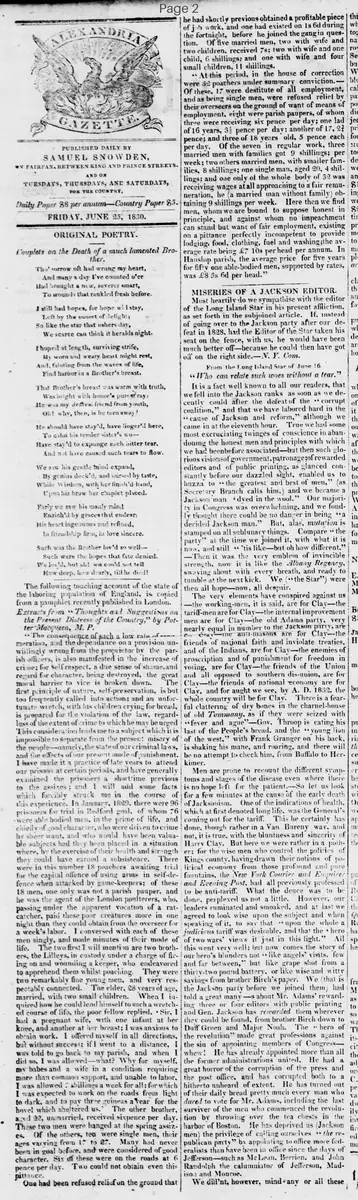
Extracts from "Thoughts and Suggestions on the Present Distress of the Country," by Peter Macqueen, M. P.
"The consequence of such a low rate of remuneration, and the dependence on a provision unwillingly wrung from the proprietor by the parish officers, is also manifested in the increase of crime; for self respect, a due sense of shame, and regard for character, being destroyed, the great moral barrier to vice is broken down.
The first principle of nature, self-preservation, is but too frequently called into action: and an unfortunate wretch, with his children crying for bread, is prepared for the violation of the law, regardless of the extent of crime to which he may be urged. This consideration leads me to a subject which it is impossible to separate from the present misery of the people—namely, the state of our criminal laws, and the effects of our present mode of punishment. I have made it a practice of late years to attend our prisons at certain periods, and have generally examined the prisoners a short time previous to the assizes; and I will add some facts which forcibly struck me in the course of this experience. In January, 1829, there were 96 prisoners for trial in Bedford gaol, of whom 76 were able-bodied men, in the prime of life, and chiefly of good character, who were driven to crime by sheer want, and who would have been valuable subjects had they been placed in a situation where, by the exercise of their health and strength they could have earned a subsistence. There were in this number 18 poachers awaiting trial for the capital offence of using arms in self-defence when attacked by game-keepers; of these 18 men, one only was not a parish pauper, and he was the agent of the London poulterers, who, passing under the apparent vocation of a rat-catcher, paid these poor creatures more in one night than they could obtain from the overseer for a week's labor. I conversed with each of these men singly, and made minutes of their mode of life. The two first I will mention are two brothers, the Lilleys, in custody under a charge of firing on and wounding a keeper, who endeavored to apprehend them whilst poaching. They were two remarkably fine young men, and very respectably connected. The elder, 28 years of age, married, with two small children. When I inquired how he could lend himself to such a wretched course of life, the poor fellow replied, 'Sir, I had a pregnant wife, with one infant at her knee, and another at her breast; I was anxious to obtain work. I offered myself in all directions, but without success: if I went to a distance, I was told to go back to my parish, and when I did so, I was allowed—what? Why for myself, my babes and a wife in a condition requiring more than common support, and unable to labor, I was allowed 7 shillings a week for all: for which I was expected to work on the roads from light to dark, and to pay three guineas a year for the hovel which sheltered us.' The other brother, aged 22, unmarried, received sixpence per day. These two men were hanged at the spring assizes. Of the others, ten were single men, their ages varying from 17 to 27. Many had never been in gaol before, and were considered of good character. Six of these were on the roads at 6 pence per day. Two could not obtain even this pittance. One had been refused relief on the ground that he had shortly previous obtained a profitable piece of job work, and one had existed on 1s 6d during the fortnight, before he joined the gang in question. Of five married men, two with wife and two children, received 7s: two with wife and one child, 6 shillings; and one with wife and four small children, 11 shillings.
"At this period, in the house of correction were 32 poachers under summary conviction.—Of these, 17 were destitute of all employment, and as being single men, were refused relief by their overseers on the ground of want of means of employment. eight were parish paupers, of whom three were receiving six pence per day; one lad of 16 years, 8 pence per day; another of 17, 2 pence; and three of 18 years old, 5 pence each per day. Of the seven in regular work, three married men with families got 9 shillings per week; two others married men, with smaller families, 8 shillings; one single man, aged 20, 4 shillings: and one only of the whole body of 32 was receiving wages at all approaching to a fair remuneration, he (a married man without family) obtaining 9 shillings per week. Here then we find men, whom we are bound to suppose honest in principle, and against whom no impeachment can stand but want of fair employment, existing on a pittance perfectly incompetent to provide lodging, food, clothing, fuel and washing; the average rate being £7 10s per head per annum. In Hanslop parish, the average price for five years for fifty one able-bodied men, supported by rates, was £8 5s 6d per head."
What sub-type of article is it?
What keywords are associated?
What entities or persons were involved?
Where did it happen?
Foreign News Details
Primary Location
England
Event Date
January 1829
Key Persons
Outcome
two lilley brothers hanged at spring assizes; 96 prisoners in bedford gaol, 76 able-bodied men driven to crime by want; 32 poachers in house of correction; average pauper support £7 10s per head per annum in hanslop parish.
Event Details
Pamphlet by Peter Macqueen describes low wages and pauper relief leading to increased crime and poaching among England's laboring population. In January 1829, Bedford gaol held 96 prisoners for trial, including 18 poachers charged with capital offence; author interviewed them, noting their desperation from inadequate relief (e.g., 7s/week for family). Two brothers, the Lilleys, detailed their circumstances before being hanged. Additionally, 32 poachers under summary conviction in house of correction, mostly destitute or on minimal wages.