Thank you for visiting SNEWPapers!
Sign up free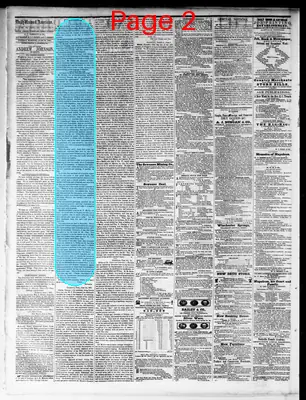
Letter to Editor
June 12, 1855
Nashville Union And American
Nashville, Davidson County, Tennessee
What is this article about?
In a June 6, 1855, letter from Louisville, KY, 'Reporter' criticizes the Know-Nothing party as secretive, nativist hypocrites opposing Democratic candidates in Kentucky's gubernatorial election. He praises Democrats' vigorous campaigning and predicts their victory, referencing historical Whig shifts and anti-immigrant prejudices.
Clipping

OCR Quality
95%
Excellent
Full Text
OUR CORRESPONDENCE.
Louisville, Ky., June 6, 1855.
Messrs. Editors: Once more the political horizon darkens; the contending clouds of opposition gather still faster and more thick; animosity grows more bitter, and the contest is becoming more deadly and exciting as the day of election approaches.
In my last I told you, the "know nothings were a braggadocia set," and a pack of liars, and so they are; or did they not tell us Sam's strength was known in Virginia, and that he was just able to crush Wise by a majority of thirty thousand votes. But alas! poor Yorick. He was routed in the Old Dominion horse, foot and dragoons.
This victory has lent fresh hope, new energy, and new life to the democracy of Kentucky. Our State is being canvassed from north to south, from east to west. Mr. Clarke, the democratic candidate for Governor, has been stumping it ever since his nomination, and says he intends to keep the field until the victory is won or lost, saying to the know nothings, in the language of Macbeth,
Lay on lay on Mac Duff
And damn'd be he, that first cries hold, enough."
Mr. Wooley, the anti-know-nothing candidate for Attorney General, has just published a list, embracing fifty appointments. While our standard bearers are thus canvassing and nobly battling for democratic principles, the know nothings are, to all appearances, inactive and perfectly unconcerned.
Sam cannot succeed in old Kentucky. Our men are not willing to join a political church, where the majority rules and forces into acquiescence the minority. They are not willing to join a secret political faction, planned, directed and managed in a fac simile manner to those that overthrew the Roman and other Republics; they are not willing to hide, stoop, dodge, sneak, lie for, and attend midnight conclaves; they are not willing to elevate to high social position the negro, that time has proven can neither be made honest, virtuous, or capable of self government, and at the same time proscribe a man for his birth; they are not willing to move among, or be identified with, a set of political renegades and bigots, on whose banner is discernible only Proscription: they are not willing to disregard the advice of the father of his country to follow in the wake and work for the political tricksters of the present day; they are not willing to set aside the glorious and patriotic example of Jefferson; they are not willing that a prohibitory liquor law should be passed; finally, they are not willing to coerce or affiliate with, the abolitionists of the North, and at the same time acknowledge the possession of a heart so hard to true love and patriotism, as to wish a man proscribed for birth or conscience sake.
When the whig party, three short years ago, declared and expressed their love for the "rich Irish brogue and sweet German accent," all of their organs threw up their hats, and loudly halloed for Scott, liberty and freedom.
But where, alas where is that proud party now? Observing its slow but steady march to the grave they saw the necessity of changing their garb—coming out in new clothes and new form—springing new questions, and carrying, if possible, the day.
To do this, they sacrificed old principles, departed from the course of their proud leader -that man who now lies entombed amid the shades of Ashland—seized upon a natural prejudice existing—clothed itself in the garb of secrecy, and came forth as they say, unconquered and to conquer.
And just here I may speak of a fact unknown to you. When in '44 the whig electors met in Nashville to cast their votes, the question was mooted and discussed how the whig party, (now that they had been routed, notwithstanding their almost superhuman efforts to the contrary,) was to go on and still live.
One distinguished gentleman proposed the native American question—said they could seize upon the prejudice existing, and make it a stepping stone once more to power.
But then and there arose one M. P. Gentry, who said "He would rather see the party sink than spring such a question—that he would rather sink himself than ride into office upon such a hobby." Let the Hon. gentleman deny this, and I will prove it upon him.
Old party issues are dead in Kentucky. Every thing now is know nothing and anti-know nothing The know nothings have nominated as their candidate for Lieutenant Governor, a man that boasts he never in his life voted for Mr. Clay. They have nominated in the 5th district one A. K. Marshall, who boasted three years ago that he, in his "heart of hearts, hated Henry Clay."
The Anties, on the other hand, have nominated in the 4th district A. G. Talbot, an old line whig. They have made repeated calls upon T. L. Branford to become a candidate in the third—and have time and again demanded that Wm. Preston become their candidate in this (the 7th) district.
The Anties are thoroughly organized, and as I have said before, there is scarcely the probability of a doubt but that we will achieve a glorious victory at the approaching election. Such hypocrites as the two Marshalls cannot succeed when it is remembered they both declared vehemently against native Americanism no longer than four years since.
They cannot succeed as long as the Journal continues their organ. This is the abolition sheet that three years ago said, "Native Americanism is at war with the Constitution and political and religious liberty in this country."
But space forbids my going farther, and now I am as ever
Yours,
REPORTER.
Louisville, Ky., June 6, 1855.
Messrs. Editors: Once more the political horizon darkens; the contending clouds of opposition gather still faster and more thick; animosity grows more bitter, and the contest is becoming more deadly and exciting as the day of election approaches.
In my last I told you, the "know nothings were a braggadocia set," and a pack of liars, and so they are; or did they not tell us Sam's strength was known in Virginia, and that he was just able to crush Wise by a majority of thirty thousand votes. But alas! poor Yorick. He was routed in the Old Dominion horse, foot and dragoons.
This victory has lent fresh hope, new energy, and new life to the democracy of Kentucky. Our State is being canvassed from north to south, from east to west. Mr. Clarke, the democratic candidate for Governor, has been stumping it ever since his nomination, and says he intends to keep the field until the victory is won or lost, saying to the know nothings, in the language of Macbeth,
Lay on lay on Mac Duff
And damn'd be he, that first cries hold, enough."
Mr. Wooley, the anti-know-nothing candidate for Attorney General, has just published a list, embracing fifty appointments. While our standard bearers are thus canvassing and nobly battling for democratic principles, the know nothings are, to all appearances, inactive and perfectly unconcerned.
Sam cannot succeed in old Kentucky. Our men are not willing to join a political church, where the majority rules and forces into acquiescence the minority. They are not willing to join a secret political faction, planned, directed and managed in a fac simile manner to those that overthrew the Roman and other Republics; they are not willing to hide, stoop, dodge, sneak, lie for, and attend midnight conclaves; they are not willing to elevate to high social position the negro, that time has proven can neither be made honest, virtuous, or capable of self government, and at the same time proscribe a man for his birth; they are not willing to move among, or be identified with, a set of political renegades and bigots, on whose banner is discernible only Proscription: they are not willing to disregard the advice of the father of his country to follow in the wake and work for the political tricksters of the present day; they are not willing to set aside the glorious and patriotic example of Jefferson; they are not willing that a prohibitory liquor law should be passed; finally, they are not willing to coerce or affiliate with, the abolitionists of the North, and at the same time acknowledge the possession of a heart so hard to true love and patriotism, as to wish a man proscribed for birth or conscience sake.
When the whig party, three short years ago, declared and expressed their love for the "rich Irish brogue and sweet German accent," all of their organs threw up their hats, and loudly halloed for Scott, liberty and freedom.
But where, alas where is that proud party now? Observing its slow but steady march to the grave they saw the necessity of changing their garb—coming out in new clothes and new form—springing new questions, and carrying, if possible, the day.
To do this, they sacrificed old principles, departed from the course of their proud leader -that man who now lies entombed amid the shades of Ashland—seized upon a natural prejudice existing—clothed itself in the garb of secrecy, and came forth as they say, unconquered and to conquer.
And just here I may speak of a fact unknown to you. When in '44 the whig electors met in Nashville to cast their votes, the question was mooted and discussed how the whig party, (now that they had been routed, notwithstanding their almost superhuman efforts to the contrary,) was to go on and still live.
One distinguished gentleman proposed the native American question—said they could seize upon the prejudice existing, and make it a stepping stone once more to power.
But then and there arose one M. P. Gentry, who said "He would rather see the party sink than spring such a question—that he would rather sink himself than ride into office upon such a hobby." Let the Hon. gentleman deny this, and I will prove it upon him.
Old party issues are dead in Kentucky. Every thing now is know nothing and anti-know nothing The know nothings have nominated as their candidate for Lieutenant Governor, a man that boasts he never in his life voted for Mr. Clay. They have nominated in the 5th district one A. K. Marshall, who boasted three years ago that he, in his "heart of hearts, hated Henry Clay."
The Anties, on the other hand, have nominated in the 4th district A. G. Talbot, an old line whig. They have made repeated calls upon T. L. Branford to become a candidate in the third—and have time and again demanded that Wm. Preston become their candidate in this (the 7th) district.
The Anties are thoroughly organized, and as I have said before, there is scarcely the probability of a doubt but that we will achieve a glorious victory at the approaching election. Such hypocrites as the two Marshalls cannot succeed when it is remembered they both declared vehemently against native Americanism no longer than four years since.
They cannot succeed as long as the Journal continues their organ. This is the abolition sheet that three years ago said, "Native Americanism is at war with the Constitution and political and religious liberty in this country."
But space forbids my going farther, and now I am as ever
Yours,
REPORTER.
What sub-type of article is it?
Persuasive
Political
Provocative
What themes does it cover?
Politics
Social Issues
What keywords are associated?
Know Nothing Party
Kentucky Election
Nativism
Democratic Candidates
Henry Clay
Whig Party
Native Americanism
Political Secrecy
What entities or persons were involved?
Reporter
Messrs. Editors
Letter to Editor Details
Author
Reporter
Recipient
Messrs. Editors
Main Argument
the know-nothing party, characterized by secrecy, nativism, and hypocrisy, will fail in kentucky's election against energetic democratic candidates like clarke and wooley, who uphold principles of liberty and oppose proscription based on birth or conscience.
Notable Details
References Shakespeare's Macbeth And Hamlet
Cites Washington And Jefferson As Patriotic Examples
Recalls 1844 Whig Electors' Meeting In Nashville And M. P. Gentry's Opposition To Nativism
Criticizes Elevation Of 'The Negro' While Proscribing Immigrants