Thank you for visiting SNEWPapers!
Sign up free
Constitutional Whig
Richmond, Virginia
What is this article about?
In the U.S. House of Representatives, a memorial from the Bank of Pennsylvania seeking re-charter of the Bank of the United States was referred to the Committee of Ways and Means on Mr. Wickliffe's motion with instructions for a new banking company post-expiration, including U.S. stock reservations, restrictions on real estate, state consents for branches, state taxation powers, and lawsuit provisions. Editorial commentary suggests this as a compromise to appease opponents like Virginia without resolving constitutional issues.
Clipping
OCR Quality
Full Text
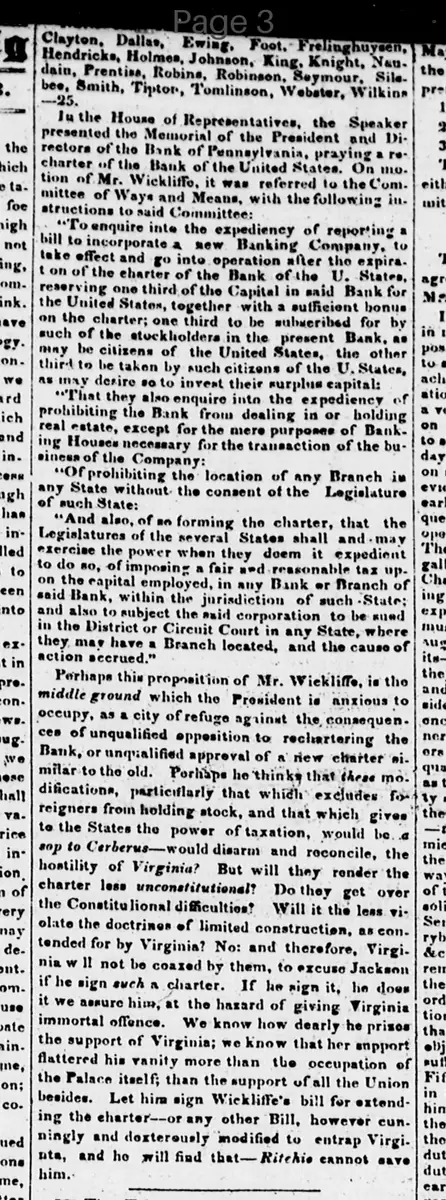
"To enquire into the expediency of reporting a bill to incorporate a new Banking Company, to take effect and go into operation after the expiration of the charter of the Bank of the U. States, reserving one third of the Capital in said Bank for the United States, together with a sufficient bonus on the charter; one third to be subscribed for by such of the stockholders in the present Bank, as may be citizens of the United States, the other third to be taken by such citizens of the U. States, as may desire so to invest their surplus capital:
"That they also enquire into the expediency of prohibiting the Bank from dealing in or holding real estate, except for the mere purposes of Banking Houses necessary for the transaction of the business of the Company:
"Of prohibiting the location of any Branch in any State without the consent of the Legislature of such State:
"And also, of so forming the charter, that the Legislatures of the several States shall and may exercise the power when they deem it expedient to do so, of imposing a fair and reasonable tax upon the capital employed, in any Bank or Branch of said Bank, within the jurisdiction of such State:
and also to subject the said corporation to be sued in the District or Circuit Court in any State, where they may have a Branch located, and the cause of action accrued."
Perhaps this proposition of Mr. Wickliffe, is the middle ground which the President is anxious to occupy, as a city of refuge against the consequences of unqualified opposition to rechartering the Bank, or unqualified approval of a new charter similar to the old. Perhaps he thinks that these modifications, particularly that which excludes foreigners from holding stock, and that which gives to the States the power of taxation, would be a sop to Cerberus—would disarm and reconcile, the hostility of Virginia? But will they render the charter less unconstitutional? Do they get over the Constitutional difficulties? Will it the less violate the doctrines of limited construction, as contended for by Virginia? No: and therefore, Virginia will not be coaxed by them, to excuse Jackson if he sign such a charter. If he sign it, he does it we assure him, at the hazard of giving Virginia immortal offence. We know how dearly he prizes the support of Virginia; we know that her support flattered his vanity more than the occupation of the Palace itself; than the support of all the Union besides. Let him sign Wickliffe's bill for extending the charter—or any other Bill, however cunningly and dexterously modified to entrap Virginia, and he will find that Ritchie cannot save him.
What sub-type of article is it?
What keywords are associated?
What entities or persons were involved?
Domestic News Details
Key Persons
Event Details
The Speaker presented the Memorial of the President and Directors of the Bank of Pennsylvania praying a re-charter of the Bank of the United States. On motion of Mr. Wickliffe, it was referred to the Committee of Ways and Means with instructions to inquire into the expediency of reporting a bill to incorporate a new Banking Company after the expiration of the current charter, reserving one third of the capital for the United States with a bonus, one third for U.S. citizen stockholders of the present bank, and the other third for other U.S. citizens; prohibiting dealing in or holding real estate except for banking houses; prohibiting branches without state legislative consent; allowing states to impose reasonable taxes on capital within their jurisdiction; and subjecting the corporation to suits in state courts where branches are located and causes accrue. Commentary suggests this as a compromise position for the President to avoid opposition or approval of the old charter, but it would not resolve constitutional issues and would offend Virginia.