Thank you for visiting SNEWPapers!
Sign up free
Story
August 2, 1910
The Madison Daily Leader
Madison, Lake County, South Dakota
What is this article about?
The U.S. Biological Survey sends experts to Colorado's Routt National Forest to combat porcupines destroying thousands of trees by eating bark during heavy snows. They also study rodent damage to reforestation efforts and test poisoned grain to control field mice and chipmunks after failed seed poisoning attempts.
Clipping
OCR Quality
98%
Excellent
Full Text
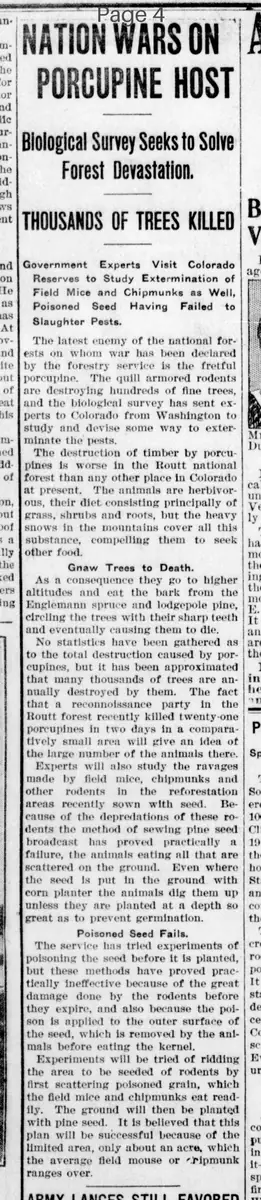
NATION WARS ON PORCUPINE HOST
Biological Survey Seeks to Solve Forest Devastation.
THOUSANDS OF TREES KILLED
Government Experts Visit Colorado Reserves to Study Extermination of Field Mice and Chipmunks as Well, Poisoned Seed Having Failed to Slaughter Pests.
The latest enemy of the national forests on whom war has been declared by the forestry service is the fretful porcupine. The quill armored rodents are destroying hundreds of fine trees, and the biological survey has sent experts to Colorado from Washington to study and devise some way to exterminate the pests.
The destruction of timber by porcupines is worse in the Routt national forest than any other place in Colorado at present. The animals are herbivorous, their diet consisting principally of grass, shrubs and roots, but the heavy snows in the mountains cover all this substance, compelling them to seek other food.
Gnaw Trees to Death.
As a consequence they go to higher altitudes and eat the bark from the Englemann spruce and lodgepole pine, circling the trees with their sharp teeth and eventually causing them to die.
No statistics have been gathered as to the total destruction caused by porcupines, but it has been approximated that many thousands of trees are annually destroyed by them. The fact that a reconnoissance party in the Routt forest recently killed twenty-one porcupines in two days in a comparatively small area will give an idea of the large number of the animals there.
Experts will also study the ravages made by field mice, chipmunks and other rodents in the reforestation areas recently sown with seed. Because of the depredations of these rodents the method of sowing pine seed broadcast has proved practically a failure, the animals eating all that are scattered on the ground. Even where the seed is put in the ground with corn planter the animals dig them up unless they are planted at a depth so great as to prevent germination.
Poisoned Seed Fails
The service has tried experiments of poisoning the seed before it is planted, but these methods have proved practically ineffective because of the great damage done by the rodents before they expire, and also because the poison is applied to the outer surface of the seed, which is removed by the animals before eating the kernel.
Experiments will be tried of ridding the area to be seeded of rodents by first scattering poisoned grain, which the field mice and chipmunks eat readily. The ground will then be planted with pine seed. It is believed that this plan will be successful because of the limited area, only about an acre, which the average field mouse or chipmunk ranges over.
Biological Survey Seeks to Solve Forest Devastation.
THOUSANDS OF TREES KILLED
Government Experts Visit Colorado Reserves to Study Extermination of Field Mice and Chipmunks as Well, Poisoned Seed Having Failed to Slaughter Pests.
The latest enemy of the national forests on whom war has been declared by the forestry service is the fretful porcupine. The quill armored rodents are destroying hundreds of fine trees, and the biological survey has sent experts to Colorado from Washington to study and devise some way to exterminate the pests.
The destruction of timber by porcupines is worse in the Routt national forest than any other place in Colorado at present. The animals are herbivorous, their diet consisting principally of grass, shrubs and roots, but the heavy snows in the mountains cover all this substance, compelling them to seek other food.
Gnaw Trees to Death.
As a consequence they go to higher altitudes and eat the bark from the Englemann spruce and lodgepole pine, circling the trees with their sharp teeth and eventually causing them to die.
No statistics have been gathered as to the total destruction caused by porcupines, but it has been approximated that many thousands of trees are annually destroyed by them. The fact that a reconnoissance party in the Routt forest recently killed twenty-one porcupines in two days in a comparatively small area will give an idea of the large number of the animals there.
Experts will also study the ravages made by field mice, chipmunks and other rodents in the reforestation areas recently sown with seed. Because of the depredations of these rodents the method of sowing pine seed broadcast has proved practically a failure, the animals eating all that are scattered on the ground. Even where the seed is put in the ground with corn planter the animals dig them up unless they are planted at a depth so great as to prevent germination.
Poisoned Seed Fails
The service has tried experiments of poisoning the seed before it is planted, but these methods have proved practically ineffective because of the great damage done by the rodents before they expire, and also because the poison is applied to the outer surface of the seed, which is removed by the animals before eating the kernel.
Experiments will be tried of ridding the area to be seeded of rodents by first scattering poisoned grain, which the field mice and chipmunks eat readily. The ground will then be planted with pine seed. It is believed that this plan will be successful because of the limited area, only about an acre, which the average field mouse or chipmunk ranges over.
What sub-type of article is it?
Curiosity
Disaster
What themes does it cover?
Nature
Catastrophe
What keywords are associated?
Porcupine Destruction
Forest Pests
Rodent Control
National Forests
Reforestation Failure
Biological Survey
Where did it happen?
Routt National Forest, Colorado
Story Details
Location
Routt National Forest, Colorado
Story Details
Porcupines destroy trees in Colorado's Routt National Forest by gnawing bark during snow cover; government experts study extermination methods. Rodents like field mice and chipmunks ruin reforestation by eating seeds; poisoned grain experiments planned after failed seed poisoning.