Thank you for visiting SNEWPapers!
Sign up free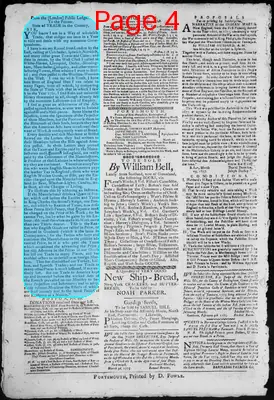
The New Hampshire Gazette And Historical Chronicle
Portsmouth, Greenland, Rockingham County, New Hampshire
What is this article about?
A merchant's letter from the London Public Ledger describes a tour of English towns revealing widespread economic distress due to British acts against America, which have reduced trade, caused unemployment, and raised goods prices through taxes borne by consumers abroad.
Clipping
OCR Quality
Full Text
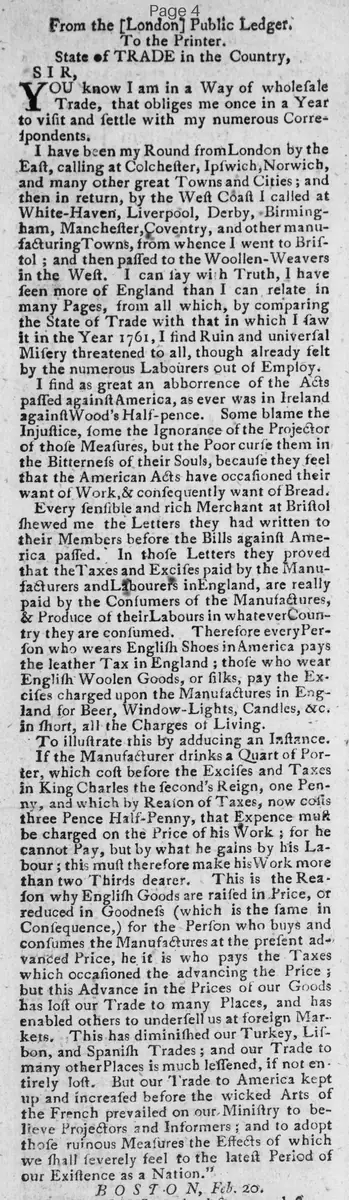
To the Printer.
State of TRADE in the Country,
SIR,
YOU know I am in a Way of wholesale
Trade, that obliges me once in a Year
to visit and settle with my numerous Corre-
spondents.
I have been my Round from London by the
East, calling at Colchester, Ipswich, Norwich,
and many other great Towns and Cities; and
then in return, by the West Coast I called at
White-Haven, Liverpool, Derby, Birming-
ham, Manchester, Coventry, and other manu-
facturing Towns, from whence I went to Bris-
tol; and then passed to the Woollen-Weavers
in the West. I can say with Truth, I have
Seen more of England than I can relate in
many Pages, from all which, by comparing
the State of Trade with that in which I saw
it in the Year 1761, I find Ruin and universal
Misery threatened to all, though already felt
by the numerous Labourers Out of Employ.
I find as great an abhorrence of the Acts
passed against America, as ever was in Ireland
against Wood's Half-pence. Some blame the
Injustice, some the Ignorance of the Projector
of those Measures, but the Poor curse them in
the Bitterness of their Souls, because they feel
that the American Acts have occasioned their
want of Work, & consequently want of Bread.
Every sensible and rich Merchant at Bristol
shewed me the Letters they had written to
their Members before the Bills against Ame-
rica passed. In those Letters they proved
that the Taxes and Excises paid by the Manu-
facturers and Labourers in England, are really
paid by the Consumers of the Manufactures,
& Produce of their Labours in whatever Coun-
try they are consumed. Therefore every Per-
son who wears English Shoes in America pays
the leather Tax in England: those who wear
English Woolen Goods, or silks, pay the Ex-
cises charged upon the Manufactures in Eng-
land for Beer, Window-Lights, Candles, &c.
in short, all the Charges of Living.
To illustrate this by adducing an Instance.
If the Manufacturer drinks a Quart of Por-
ter, which cost before the Excises and Taxes
in King Charles the Second's Reign, one Pen-
ny, and which by Reason of Taxes, now costs
three Pence Half-Penny, that Expence must
be charged on the Price of his Work: for he
cannot Pay, but by what he gains by his La-
bour; this must therefore make his Work more
than two Thirds dearer. This is the Rea-
son why English Goods are raised in Price, Or
reduced in Goodness (which is the same in
Consequence,) for the Person who buys and
consumes the Manufactures at the present ad-
vanced Price, he it is who pays the Taxes
which occasioned the advancing the Price;
but this Advance in the Prices of our Goods
has lost our Trade to many Places, and has
enabled others to undersell us at foreign Mar-
kets. This has diminished our Turkey, Lis-
bon, and Spanish Trades; and our Trade to
many other Places is much lessened, if not en-
tirely lost. But Our Trade to America kept
up and increased before the wicked Arts of
the French prevailed on our Ministry to be-
lieve Projectors and Informers; and to adopt
those ruinous Measures the Effects of which
we shall severely feel to the latest Period of
our Existence as a Nation.
What sub-type of article is it?
What keywords are associated?
Where did it happen?
Foreign News Details
Primary Location
England
Outcome
ruin and universal misery threatened; numerous laborers out of employ; diminished trade to turkey, lisbon, spain, and other places; trade to america kept up before the acts but now affected by ruinous measures.
Event Details
A wholesale merchant tours English towns including Colchester, Ipswich, Norwich, White-Haven, Liverpool, Derby, Birmingham, Manchester, Coventry, Bristol, and woollen-weavers in the West, observing compared to 1761 a state of trade threatening ruin and misery, with abhorrence of acts passed against America causing want of work and bread among the poor; merchants at Bristol wrote letters proving taxes and excises on manufacturers are paid by consumers abroad including in America; illustration of how taxes raise prices of goods, leading to loss of trade to foreign markets; trade to America increased before French influence led ministry to adopt ruinous measures.