Thank you for visiting SNEWPapers!
Sign up free
The New Era
Portsmouth, Virginia
What is this article about?
Summary of Mr. Calhoun's Senate report on improving Mississippi River navigation, arguing federal power under commerce clause to remove obstructions in multi-state rivers, limits on harbors and canals, support for railroads via public lands, and repeal of iron duty.
Clipping
OCR Quality
Full Text
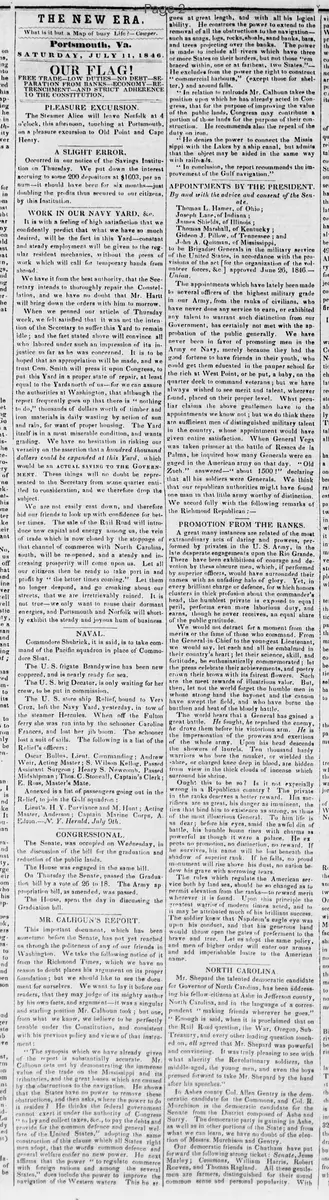
This important document, which has been sometime before the Senate, has not yet reached us through the politeness of any of our friends in Washington. We take the following notice of it from the Richmond Times, which we have no reason to doubt places his argument on its proper foundation; but we should like to see the document for ourselves. We want to lay it before our readers, that they may judge of its mighty author by his own facts, and argument—it was a singular and startling position Mr. Calhoun took; but one, from what we know, we believe to be perfectly tenable under the Constitution, and consistent with his previous policy and views of that instrument:
"The synopsis which we have already given of the report is substantially accurate. Mr. Calhoun sets out by demonstrating the immense value of the trade on the Mississippi and its tributaries, and the great losses which are caused by the obstructions to the navigation. He shows that the States have no power to remove these obstructions, and then asks, where the power to do it resides? He thinks the federal government cannot exert it under the authority of Congress "to lay and collect taxes, &c., to pay the debts and provide for the common defence and general welfare of the United States," adopting the same construction of this clause which all States rights men adopt, that the words common defence and general welfare confer no new power. He next affirms that the power "to regulate commerce with foreign nations and among the several States," does include the power to improve the navigation of the Western waters. This he argues at great length, and with all his logical ability. He construes the power to extend to the removal of all the obstructions to the navigation—such as snags, logs, rocks, shoals, sand banks, bars, and trees projecting over the banks. The power is made to include all rivers which have three or more States on their borders, but not those "embraced within, one or at farthest, two States."
He excludes from the power the right to construct "commercial harbours," (except those for shelter) and around falls.
In relation to railroads Mr. Calhoun takes the position upon which he has already acted in Congress, that for the purpose of improving the value of the public lands, Congress may contribute portion of those lands for the purpose of their construction. He recommends also the repeal of the duty on iron.
He denies the power to connect the Mississippi with the Lakes by a ship canal, but admits that the object may be aided in the same way with railroads,
"In conclusion, the report recommends the improvement of the Gulf navigation."
What sub-type of article is it?
What themes does it cover?
What keywords are associated?
What entities or persons were involved?
Where did it happen?
Story Details
Key Persons
Location
Mississippi River And Tributaries, Washington
Story Details
Mr. Calhoun's Senate report argues that federal government has power under commerce clause to remove navigation obstructions in multi-state rivers like the Mississippi, but not for single or two-state rivers, harbors, or ship canals; supports aiding railroads with public lands and repealing iron duty; recommends improving Gulf navigation.