Thank you for visiting SNEWPapers!
Sign up free
Literary
May 20, 1932
The Coolidge Examiner
Coolidge, Pinal County, Arizona
What is this article about?
In this excerpt from Henry Kitchell Webster's novel 'The Beginners,' Edith Patterson navigates family tensions amid financial hardship from her father's new business venture. She shares a budding romance with Roger Morgan, rejects her brother's offer to fund her schooling, and interacts with her family, highlighting themes of independence and sibling support.
Merged-components note: Serialized novel 'The Beginners'; image is likely an illustration, merged with literary text; label changed from 'image' for the merged component.
Clipping
OCR Quality
72%
Good
Full Text
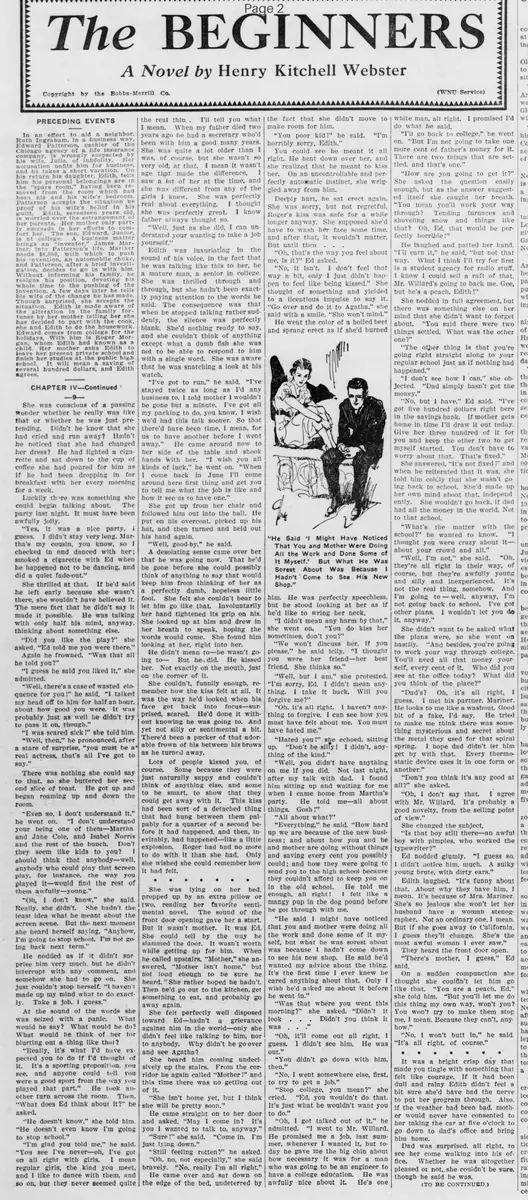
The BEGINNERS
A Novel by Henry Kitchell Webster
Copyright by the Bobbs-Merrill Co.
(WNU Service)
PRECEDING EVENTS
In an effort to aid a neighbor. Ruth Ingraham, in a business way. Edward Patterson, cashier of the Chicago agency of a life insurance company. is wrongly suspected by his wife. Julia. of infidelity. Her accusation unfits him for business and he takes a short vacation. On his return his daughter. Edith. tells him his personal belongings are in the "spare room." having been re- moved from the room which had been his and his wife's bedroom. Patterson accepts the situation as proof of his wife's belief in his guilt. Edith, seventeen years old, is worried over the estrangement of her parents. Her mother only part- ly succeeds in her efforts to com- fort her. The son. Edward. Junior. is at college. A business matter brings an "inventor." James Mar- iner. Into Patterson's life. Mariner needs $6,000. with which to push his invention, an automobile choke, and Patterson. after a brief investi- gation, decides to go in with him. Without informing his family. he resigns his position, devoting his whole time to the pushing of the invention. A few days later he tells his wife of the change he has made. Though surprised, she accepts the situation. Edith is made aware of the alteration in the family for- tunes by her mother telling her she has decided to part with the cook. she and Edith to do the housework. Edward comes from college for the holidays. With him is Roger Mor- gan. whom Edith had known as a child. Her mother asks Edith to leave her present private school and finish her studies at the public high school. It will mean a saving of several hundred dollars, and Edith agrees.
CHAPTER IV-Continued
She was conscious of a passing wonder whether he really was like that or whether he was just pre- tending. Didn't he know that she had cried and run away? Hadn't he noticed that she had changed her dress? He had lighted a ciga- rette and sat down to the cup of coffee she had poured for him as if he had been dropping in for breakfast with her every morning for a week.
Luckily there was something she could begin talking about. The party last night. It must have been awfully jolly.
"Yes, it was a nice party, guess. I didn't stay very long. Mar- tha's my cousin, you know, so I checked in and danced with her: smoked a cigarette with Ed when he happened not to be dancing, and did a quiet fade-out."
She thrilled at that. If he'd said he left early because she wasn't there, she wouldn't have believed it. The mere fact that he didn't say it made it possible. He was talking with only half his mind, anyway. thinking about something else.
"Did you like the play?" she asked. "Ed told me you were there."
Again he frowned, "Was that all he told you?"
"I guess he said you liked it," she admitted.
"Well, there's a case of wasted elo- quence for you!" he said. "I talked my head off to him for half an hour. about how good you were. It was probably just as well he didn't try to pass it on, though."
"I was scared sick!" she told him,
"Well, then." he pronounced, after a stare of surprise, "you must be a real actress, that's all I've got to say."
There was nothing she could say to that. so she buttered her sec- ond slice of toast. He got up and began roaming up and down the room.
"Even so. I don't understand it.' he went on. "I don't understand your being one of them—Martha and Jane Cole, and Isabel Norris and the rest of the bunch. Don't they seem like kids to you? I should think that anybody—well. anybody who could play that screen play. for instance. the way you played it—would find the rest of them awfully—young."
"Oh, I don't know," she said.
Really, she didn't. She hadn't the least idea what he meant about the screen scene. But the next moment she heard herself saying. "Anyhow. I'm going to stop school. I'm not go- ing back next term."
He nodded as if it didn't sur- prise him very much. but he didn't interrupt with any comment, and somehow she had to go on. She just couldn't stop herself. "I haven't made up my mind what to do exact- ly. Take a job, I guess."
At the sound of the words she was seized with a panic. What would he say? What would be do? What would he think of her for blurting out a thing like that?
"Really, it's what I'd have ex- pected you to do if I'd thought of it. It's a sporting proposition, you see, and anyone could tell you were a good sport from the way you played that part."
He took another turn across the room. Then.
"What does Ed think about it?" he asked.
"He doesn't know." she told him. He doesn't even know I'm going to stop school."
"I'm glad you told me." he said "You see I've never—oh, I've got on all right with girls. I mean regular girls, the kind you meet, and I like to dance with them, and so on, but they never seemed quite the real thing. I'll tell you what I mean. When my father died two years ago he had a secretary who'd been with him a good many years. She was quite a lot older than I was, of course. but she wasn't so very old, at that. I mean it wasn't age that made the difference. I saw a lot of her at the time. and she was different from any of the girls I knew. She was perfectly real about everything. I thought she was perfectly great. I know father always thought so.
"Well, just as she did. I can un- derstand your wanting to take a job yourself."
Edith was luxuriating in the sound of his voice. in the fact that he was talking like this to her, he a mature man, a senior in college. She was thrilled through and through, but she hadn't been exact- ly paying attention to the words he said. The consequence was that when he stopped talking rather sud- denly, the silence was perfectly blank. She'd nothing ready to say. and she couldn't think of anything except what a dumb fish she was not to be able to respond to him with a single word. She was aware that he was snatching a look at his watch.
"I've got to run," he said. "I've stayed twice as long as I'd any business to. I told mother I wouldn't be gone but a minute. I've got all my packing to do, you know. I wish we'd had this talk sooner. So that there'd have been time, I mean, for us to have another before I went away." He came around now to her side of the table and shook hands with her. "I wish you all kinds of luck," he went on. "When I come back in June I'll come around here first thing and get you to tell me what the job is like and how it seems to have one."
She got up from her chair and followed him out into the hall. He put on his overcoat, picked up his hat. and then turned and held out his hand again.
"Well, good-by," he said.
A desolating sense came over her that he was going now. That he'd be gone before she could possibly think of anything to say that would keep him from thinking of her as a perfectly dumb, hopeless little fool. She felt she couldn't bear to let him go like that. Involuntarily her hand tightened its grip on his. She looked up at him and drew in her breath to speak, hoping the words would come. She found him looking at her. right into her.
He didn't mean to—he wasn't go- ing to— But he did. He kissed her. Not exactly on the mouth. just on the corner of it.
She couldn't, funnily enough, re- member how the kiss felt at all. It was the way he'd looked when his face got back into focus—sur- prised. scared. He'd done it with- out knowing he was going to. And yet not silly or sentimental a bit. There'd been a pucker of that ador- able frown of his between his brows as he turned away.
Lots of people kissed you, of course. Some because they were just naturally sappy and couldn't think of anything else, and some to be smart, to show that they could get away with it. This kiss had been sort of a detached thing that had hung between them pal- pably for a quarter of a second be- fore it had happened. and then, in- evitably, had happened—like a little explosion. Roger had had no more to do with it than she had. Only she wished she could remember how it had felt.
She was lying on her bed. propped up by an extra pillow or two, reading her favorite senti- mental novel. The sound of the front door opening gave her a start. But it wasn't mother. It was Ed. She could tell by the way he slammed the door. It wasn't worth while getting up for him. When he called upstairs, "Mother." she an- swered. "Mother isn't home." but not loud enough to be sure he heard. She rather hoped he hadn't. Then he'd go out to the kitchen, get something to eat, and probably go away again.
She felt perfectly well disposed toward Ed—hadn't a grievance against him in the world—only she didn't feel like talking to him, nor to anybody.
Why didn't he go over and see Agatha?
She heard him coming undeci- sively up the stairs. From the cor- ridor he again called "Mother!" and this time there was no getting out of it.
"She isn't home yet, but I think she will be pretty soon."
He came straight on to her door and asked, "May I come in? It's you I wanted to talk to, anyway."
"Sure!" she said. "Come in. I'm just lying down."
"Still feeling rotten?" he asked.
"Oh, no. not especially," she said bravely. "No. really I'm all right."
He came over and sat down on the edge of the bed, undeterred by the fact that she didn't move to make room for him.
"You poor kid!" he said. "I'm horribly sorry, Edith."
You could see he meant it all right. He bent down over her, and she realized that he meant to kiss her. On an uncontrollable and per- fectly automatic instinct, she wrig- gled away from him.
Deeply hurt, he sat erect again. She was sorry, but not regretful. Roger's kiss was safe for a while longer anyway. She supposed she'd have to wash her face some time, and after that, it wouldn't matter. But until then
"Oh, that's the way you feel about me, is it?" Ed asked.
"No. it isn't. I don't feel that way a bit, only I just didn't hap- pen to feel like being kissed." She thought of something and yielded to a licentious impulse to say it. "Go over and do it to Agatha," she said with a smile. "She won't mind."
He went the color of a boiled beet and sprang erect as if she'd burned him. He was perfectly speechless, but he stood looking at her as if he'd like to wring her neck.
"I didn't mean any harm by that," she went on. "You do kiss her sometimes, don't you?"
"We won't discuss her, if you please." he said icily. "I thought you were her friend—her best friend. She thinks so."
"Well, but I am," she protested. "I'm sorry. Ed. I didn't mean any- thing. I take it back. Will you forgive me?"
"Oh. it's all right. I haven't any- thing to forgive. I can see how you must have felt about me. You must have hated me."
"Hated you!" she echoed, sitting up. "Don't be silly! I didn't, any- thing of the kind."
"Well. you didn't have anything on me if you did. Not last night, after my talk with dad. I found him sitting up and waiting for me when I came home from Martha's party. He told me all about things. Gosh!
"All about what?"
"Everything," he said. "How hard up we are because of the new busi- ness: and about how you and he and mother are doing without things and saving every cent you possibly could: and how they were going to send you to the high school because they couldn't afford to keep you on in the old school. He told me enough, all right! I felt like a mangy pup in the dog pound before he got through with me. He said I might have noticed that you and mother were doing all the work and done some of it my- self, but what he was sorest about was because I hadn't come down to see his new shop. He said he'd wanted my advice about the thing. It's the first time I ever knew he cared anything about that. Only I wish he'd asked me about it before he went in."
"Was that where you went this morning?" she asked. "Didn't it look Didn't you think it was
"Oh, it'll come out all right. I guess. I didn't see him. He was out."
"You didn't go down with him, then."
"No, I went somewhere else, first, to try to get a job."
"Stop college, you mean?" she cried. "Ed. you wouldn't do that It's just what he wouldn't want you to do."
"Oh, I got talked out of it," he admitted. "I went to Mr. Willard. He promised me a job, last sum- mer, whenever I wanted it, but to- day he gave me the big chin about how necessary it was for a man who was going to be an engineer to have a college education. He was awfully nice about it. He's one white man, all right. I promised I'd do what he said.
"I'll go back to college," he went on. "But I'm not going to take one more cent of father's money for it. There are two things that are set- tled. and that's one."
"How are you going to get it?" She asked the question easily enough, but as the answer suggest- ed itself she caught her breath.
"You mean you'll work your way through? Tending furnaces and shoveling snow and things like that? Oh, Ed, that would be per- fectly horrible!"
He laughed and patted her hand "I'll earn it." he said. "but not that way. What I think I'll try for first is a student agency for radio stuff. I know I could sell a raft of that Mr. Willard's going to back me. Gee. but he's a peach, Edith!"
She nodded in full agreement, but there was something else on her mind that she didn't want to forget about. "You said there were two things settled. What was the other one?"
"The other thing is that you're going right straight along to your regular school just as if nothing had happened."
"I don't see how I can," she ob- jected. "Dad simply hasn't got the money."
"No. but I have." Ed said. "I've got five hundred dollars right here in the savings bank, If mother gets home in time I'll draw it out today. Give her three hundred of it for you and keep the other two to get myself started. You don't have to worry about that. That's fixed."
She answered. "It's not fixed!" and when he reiterated that it was. she told him coldly that she wasn't go- ing back to school. She'd made up her own mind about that, independ- ently. She wouldn't go back. if dad had all the money in the world. Not to that school.
"What's the matter with the school?" he wanted to know. "I thought you were crazy about it— about your crowd and all."
"Well. I'm not." she said. "Oh. they're all right in their way, of course. but they're awfully young and silly and inexperienced. It's not the real thing. somehow. And I'm going to— well, anyway, I'm not going back to school. I've got other plans. I wouldn't let you do it. anyway."
She didn't want to be asked what the plans were, so she went on hastily. "And besides. you're going to work your way through college. You'll need all that money your- self, every cent of it. Who did you see at the office today? What did you think of the place?"
"Dad's? Oh. it's all right, I guess. I met his partner. Mariner. He looks to me like a washout. Good bit of a fake, I'd say. He tried to make me think there was some- thing mysterious and secret about the metal they used for that spiral spring. I hope dad didn't let him get by with that. Every thermo- static device uses it in one form or another."
"Don't you think it's any good at all?" she asked.
"Oh, I don't say that. I agree with Mr. Willard. It's probably a good novelty. from the selling point of view."
She changed the subject. "Is that boy still there—an awful boy with pimples. who worked the typewriter?"
Ed nodded glumly. "I guess so. I didn't notice him, much. A sulky young brute. with dirty ears."
Edith laughed. "It's funny about that. About why they have him. I mean. It's because of Mrs. Mariner She's so jealous she won't let her husband have a woman stenog- rapher. Not an ordinary one, I mean. But if she goes away to California. I guess they'll change. She's the most awful woman I ever saw."
They heard the front door open.
"There's mother, I guess," Ed said.
On a sudden compunction she thought she couldn't let him go like that. "You are a peach, Ed.' she told him. "But you'll let me do this thing my own way. won't you? You won't try to make them stop me. I mean. Because they can't, any- how."
"No. I won't butt in," he said "It's all right. of course."
It was a bright crisp day that made you tingle with something that felt like courage. If it had been dull and rainy Edith didn't feel a bit sure she'd have had the nerve to put her program through. Also. if the weather had been bad. moth- er would never have consented to her taking the car at five o'clock to go down to dad's office and bring him home.
Dad was surprised, all right, to see her come walking into his of- fice. Whether he was altogether pleased or not. she couldn't be sure. though he said he was.
(TO BE CONTINUED.)
A Novel by Henry Kitchell Webster
Copyright by the Bobbs-Merrill Co.
(WNU Service)
PRECEDING EVENTS
In an effort to aid a neighbor. Ruth Ingraham, in a business way. Edward Patterson, cashier of the Chicago agency of a life insurance company. is wrongly suspected by his wife. Julia. of infidelity. Her accusation unfits him for business and he takes a short vacation. On his return his daughter. Edith. tells him his personal belongings are in the "spare room." having been re- moved from the room which had been his and his wife's bedroom. Patterson accepts the situation as proof of his wife's belief in his guilt. Edith, seventeen years old, is worried over the estrangement of her parents. Her mother only part- ly succeeds in her efforts to com- fort her. The son. Edward. Junior. is at college. A business matter brings an "inventor." James Mar- iner. Into Patterson's life. Mariner needs $6,000. with which to push his invention, an automobile choke, and Patterson. after a brief investi- gation, decides to go in with him. Without informing his family. he resigns his position, devoting his whole time to the pushing of the invention. A few days later he tells his wife of the change he has made. Though surprised, she accepts the situation. Edith is made aware of the alteration in the family for- tunes by her mother telling her she has decided to part with the cook. she and Edith to do the housework. Edward comes from college for the holidays. With him is Roger Mor- gan. whom Edith had known as a child. Her mother asks Edith to leave her present private school and finish her studies at the public high school. It will mean a saving of several hundred dollars, and Edith agrees.
CHAPTER IV-Continued
She was conscious of a passing wonder whether he really was like that or whether he was just pre- tending. Didn't he know that she had cried and run away? Hadn't he noticed that she had changed her dress? He had lighted a ciga- rette and sat down to the cup of coffee she had poured for him as if he had been dropping in for breakfast with her every morning for a week.
Luckily there was something she could begin talking about. The party last night. It must have been awfully jolly.
"Yes, it was a nice party, guess. I didn't stay very long. Mar- tha's my cousin, you know, so I checked in and danced with her: smoked a cigarette with Ed when he happened not to be dancing, and did a quiet fade-out."
She thrilled at that. If he'd said he left early because she wasn't there, she wouldn't have believed it. The mere fact that he didn't say it made it possible. He was talking with only half his mind, anyway. thinking about something else.
"Did you like the play?" she asked. "Ed told me you were there."
Again he frowned, "Was that all he told you?"
"I guess he said you liked it," she admitted.
"Well, there's a case of wasted elo- quence for you!" he said. "I talked my head off to him for half an hour. about how good you were. It was probably just as well he didn't try to pass it on, though."
"I was scared sick!" she told him,
"Well, then." he pronounced, after a stare of surprise, "you must be a real actress, that's all I've got to say."
There was nothing she could say to that. so she buttered her sec- ond slice of toast. He got up and began roaming up and down the room.
"Even so. I don't understand it.' he went on. "I don't understand your being one of them—Martha and Jane Cole, and Isabel Norris and the rest of the bunch. Don't they seem like kids to you? I should think that anybody—well. anybody who could play that screen play. for instance. the way you played it—would find the rest of them awfully—young."
"Oh, I don't know," she said.
Really, she didn't. She hadn't the least idea what he meant about the screen scene. But the next moment she heard herself saying. "Anyhow. I'm going to stop school. I'm not go- ing back next term."
He nodded as if it didn't sur- prise him very much. but he didn't interrupt with any comment, and somehow she had to go on. She just couldn't stop herself. "I haven't made up my mind what to do exact- ly. Take a job, I guess."
At the sound of the words she was seized with a panic. What would he say? What would be do? What would he think of her for blurting out a thing like that?
"Really, it's what I'd have ex- pected you to do if I'd thought of it. It's a sporting proposition, you see, and anyone could tell you were a good sport from the way you played that part."
He took another turn across the room. Then.
"What does Ed think about it?" he asked.
"He doesn't know." she told him. He doesn't even know I'm going to stop school."
"I'm glad you told me." he said "You see I've never—oh, I've got on all right with girls. I mean regular girls, the kind you meet, and I like to dance with them, and so on, but they never seemed quite the real thing. I'll tell you what I mean. When my father died two years ago he had a secretary who'd been with him a good many years. She was quite a lot older than I was, of course. but she wasn't so very old, at that. I mean it wasn't age that made the difference. I saw a lot of her at the time. and she was different from any of the girls I knew. She was perfectly real about everything. I thought she was perfectly great. I know father always thought so.
"Well, just as she did. I can un- derstand your wanting to take a job yourself."
Edith was luxuriating in the sound of his voice. in the fact that he was talking like this to her, he a mature man, a senior in college. She was thrilled through and through, but she hadn't been exact- ly paying attention to the words he said. The consequence was that when he stopped talking rather sud- denly, the silence was perfectly blank. She'd nothing ready to say. and she couldn't think of anything except what a dumb fish she was not to be able to respond to him with a single word. She was aware that he was snatching a look at his watch.
"I've got to run," he said. "I've stayed twice as long as I'd any business to. I told mother I wouldn't be gone but a minute. I've got all my packing to do, you know. I wish we'd had this talk sooner. So that there'd have been time, I mean, for us to have another before I went away." He came around now to her side of the table and shook hands with her. "I wish you all kinds of luck," he went on. "When I come back in June I'll come around here first thing and get you to tell me what the job is like and how it seems to have one."
She got up from her chair and followed him out into the hall. He put on his overcoat, picked up his hat. and then turned and held out his hand again.
"Well, good-by," he said.
A desolating sense came over her that he was going now. That he'd be gone before she could possibly think of anything to say that would keep him from thinking of her as a perfectly dumb, hopeless little fool. She felt she couldn't bear to let him go like that. Involuntarily her hand tightened its grip on his. She looked up at him and drew in her breath to speak, hoping the words would come. She found him looking at her. right into her.
He didn't mean to—he wasn't go- ing to— But he did. He kissed her. Not exactly on the mouth. just on the corner of it.
She couldn't, funnily enough, re- member how the kiss felt at all. It was the way he'd looked when his face got back into focus—sur- prised. scared. He'd done it with- out knowing he was going to. And yet not silly or sentimental a bit. There'd been a pucker of that ador- able frown of his between his brows as he turned away.
Lots of people kissed you, of course. Some because they were just naturally sappy and couldn't think of anything else, and some to be smart, to show that they could get away with it. This kiss had been sort of a detached thing that had hung between them pal- pably for a quarter of a second be- fore it had happened. and then, in- evitably, had happened—like a little explosion. Roger had had no more to do with it than she had. Only she wished she could remember how it had felt.
She was lying on her bed. propped up by an extra pillow or two, reading her favorite senti- mental novel. The sound of the front door opening gave her a start. But it wasn't mother. It was Ed. She could tell by the way he slammed the door. It wasn't worth while getting up for him. When he called upstairs, "Mother." she an- swered. "Mother isn't home." but not loud enough to be sure he heard. She rather hoped he hadn't. Then he'd go out to the kitchen, get something to eat, and probably go away again.
She felt perfectly well disposed toward Ed—hadn't a grievance against him in the world—only she didn't feel like talking to him, nor to anybody.
Why didn't he go over and see Agatha?
She heard him coming undeci- sively up the stairs. From the cor- ridor he again called "Mother!" and this time there was no getting out of it.
"She isn't home yet, but I think she will be pretty soon."
He came straight on to her door and asked, "May I come in? It's you I wanted to talk to, anyway."
"Sure!" she said. "Come in. I'm just lying down."
"Still feeling rotten?" he asked.
"Oh, no. not especially," she said bravely. "No. really I'm all right."
He came over and sat down on the edge of the bed, undeterred by the fact that she didn't move to make room for him.
"You poor kid!" he said. "I'm horribly sorry, Edith."
You could see he meant it all right. He bent down over her, and she realized that he meant to kiss her. On an uncontrollable and per- fectly automatic instinct, she wrig- gled away from him.
Deeply hurt, he sat erect again. She was sorry, but not regretful. Roger's kiss was safe for a while longer anyway. She supposed she'd have to wash her face some time, and after that, it wouldn't matter. But until then
"Oh, that's the way you feel about me, is it?" Ed asked.
"No. it isn't. I don't feel that way a bit, only I just didn't hap- pen to feel like being kissed." She thought of something and yielded to a licentious impulse to say it. "Go over and do it to Agatha," she said with a smile. "She won't mind."
He went the color of a boiled beet and sprang erect as if she'd burned him. He was perfectly speechless, but he stood looking at her as if he'd like to wring her neck.
"I didn't mean any harm by that," she went on. "You do kiss her sometimes, don't you?"
"We won't discuss her, if you please." he said icily. "I thought you were her friend—her best friend. She thinks so."
"Well, but I am," she protested. "I'm sorry. Ed. I didn't mean any- thing. I take it back. Will you forgive me?"
"Oh. it's all right. I haven't any- thing to forgive. I can see how you must have felt about me. You must have hated me."
"Hated you!" she echoed, sitting up. "Don't be silly! I didn't, any- thing of the kind."
"Well. you didn't have anything on me if you did. Not last night, after my talk with dad. I found him sitting up and waiting for me when I came home from Martha's party. He told me all about things. Gosh!
"All about what?"
"Everything," he said. "How hard up we are because of the new busi- ness: and about how you and he and mother are doing without things and saving every cent you possibly could: and how they were going to send you to the high school because they couldn't afford to keep you on in the old school. He told me enough, all right! I felt like a mangy pup in the dog pound before he got through with me. He said I might have noticed that you and mother were doing all the work and done some of it my- self, but what he was sorest about was because I hadn't come down to see his new shop. He said he'd wanted my advice about the thing. It's the first time I ever knew he cared anything about that. Only I wish he'd asked me about it before he went in."
"Was that where you went this morning?" she asked. "Didn't it look Didn't you think it was
"Oh, it'll come out all right. I guess. I didn't see him. He was out."
"You didn't go down with him, then."
"No, I went somewhere else, first, to try to get a job."
"Stop college, you mean?" she cried. "Ed. you wouldn't do that It's just what he wouldn't want you to do."
"Oh, I got talked out of it," he admitted. "I went to Mr. Willard. He promised me a job, last sum- mer, whenever I wanted it, but to- day he gave me the big chin about how necessary it was for a man who was going to be an engineer to have a college education. He was awfully nice about it. He's one white man, all right. I promised I'd do what he said.
"I'll go back to college," he went on. "But I'm not going to take one more cent of father's money for it. There are two things that are set- tled. and that's one."
"How are you going to get it?" She asked the question easily enough, but as the answer suggest- ed itself she caught her breath.
"You mean you'll work your way through? Tending furnaces and shoveling snow and things like that? Oh, Ed, that would be per- fectly horrible!"
He laughed and patted her hand "I'll earn it." he said. "but not that way. What I think I'll try for first is a student agency for radio stuff. I know I could sell a raft of that Mr. Willard's going to back me. Gee. but he's a peach, Edith!"
She nodded in full agreement, but there was something else on her mind that she didn't want to forget about. "You said there were two things settled. What was the other one?"
"The other thing is that you're going right straight along to your regular school just as if nothing had happened."
"I don't see how I can," she ob- jected. "Dad simply hasn't got the money."
"No. but I have." Ed said. "I've got five hundred dollars right here in the savings bank, If mother gets home in time I'll draw it out today. Give her three hundred of it for you and keep the other two to get myself started. You don't have to worry about that. That's fixed."
She answered. "It's not fixed!" and when he reiterated that it was. she told him coldly that she wasn't go- ing back to school. She'd made up her own mind about that, independ- ently. She wouldn't go back. if dad had all the money in the world. Not to that school.
"What's the matter with the school?" he wanted to know. "I thought you were crazy about it— about your crowd and all."
"Well. I'm not." she said. "Oh. they're all right in their way, of course. but they're awfully young and silly and inexperienced. It's not the real thing. somehow. And I'm going to— well, anyway, I'm not going back to school. I've got other plans. I wouldn't let you do it. anyway."
She didn't want to be asked what the plans were, so she went on hastily. "And besides. you're going to work your way through college. You'll need all that money your- self, every cent of it. Who did you see at the office today? What did you think of the place?"
"Dad's? Oh. it's all right, I guess. I met his partner. Mariner. He looks to me like a washout. Good bit of a fake, I'd say. He tried to make me think there was some- thing mysterious and secret about the metal they used for that spiral spring. I hope dad didn't let him get by with that. Every thermo- static device uses it in one form or another."
"Don't you think it's any good at all?" she asked.
"Oh, I don't say that. I agree with Mr. Willard. It's probably a good novelty. from the selling point of view."
She changed the subject. "Is that boy still there—an awful boy with pimples. who worked the typewriter?"
Ed nodded glumly. "I guess so. I didn't notice him, much. A sulky young brute. with dirty ears."
Edith laughed. "It's funny about that. About why they have him. I mean. It's because of Mrs. Mariner She's so jealous she won't let her husband have a woman stenog- rapher. Not an ordinary one, I mean. But if she goes away to California. I guess they'll change. She's the most awful woman I ever saw."
They heard the front door open.
"There's mother, I guess," Ed said.
On a sudden compunction she thought she couldn't let him go like that. "You are a peach, Ed.' she told him. "But you'll let me do this thing my own way. won't you? You won't try to make them stop me. I mean. Because they can't, any- how."
"No. I won't butt in," he said "It's all right. of course."
It was a bright crisp day that made you tingle with something that felt like courage. If it had been dull and rainy Edith didn't feel a bit sure she'd have had the nerve to put her program through. Also. if the weather had been bad. moth- er would never have consented to her taking the car at five o'clock to go down to dad's office and bring him home.
Dad was surprised, all right, to see her come walking into his of- fice. Whether he was altogether pleased or not. she couldn't be sure. though he said he was.
(TO BE CONTINUED.)
What sub-type of article is it?
Prose Fiction
What themes does it cover?
Love Romance
Friendship
Commerce Trade
What keywords are associated?
Family Finances
Young Romance
Sibling Support
Business Invention
School Decision
Kiss Moment
Independence
College Plans
What entities or persons were involved?
A Novel By Henry Kitchell Webster
Literary Details
Title
Chapter Iv Continued
Author
A Novel By Henry Kitchell Webster
Key Lines
"Really, It's What I'd Have Ex Pected You To Do If I'd Thought Of It. It's A Sporting Proposition, You See, And Anyone Could Tell You Were A Good Sport From The Way You Played That Part."
"He Didn't Mean To—He Wasn't Go Ing To— But He Did. He Kissed Her. Not Exactly On The Mouth. Just On The Corner Of It."
"You Poor Kid!" He Said. "I'm Horribly Sorry, Edith."
"Everything," He Said. "How Hard Up We Are Because Of The New Busi Ness: And About How You And He And Mother Are Doing Without Things And Saving Every Cent You Possibly Could:"
"The Other Thing Is That You're Going Right Straight Along To Your Regular School Just As If Nothing Had Happened."