Thank you for visiting SNEWPapers!
Sign up free
Spirit Of The Age
Woodstock, Windsor County, Vermont
What is this article about?
Doc Newton, a reckless but skilled locomotive engineer repeatedly in trouble for his spirited driving, redeems himself during a fierce snowstorm by piloting the railroad president through peril to intercept a rival express train, blocking a major deal and earning a promotion to division inspector.
Clipping
OCR Quality
Full Text
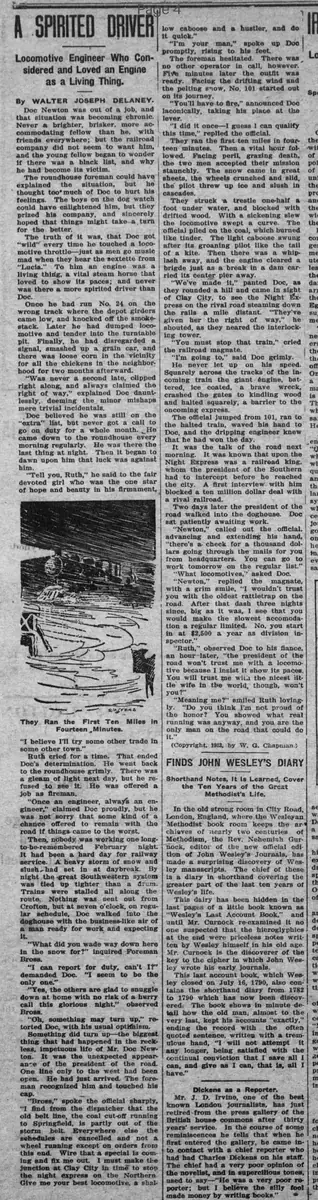
Locomotive Engineer Who Considered and Loved an Engine as a Living Thing.
By WALTER JOSEPH DELANEY.
Doc Newton was out of a job, and that situation was becoming chronic. Never a brighter, brisker, more accommodating fellow than he, with friends everywhere; but the railroad company did not seem to want him, and the young fellow began to wonder if there was a black list, and why he had become its victim.
The roundhouse foreman could have explained the situation, but he thought too much of Doc to hurt his feelings. The boys on the dog watch could have enlightened him, but they prized his company and sincerely hoped that things might take a turn for the better.
The truth of it was that Doc got "wild" every time he touched a locomotive throttle—just as men go music mad when they hear the sextette from "Lucia." To him an engine was a living thing, a vital steam horse that loved to show its paces; and never was there a more spirited driver than Doc.
Once he had run No. 24 on the wrong track where the depot girders came low, and knocked off the smoke-stack. Later he had dumped locomotive and tender into the turntable pit. Finally, he had disregarded a signal, smashed up a grain car, and there was loose corn in the vicinity for all the chickens in the neighborhood for two months afterward.
"Was never a second late, clipped right along, and always claimed the right of way," explained Doc dauntlessly, deeming the minor mishaps mere trivial incidentals.
Doc believed he was still on the "extra" list, but never got a call to go on duty for a whole month. He came down to the roundhouse every morning regularly. He was there the last thing at night. Then it began to dawn upon him that luck was against him.
"Tell you, Ruth," he said to the fair devoted girl who was the one star of hope and beauty in his firmament, "I believe I'll try some other trade in some other town."
Ruth cried for a time. That ended Doc's determination. He went back to the roundhouse grimly. There was a gleam of light next day, but he refused to see it. He was offered a job as fireman.
"Once an engineer, always an engineer," claimed Doc proudly, but he was not sorry that some kind of a chance offered to remain with the road if things came to the worst.
Then, nobody was working one long-to-be-remembered February night. It had been a hard day for railway service. A heavy storm of snow and slush had set in at daybreak. By night the great Southwestern system was tied up tighter than a drum. Trains were stalled all along the route. Nothing was sent out from Crofton, but at seven o'clock, on regular schedule, Doc walked into the doghouse with the business-like air of a man ready for work and expecting it.
"What did you wade way down here in the snow for?" inquired Foreman Bross.
"I can report for duty, can't I?" demanded Doc. "I seem to be the only one."
"Yes, the others are glad to snuggle down at home with no risk of a hurry call this glorious night," observed Bross.
"Oh, something may turn up," retorted Doc, with his usual optimism.
Something did turn up—the biggest thing that had happened in the reckless, impetuous life of Mr. Doc Newton. It was the unexpected appearance of the president of the road. One line only to the west had been open. He had just arrived. The foreman recognized him and touched his cap.
"Bross," spoke the official sharply, "I find from the dispatcher that the old belt line, the coal cut-off running to Springfield, is partly out of the storm belt. Everywhere else the schedules are cancelled and not a wheel running except on orders from this end. Wire that a special is coming and fix me out. I must make the junction at Clay City in time to stop the night express on the Northern. Give me your best locomotive, a shallow low caboose and a hustler, and do it quick."
"I'm your man," spoke up Doc promptly, rising to his feet.
The foreman hesitated. There was no other operator in call, however. Five minutes later the outfit was ready. Facing the drifting wind and the pelting snow, No. 101 started out on its journey.
"You'll have to fire," announced Doc laconically, taking his place at the lever.
"I did it once—I guess I can qualify this time," replied the official.
They ran the first ten miles in fourteen minutes. Then a vital hour followed. Facing peril, grazing death, the two men accepted their mission staunchly. The snow came in great sheets, the wheels crunched and slid, the pilot threw up ice and slush in cascades.
They struck a trestle one-half a foot under water, and blocked with drifted wood. With a sickening slew the locomotive swept a curve. The official piled on the coal, which burned like tinder. The light caboose swung after its groaning pilot like the tail of a kite. Then there was a whip-lash sway, and the engine cleared a bridge just as a break in a dam carried its center pier away.
"We've made it," panted Doc, as they rounded a hill and came in sight of Clay City, to see the Night Express on the rival road steaming down the rails a mile distant. "They've given her the right of way," he shouted, as they neared the interlocking tower.
"You must stop that train," cried the railroad magnate.
"I'm going to," said Doc grimly.
He never let up on his speed. Squarely across the tracks of the incoming train the giant engine, battered, ice coated, a brave wreck crashed the gates to kindling wood and halted squarely, a barrier to the oncoming express.
The official jumped from 101, ran to the halted train, waved his hand to Doc, and the dripping engineer knew that he had won the day.
It was the talk of the road next morning. It was known that upon the Night Express was a railroad king, whom the president of the Southern had to intercept before he reached the city. A first interview with him blocked a ten million dollar deal with a rival railroad.
Two days later the president of the road walked into the doghouse. Doc sat patiently awaiting work.
"Newton," called out the official advancing and extending his hand, "there's a check for a thousand dollars going through the mails for you from headquarters. You can go to work tomorrow on the regular list."
"What locomotives," asked Doc.
"Newton," replied the magnate with a grim smile, "I wouldn't trust you with the oldest rattletrap on the road. After that dash three nights since, big as it was, I see that you would make the slowest accommodation a regular limited. No, you start in at $2,500 a year as division inspector."
"Ruth," observed Doc to his fiancee an hour later, "the president of the road won't trust me with a locomotive because I insist it show its paces. You will trust me with the nicest little wife in the world, though, won't you?"
"Meaning me?" smiled Ruth lovingly. "Do you think I'm not proud of the honor? You showed what real running was anyway, and you are the only man on the road that could do it."
(Copyright, 1913, by W. G. Chapman.)
What sub-type of article is it?
What themes does it cover?
What keywords are associated?
What entities or persons were involved?
Where did it happen?
Story Details
Key Persons
Location
Southwestern Railroad System, From Crofton To Clay City
Event Date
A February Night
Story Details
Unemployed engineer Doc Newton, known for reckless but speedy driving, volunteers during a blizzard to drive the railroad president on a urgent mission through storm perils to Clay City, where he blocks a rival express train carrying a competitor, averting a major deal; rewarded with a bonus and promotion to division inspector.