Thank you for visiting SNEWPapers!
Sign up free
Editorial
May 11, 1836
Morning Star
Limerick, York County, Maine
What is this article about?
An editorial critiques the practice of baptizing infant slaves on the faith of their Christian masters, using a hypothetical dialogue to expose hypocrisy and biblical violations against man-stealing, urging restoration of slaves' liberty.
Clipping
OCR Quality
98%
Excellent
Full Text
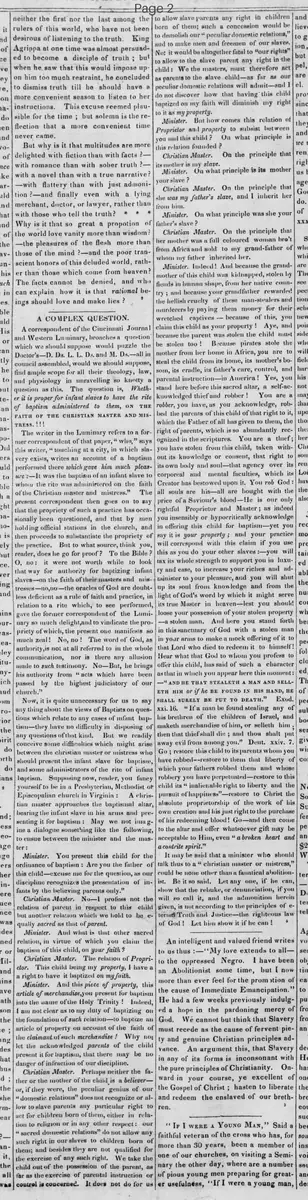
A COMPLEX QUESTION.
A correspondent of the Cincinnati Journal and Western Luminary, broaches a question which we should suppose would puzzle the Doctors—D. Ds. L. L. Ds. and M. Ds.—all in council assembled, we should suppose. They would find ample scope for all their theology, law, and physiology in unravelling so knotty a question as this. The question is, Whether it is proper for infant slaves to have the rite of baptism administered to them, on THE FAITH OF THE CHRISTIAN MASTER AND MISTRESS.!!!
The writer in the Luminary refers to a former correspondent of that paper, "who," says this writer, "touching at a city, in which slavery exists, writes an account of a baptism performed there which gave him much pleasure:—It was the baptism of an infant slave to whom the rite was administered on the faith of the Christian master and mistress." The present correspondent then goes on to say that the propriety of such a practice has occasionally been questioned, and that by men holding official stations in the church, and then proceeds to substantiate the propriety of the practice. But to what source, think you, reader, does he go for proof? To the Bible? O, no: it were not worth while to look that way for authority for baptizing infant slaves—on the faith of their masters and mistresses—no, no—the oracles of God are doubtless deficient as a rule of faith and practice, in relation to a rite which, to see performed, gave the former correspondent of the Luminary so much delight, and to vindicate the propriety of which, the present one manifests so much zeal! No. no! The word of God, as authority, is not at all referred to in the whole communication, nor is there any allusion made to such testimony. No—But, he brings his authority from "acts which have been passed by the highest judicatory of our church."
Now, it is quite unnecessary for us to say anything about the views of Baptists on questions which relate to any cases of infant baptism—they have no difficulty in disposing of any questions of that kind. But we readily conceive some difficulties which might arise between the christian master or mistress who should present the infant slave for baptism, and some administrators of the rite of infant baptism. Supposing now, reader, you fancy yourself to be in a Presbyterian, Methodist or Episcopalian church in Virginia: A christian master approaches the baptismal altar, bearing the infant slave in his arms and presenting it for baptism: May we not imagine a dialogue something like the following, to ensue between the minister and the master?
Minister. You present this child for the ordinance of baptism: Are you the father of this child—excuse me for the question, as our discipline recognizes the presentation of infants by the believing parents only."
Christian Master. No—I profess not the relation of parent in respect to this child but another relation which we hold to be equally sacred as that of parent.
Minister. And what is that other sacred relation, in virtue of which you claim the baptism of this child, on your faith?
Christian Master. The relation of Proprietor. This child being my property, I have a right to have it baptized on my faith.
Minister. And this piece of property, this article of merchandise, you present for baptism into the name of the Holy Trinity! Indeed, I am not clear as to my duty of baptizing on the foundation of such relation—to baptize an article of property on account of the faith of the claimant of such merchandise! Why not let the acknowledged parents of the child present it for baptism, that there may be no danger of infraction of our discipline.
Christian Master. Perhaps neither the father or the mother of the child is a believer—or, if they were, the peculiar genius of our "domestic relations" does not recognize or allow to slave parents any particular right to act for children born of them, either in relation to religion or in any other respect: our "sacred domestic relations" do not allow any such right in our slaves to children born of them; and besides they are not qualified for the exercise of any such right. We take the child out of the possession of the parent, as far as the exercise of parental instruction or control is concerned. It does not do to allow slave parents any right in children born of them; such a concession would be to demolish our "peculiar domestic relations," and to make men and freemen of our slaves. No: it would be altogether fatal to "our rights" to allow to the slave parent any right in the child: We the masters, must therefore act as parents to the slave child—as far as our peculiar domestic relations will admit—and I do not discover how that having this child baptized on my faith will diminish my right to it as my property.
Minister. But how comes this relation of Proprietor and property to subsist between you and this child? On what principle is this relation founded?
Christian Master. On the principle that its mother is my slave.
Minister. On what principle is its mother your slave?
Christian Master. On the principle that she was my father's slave, and I inherit her from him.
Minister. On what principle was she your father's slave?
Christian Master. On the principle that her mother was a full coloured woman bro't from Africa and sold to my grand-father of whom my father inherited her.
Minister. Indeed! And because the grand-mother of this child was kidnapped, stolen by fiends in human shape, from her native country; and because your grandfather rewarded the hellish cruelty of these man-stealers and murderers by paying them money for their wretched captives—because of this, you claim this child as your property! Aye, and because the parent was stolen the child must be stolen too! Because pirates stole the mother from her home in Africa, you are to steal the child from its home, its mother's bosom, its cradle, its father's care, control, and parental instruction—in America! Yes, you stand here before this sacred altar, a self-acknowledged thief and robber! You are a robber, you have, as you acknowledge, robbed the parents of this child of that right to it which the Father of all has given to them, the right of parents, which is so abundantly recognized in the scriptures. You are a thief; you have stolen from this child, taken without its knowledge or consent, that right to its own body and soul—that agency over its corporeal and mental faculties, which its Creator has bestowed upon it. You rob God: all souls are his—all are bought with the price of a Saviour's blood—He is our only rightful Proprietor and Master; as indeed you insensibly or hypocritically acknowledge in offering this child for baptism—yet you say it is your property; and your practice will correspond with this claim if you use this as you do your other slaves:—you will tax its whole strength to support you in luxury and ease, to increase your riches and administer to your pleasure, and you will shut up its soul from knowledge and from the light of God's word by which it might serve its true Master in heaven—lest you should lose your possession of your stolen property—a stolen man. And here you stand forth in this sanctuary of God with a stolen man in your arms to make a mock offering of it to that Lord who died to redeem it to himself! Hear what that God to whom you profess to offer this child, has said of such a character as that in which you appear here this moment: "AND HE THAT STEALETH A MAN AND SELLETH HIM Or if he BE FOUND IN HIS HAND, HE SHALL SURELY BE PUT TO DEATH." EXOD. xxi. 16. "If a man be found stealing any of his brethren of the children of Israel, and maketh merchandise of him, or selleth him: then that thief shall die; and thou shalt put away evil from among you." Deut. xxiv. 7.
Go; restore this child to its parents whom you have robbed—restore to them that liberty of which your fathers robbed them and whose robbery you have perpetuated—restore to this child its "inalienable right to liberty and the pursuit of happiness"—restore to Christ the absolute proprietorship of the work of his own creation and his just right to the purchase of his redeeming blood! Go—and then come to the altar and offer whatsoever gift may be acceptable to Him, even "a broken heart and a contrite spirit."
It may be said that a minister who should talk thus to a "christian master or mistress," could be none other than a fanatical abolitionist. Be it so said. Let any one, if he can, show that the rebuke, or denunciation, if you will so call it, and the admonition herein given, is not according to the principles of eternal Truth and Justice—the righteous law of God! Let him show it if he can!
A correspondent of the Cincinnati Journal and Western Luminary, broaches a question which we should suppose would puzzle the Doctors—D. Ds. L. L. Ds. and M. Ds.—all in council assembled, we should suppose. They would find ample scope for all their theology, law, and physiology in unravelling so knotty a question as this. The question is, Whether it is proper for infant slaves to have the rite of baptism administered to them, on THE FAITH OF THE CHRISTIAN MASTER AND MISTRESS.!!!
The writer in the Luminary refers to a former correspondent of that paper, "who," says this writer, "touching at a city, in which slavery exists, writes an account of a baptism performed there which gave him much pleasure:—It was the baptism of an infant slave to whom the rite was administered on the faith of the Christian master and mistress." The present correspondent then goes on to say that the propriety of such a practice has occasionally been questioned, and that by men holding official stations in the church, and then proceeds to substantiate the propriety of the practice. But to what source, think you, reader, does he go for proof? To the Bible? O, no: it were not worth while to look that way for authority for baptizing infant slaves—on the faith of their masters and mistresses—no, no—the oracles of God are doubtless deficient as a rule of faith and practice, in relation to a rite which, to see performed, gave the former correspondent of the Luminary so much delight, and to vindicate the propriety of which, the present one manifests so much zeal! No. no! The word of God, as authority, is not at all referred to in the whole communication, nor is there any allusion made to such testimony. No—But, he brings his authority from "acts which have been passed by the highest judicatory of our church."
Now, it is quite unnecessary for us to say anything about the views of Baptists on questions which relate to any cases of infant baptism—they have no difficulty in disposing of any questions of that kind. But we readily conceive some difficulties which might arise between the christian master or mistress who should present the infant slave for baptism, and some administrators of the rite of infant baptism. Supposing now, reader, you fancy yourself to be in a Presbyterian, Methodist or Episcopalian church in Virginia: A christian master approaches the baptismal altar, bearing the infant slave in his arms and presenting it for baptism: May we not imagine a dialogue something like the following, to ensue between the minister and the master?
Minister. You present this child for the ordinance of baptism: Are you the father of this child—excuse me for the question, as our discipline recognizes the presentation of infants by the believing parents only."
Christian Master. No—I profess not the relation of parent in respect to this child but another relation which we hold to be equally sacred as that of parent.
Minister. And what is that other sacred relation, in virtue of which you claim the baptism of this child, on your faith?
Christian Master. The relation of Proprietor. This child being my property, I have a right to have it baptized on my faith.
Minister. And this piece of property, this article of merchandise, you present for baptism into the name of the Holy Trinity! Indeed, I am not clear as to my duty of baptizing on the foundation of such relation—to baptize an article of property on account of the faith of the claimant of such merchandise! Why not let the acknowledged parents of the child present it for baptism, that there may be no danger of infraction of our discipline.
Christian Master. Perhaps neither the father or the mother of the child is a believer—or, if they were, the peculiar genius of our "domestic relations" does not recognize or allow to slave parents any particular right to act for children born of them, either in relation to religion or in any other respect: our "sacred domestic relations" do not allow any such right in our slaves to children born of them; and besides they are not qualified for the exercise of any such right. We take the child out of the possession of the parent, as far as the exercise of parental instruction or control is concerned. It does not do to allow slave parents any right in children born of them; such a concession would be to demolish our "peculiar domestic relations," and to make men and freemen of our slaves. No: it would be altogether fatal to "our rights" to allow to the slave parent any right in the child: We the masters, must therefore act as parents to the slave child—as far as our peculiar domestic relations will admit—and I do not discover how that having this child baptized on my faith will diminish my right to it as my property.
Minister. But how comes this relation of Proprietor and property to subsist between you and this child? On what principle is this relation founded?
Christian Master. On the principle that its mother is my slave.
Minister. On what principle is its mother your slave?
Christian Master. On the principle that she was my father's slave, and I inherit her from him.
Minister. On what principle was she your father's slave?
Christian Master. On the principle that her mother was a full coloured woman bro't from Africa and sold to my grand-father of whom my father inherited her.
Minister. Indeed! And because the grand-mother of this child was kidnapped, stolen by fiends in human shape, from her native country; and because your grandfather rewarded the hellish cruelty of these man-stealers and murderers by paying them money for their wretched captives—because of this, you claim this child as your property! Aye, and because the parent was stolen the child must be stolen too! Because pirates stole the mother from her home in Africa, you are to steal the child from its home, its mother's bosom, its cradle, its father's care, control, and parental instruction—in America! Yes, you stand here before this sacred altar, a self-acknowledged thief and robber! You are a robber, you have, as you acknowledge, robbed the parents of this child of that right to it which the Father of all has given to them, the right of parents, which is so abundantly recognized in the scriptures. You are a thief; you have stolen from this child, taken without its knowledge or consent, that right to its own body and soul—that agency over its corporeal and mental faculties, which its Creator has bestowed upon it. You rob God: all souls are his—all are bought with the price of a Saviour's blood—He is our only rightful Proprietor and Master; as indeed you insensibly or hypocritically acknowledge in offering this child for baptism—yet you say it is your property; and your practice will correspond with this claim if you use this as you do your other slaves:—you will tax its whole strength to support you in luxury and ease, to increase your riches and administer to your pleasure, and you will shut up its soul from knowledge and from the light of God's word by which it might serve its true Master in heaven—lest you should lose your possession of your stolen property—a stolen man. And here you stand forth in this sanctuary of God with a stolen man in your arms to make a mock offering of it to that Lord who died to redeem it to himself! Hear what that God to whom you profess to offer this child, has said of such a character as that in which you appear here this moment: "AND HE THAT STEALETH A MAN AND SELLETH HIM Or if he BE FOUND IN HIS HAND, HE SHALL SURELY BE PUT TO DEATH." EXOD. xxi. 16. "If a man be found stealing any of his brethren of the children of Israel, and maketh merchandise of him, or selleth him: then that thief shall die; and thou shalt put away evil from among you." Deut. xxiv. 7.
Go; restore this child to its parents whom you have robbed—restore to them that liberty of which your fathers robbed them and whose robbery you have perpetuated—restore to this child its "inalienable right to liberty and the pursuit of happiness"—restore to Christ the absolute proprietorship of the work of his own creation and his just right to the purchase of his redeeming blood! Go—and then come to the altar and offer whatsoever gift may be acceptable to Him, even "a broken heart and a contrite spirit."
It may be said that a minister who should talk thus to a "christian master or mistress," could be none other than a fanatical abolitionist. Be it so said. Let any one, if he can, show that the rebuke, or denunciation, if you will so call it, and the admonition herein given, is not according to the principles of eternal Truth and Justice—the righteous law of God! Let him show it if he can!
What sub-type of article is it?
Slavery Abolition
Moral Or Religious
What keywords are associated?
Infant Slave Baptism
Christian Masters
Biblical Man Stealing
Anti Slavery Critique
Church Hypocrisy
Parental Rights
What entities or persons were involved?
Christian Masters And Mistresses
Baptists
Presbyterians
Methodists
Episcopalians
Church Judicatories
Editorial Details
Primary Topic
Critique Of Baptizing Infant Slaves On Masters' Faith
Stance / Tone
Strongly Anti Slavery Moral Denunciation
Key Figures
Christian Masters And Mistresses
Baptists
Presbyterians
Methodists
Episcopalians
Church Judicatories
Key Arguments
Baptizing Slaves On Masters' Faith Lacks Biblical Authority And Relies On Church Acts
Masters' Proprietary Relation To Slaves Contradicts Parental Rights In Baptism
Slavery Originates From Kidnapping And Inheritance, Making Owners Thieves Per Exodus 21:16 And Deuteronomy 24:7
Slavery Robs Parents, Children, And God Of Rightful Ownership
Call To Restore Liberty To Slaves And Offer True Repentance