Thank you for visiting SNEWPapers!
Sign up free
The Western Democrat
Charlotte, Mecklenburg County, North Carolina
What is this article about?
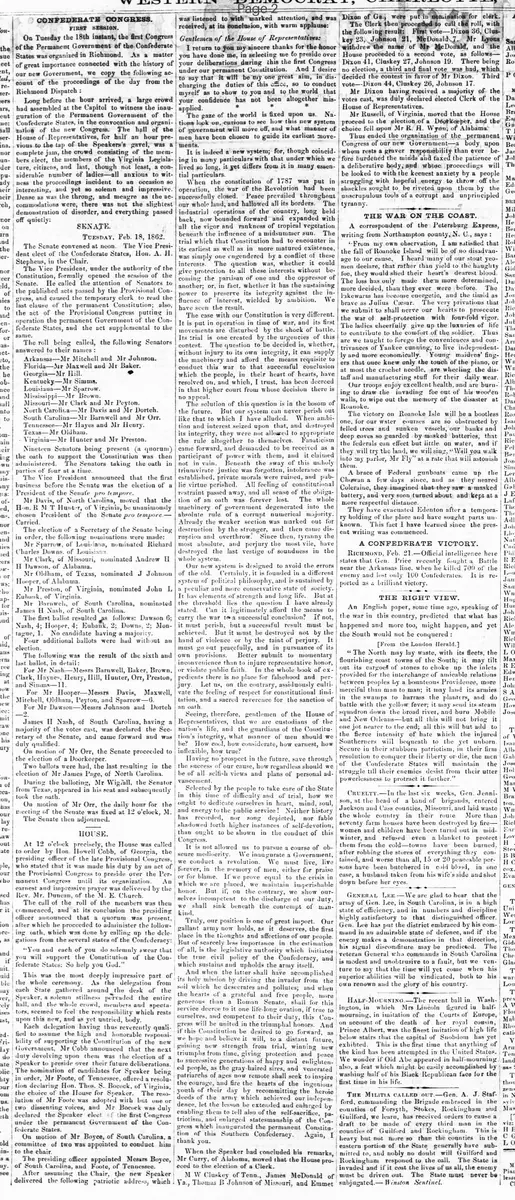
On February 18, 1862, in Richmond, the Permanent Congress of the Confederate States was organized. The Senate, presided by Vice President A. H. Stephens, elected R. M. T. Hunter as President pro tempore and James H. Nash as Secretary. The House, led temporarily by Howell Cobb, elected Thomas S. Bocock as Speaker and Emmet Dixon as Clerk, amid a patriotic address emphasizing the new government's role in the war.
Merged-components note: Merged sequential components reporting on the organization of the permanent Confederate Congress, as they form a continuous narrative.
Clipping
OCR Quality
Full Text
Long before the hour arrived, a large crowd had assembled at the Capitol to witness the inauguration of the Permanent Government of the Confederate States, in the convocation and organization of the new Congress. The hall of the House of Representatives, for half an hour previous to the tap of the Speaker's gavel, was a complete jam, the crowd consisting of the members elect, the members of the Virginia Legislature, citizens, and last, though not least, a considerable number of ladies--all anxious to witness the proceedings incident to an occasion so interesting, and yet so solemn and impressive.
Dense as was the throng, and meagre as the accommodations were, there was not the slightest demonstration of disorder, and everything passed off quietly.
SENATE.
TUESDAY, Feb. 18, 1862.
The Senate convened at noon. The Vice President elect of the Confederate States, Hon. A. H. Stephens, in the Chair.
The Vice President, under the authority of the Constitution, formally opened the session of the Senate. He called the attention of Senators to the published acts passed by the Provisional Congress, and caused the temporary clerk to read the last clause of the permanent Constitution; also, the act of the Provisional Congress putting in operation the permanent Government of the Confederate States, and the act supplemental to the same.
The roll being called, the following Senators answered to their names:
Arkansas--Mr Mitchell and Mr Johnson.
Florida--Mr Maxwell and Mr Baker.
Georgia--Mr Hill.
Kentucky--Mr Simms.
Louisiana--Mr Sparrow.
Mississippi--Mr Brown.
Missouri--Mr Clark and Mr Peyton.
North Carolina--Mr Davis and Mr Dortch
South Carolina--Mr Barnwell and Mr Orr.
Tennessee--Mr Hayes and Mr Henry.
Texas--Mr Oldham.
Virginia--Mr Hunter and Mr Preston.
Nineteen Senators being present (a quorum) the oath to support the Constitution was then administered. The Senators taking the oath in parties of four at a time.
The Vice President announced that the first business before the Senate was the election of a President of the Senate pro tempore.
Mr Davis, of North Carolina, moved that the Hon. R M T Hunter, of Virginia, be unanimously chosen President of the Senate pro tempore.--Carried.
The election of a Secretary of the Senate being in order, the following nominations were made:
Mr Sparrow, of Louisiana, nominated Richard Charles Downs, of Louisiana.
Mr Clark, of Missouri, nominated Andrew H H Dawson, of Alabama.
Mr Oldham, of Texas, nominated J Johnson Hooper, of Alabama.
Mr Preston, of Virginia, nominated John L Eubank, of Virginia.
Mr Barnwell, of South Carolina, nominated James H Nash, of South Carolina.
The first ballot resulted as follows: Dawson 6; Nash, 4: Hooper, 4; Eubank, 2; Downs, 2; Montague, 1. No candidate having a majority.
Four additional ballots were had without an election.
The following was the result of the sixth and last ballot, in detail:
For Mr Nash--Messrs Barnwell, Baker, Brown, Clark, Haynes, Henry, Hill, Hunter, Orr, Preston, and Simms--11.
For Mr Hooper--Messrs Davis, Maxwell, Mitchell, Oldham, Peyton, and Sparrow--6.
For Mr Dawson--Messrs Johnson and Dortch--2.
James H Nash, of South Carolina, having a majority of the votes cast, was declared the Secretary of the Senate, and came forward and was duly qualified.
On motion of Mr Orr, the Senate proceeded to the election of a Doorkeeper.
Two ballots were had, the last resulting in the election of Mr James Page, of North Carolina.
During the balloting, Mr Wigfall, the Senator from Texas, appeared in his seat and subsequently took the oath.
On motion of Mr Orr, the daily hour for the meeting of the Senate was fixed at 12 o'clock, M.
The Senate then adjourned.
HOUSE.
At 12 o'clock precisely, the House was called to order by Hon. Howell Cobb, of Georgia, the presiding officer of the late Provisional Congress, who stated that it was made his duty by an act of the Provisional Congress to preside over the Permanent Congress until its organization. An earnest and impressive prayer was delivered by the Rev. Mr. Duncan, of the M. E. Church.
The call of the roll of the members was then commenced, and at its conclusion the presiding officer announced that a quorum was present, after which he proceeded to administer the following oath, which was done by calling up the delegations from the several states of the Confederacy:
"You and each of you do solemnly swear that you will support the Constitution of the Confederate States: So help you God."
This was the most deeply impressive part of the whole ceremony. As the delegation from each State gathered around the desk of the Speaker, a solemn stillness pervaded the entire hall, and the whole crowd, members and spectators, seemed to feel the responsibility which rests upon this new, and as yet untried, body.
Each delegation having thus reverently qualified to assume the high and honorable responsibility of supporting the Constitution of the new Government, Mr Cobb announced that the next duty devolving upon them was the election of a Speaker to preside over their future deliberations.
The nomination of candidates for Speaker being in order, Mr Foote, of Tennessee, offered a resolution declaring Hon. Thos. S. Bocock, of Virginia, the choice of the House for Speaker. The resolution of Mr Foote was adopted with but one or two dissenting voices, and Mr Bocock was duly declared the Speaker elect of the first Congress under the permanent Government of the Confederate States.
On motion of Mr Boyce, of South Carolina, a committee of two was appointed to conduct him to the chair.
The presiding officer appointed Messrs Boyce, of South Carolina, and Foote, of Tennessee.
After assuming the Chair, the new Speaker delivered the following patriotic address, which
was listened to with marked attention, and was received, at its conclusion, with warm applause:
Gentlemen of the House of Representatives:
I return to you my sincere thanks for the honor you have done me, in selecting me to preside over your deliberations during this the first Congress under our permanent Constitution. And I desire to say that it will be my one great aim, in discharging the duties of this office, so to conduct myself as to show to you and to the world that your confidence has not been altogether misapplied.
The gaze of the world is fixed upon us. Nations look on, curious to see how this new system of government will move off, and what manner of men have been chosen to guide its earliest movements.
It is indeed a new system; for, though coinciding in many particulars with that under which we lived so long, it yet differs from it in many essential particulars.
When the constitution of 1787 was put in operation, the war of the Revolution had been successfully closed. Peace prevailed throughout our whole land, and hallowed all its borders. The industrial operations of the country, long held back, now bounded forward and expanded with all the vigor and rankness of tropical vegetation beneath the influence of a midsummer sun. The trial which that Constitution had to encounter in its earliest as well as in more matured existence, was simply one engendered by a conflict of these interests. The question was, whether it could give protection to all these interests without becoming the partisan of one and the oppressor of another; or, in fact, whether it has the sustaining power to preserve its integrity against the influence of interest, wielded by ambition. We have seen the result.
The case with our Constitution is very different. It is put in operation in time of war, and its first movements are disturbed by the shock of battle. Its trial is one created by the urgencies of this contest. The question to be decided is, whether, without injury to its own integrity, it can supply the machinery and afford the means requisite to conduct this war to that successful conclusion which the people, in their heart of hearts, have resolved on, and which, I trust, has been decreed in that higher court from whose decision there is no appeal.
The solution of this question is in the bosom of the future. But our system can never perish out like that to which I have alluded. When ambition and interest seized upon that, and destroyed its integrity, they were not allowed to appropriate the rule altogether to themselves. Fanaticism came forward, and demanded to be received as a participant of power with them, and it claimed not in vain. Beneath the sway of this unholy triumvirate justice was forgotten, intolerance was established, private morals were ruined, and public virtue perished. All feeling of constitutional restraint passed away, and all sense of the obligation of an oath was forever lost. The whole machinery of government degenerated into the absolute rule of a corrupt numerical majority.
Already the weaker section was marked out for destruction by the stronger, and then came disruption and overthrow. Since then, tyranny the most absolute, and perjury the most vile, have destroyed the last vestige of soundness in the whole system.
Our new system is designed to avoid the errors of the old. Certainly, it is founded in a different system of political philosophy, and is sustained by a peculiar and more conservative state of society. It has elements of strength and long life. But at the threshold lies the question I have already stated. Can it legitimately afford the means to carry the war to a successful conclusion? If not, it must perish, but a successful result must be achieved. But it must be destroyed not by the hand of violence or by the taint of perjury. It must go out peacefully, and in pursuance of its own provisions. Better submit to momentary inconvenience than to injure representative honor, or violate public faith. In the whole book of expedients there is no place for falsehood and perjury. Let us, on the contrary, assiduously cultivate the feeling of respect for constitutional limitation, and a sacred reverence for the sanction of an oath.
Seeing, therefore, gentlemen of the House of Representatives, that we are custodians of the nation's life, and the guardians of the Constitution's integrity, what manner of men should we be? How cool, how considerate, how earnest, how inflexible, how true?
Having no prospect in the future, save through the success of our cause, how regardless should we be of all selfish views and plans of personal advancement.
Selected by the people to take care of the State in this time of difficulty and of trial, how we ought to dedicate ourselves in heart, mind, soul, and energy to the public service! Neither history has recorded, nor song depicted, nor fable shadowed forth higher instances of self-devotion, than ought to be shown in the conduct of this Congress.
It is not allowed us to pursue a course of obscure mediocrity. We inaugurate a Government, we conduct a revolution. We must live, live forever, in the memory of men, either for praise or for blame. If we prove equal to the crisis in which we are placed, we maintain imperishable honor. But if, on the contrary, we show ourselves incompetent to the discharge of our duty, we shall sink beneath the contempt of mankind.
Truly, our position is one of great import. Our gallant army now holds, as it deserves, the first place in the thoughts and affections of our people. But of scarcely less importance in the estimation of all, is the legislative authority which initiates the true civil policy of the Confederacy, and which sustains and upholds the army itself.
And when the latter shall have accomplished its holy mission by driving the invader from the soil which he desecrates and pollutes; and when the hearts of a grateful and free people, more generous than a Roman Senate, shall for this service decree to it one life-long ovation, if true to ourselves, and competent to their duty, this Congress will be united in the triumphal honors. And if this Constitution be destined to go forward, as we hope and believe it will, to a distant future, gaining new strength from trial, winning new triumphs from time, giving protection and peace to successive generations of happy and enlightened people, as the gray-haired sires, and venerated patriarchs of ages now remote shall seek to inspire the courage, and fire the hearts of the ingenious youth of their day by recommitting the heroic deeds of the army which achieved our independence, let the lesson be extended and enlarged by enabling them to tell also of the self-sacrifice, patriotism, and enlarged statesmanship of the Congress which inaugurated the permanent Constitution of this Southern Confederacy. Again, I thank you.
When the Speaker had concluded his remarks, Mr Curry, of Alabama, moved that the House proceed to the election of a Clerk.
M W Cluskey of Tenn., James McDonald of Va., Thomas B Johnson of Missouri, and Emmet
Dixon of Ga. were put in nomination for clerk.
The Clerk then proceeded to call the roll, with the following result: First vote--Dixon 36, Cluskey 23, Johnson 21, McDonald 7. Mr Lyons withdrew the name of Mr McDonald, and the House proceeded to a second vote, as follows--Dixon 41, Cluskey 27, Johnson 19. There being no election, a third and final vote was had, which decided the contest in favor of Mr Dixon. Third vote--Dixon 44, Cluskey 26, Johnson 17.
Mr Dixon having received a majority of the votes cast, was duly declared elected Clerk of the House of Representatives.
Mr Russell, of Virginia, moved that the House proceed to the election of a Doorkeeper, and the choice fell upon Mr R. H. Wynn, of Alabama.
Thus ended the organization of the permanent Congress of our new Government--a body upon whom rests a graver responsibility than ever before burdened the minds and tasked the patience of a deliberative body, and whose proceedings will be looked to with the keenest anxiety by a people struggling with hopeful energy to throw off the shackles sought to be riveted upon them by the unscrupulous tools of a corrupt and unprincipled tyranny.
What sub-type of article is it?
What keywords are associated?
What entities or persons were involved?
Where did it happen?
Domestic News Details
Primary Location
Richmond
Event Date
Tuesday, Feb. 18, 1862
Key Persons
Outcome
the permanent congress was successfully organized with elections of officers for both senate and house; no casualties reported.
Event Details
The Senate convened under Vice President A. H. Stephens, Senators took oaths, elected R. M. T. Hunter as President pro tempore, James H. Nash as Secretary, and James Page as Doorkeeper. The House, presided by Howell Cobb, members took oaths by state delegations, elected Thos. S. Bocock as Speaker who delivered a patriotic address, Emmet Dixon as Clerk, and R. H. Wynn as Doorkeeper. Large crowd attended peacefully at the Capitol.