Thank you for visiting SNEWPapers!
Sign up free
The Sun
New York, New York County, New York
What is this article about?
Political quarrel in Havana between President Palma and Vice-President Capote amid ongoing Cuban rebellion. Rebels reject amnesty, attack towns; government faces military challenges and fears U.S. intervention per Platt Amendment. Fights reported near Santa Clara and Artemisa.
Clipping
OCR Quality
Full Text
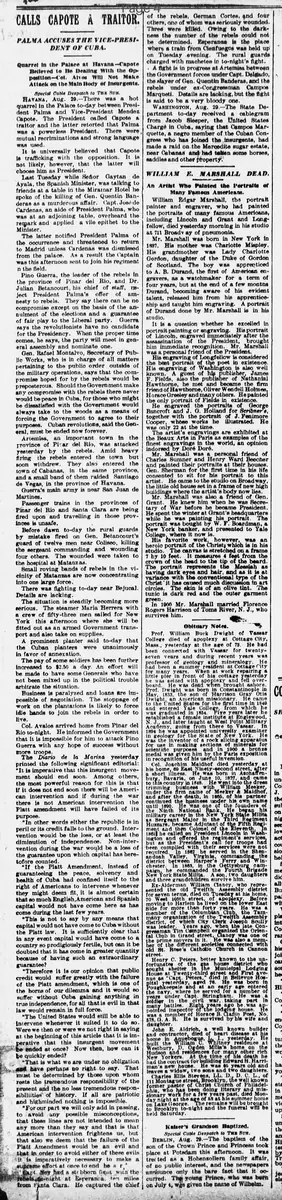
PALMA ACCUSES THE VICE-PRESIDENT OF CUBA.
Quarrel in the Palace at Havana—Capote Believed to Be Dealing With the Opposition—Col. Avalos Will Not Make Attack on the Main Body of Insurgents.
Special Cable Despatch to The Sun.
HAVANA, Aug. 29.—There was a hot quarrel in the Palace to-day between President Palma and Vice-President Mendez Capote. The President called Capote a traitor and the latter retorted that Palma was a powerless President. There were mutual recriminations and strong language was used.
It is universally believed that Capote is trafficking with the opposition. It is not likely, however, that the latter will choose him as President.
Last Tuesday while Señor Gaytan de Ayala, the Spanish Minister, was talking to friends at a table in the Miramar Hotel he spoke of the killing of Gen. Quentin Bandera as a murderous affair. Capt. José de Cardenas, an aide of President Palma, who was at an adjoining table, overheard the remark and applied a vile epithet to the Minister.
The latter notified President Palma of the occurrence and threatened to return to Madrid unless Cardenas was dismissed from the palace. As a result the Captain was this afternoon sent to join his regiment in the field.
Pino Guerra, the leader of the rebels in the province of Pinar del Rio, and Dr. Julian Betancourt, his chief of staff, reject President Palma's offer of amnesty to rebels. They say there can be no compromise except on the basis of the annulment of the elections and a guarantee of fair play to the Liberal party. Guerra says the revolutionists have no candidate for the Presidency. When the proper time comes, he says, the party will meet in general assembly and nominate one.
Gen. Rafael Montalvo, Secretary of Public Works, who is in charge of all matters pertaining to the public order outside of the military operations, says that the compromise hoped for by the rebels would be preposterous. Should the Government make any compromise with the rebels there never would be peace in Cuba, for those who might be dissatisfied with the Government would always take to the woods as a means of forcing the Government to agree to their purposes. Cuban revolutions, said the General, must be ended now forever.
Artemisa, an important town in the province of Pinar del Rio, was attacked yesterday by the rebels. Amid heavy firing the rebels entered the town but soon withdrew. They also entered the town of Cabanas, in the same province, and a small band of them raided Santiago de Vegas, in the province of Havana.
Guerra's main army is near San Juan de Martinez.
Passenger trains in the provinces of Pinar del Rio and Santa Clara are being fired upon and travelling in those provinces is unsafe.
Before dawn to-day the rural guards by mistake fired on Gen. Betancourt's guard of twelve men near Coliseo, killing the sergeant commanding and wounding four others. The wounded were taken to the hospital at Matanzas.
Small roving bands of rebels in the vicinity of Matanzas are now concentrating into one large force.
There was fighting to-day near Bejucal. Details are lacking.
The situation is steadily becoming more serious. The steamer Maria Herrera with a crew of fifty-three men sailed for New York this afternoon where she will be fitted out as an armed Government transport and also take on supplies.
A prominent planter said to-day that the Cuban planters were unanimously in favor of annexation.
The pay of some soldiers has been further increased to $2.50 a day. An effort will be made to have some Generals who have not been mixed up in the political trouble arbitrate the situation.
Business is paralyzed and loans are impossible of negotiation. The stoppage of work on the plantations is likely to force idle bands to join the rebels in order to live.
Col. Avalos arrived home from Pinar del Rio to-night. He informed the Government that it is impossible for him to attack Pino Guerra with any hope of success without more troops.
The Diario de la Marina yesterday printed the following significant editorial:
It is imperative that this insurgent movement should end soon. Among others, the most powerful reason for this is that if it does not end soon there will be American intervention and if during the war there is not American intervention the Platt amendment will have failed of its purpose.
In other words either the republic is in peril or its credit falls to the ground. Intervention would be the loss, or at least the diminution of independence. Non-intervention during the war would be a loss of the guarantee upon which capital has heretofore counted.
If the Platt Amendment, instead of guaranteeing the peace, solvency and health of Cuba had confined itself to the right of Americans to intervene whenever they might deem fit, it is almost certain that so much English, American and Spanish capital would not have come here as has come during the last few years.
This is not to say by any means that capital would not have come to Cuba without the Platt law. It is sufficiently clear that in any event capital would have come to a country so prodigiously fertile, but can it be doubted that it has come in greater quantity because of having such an extraordinary guarantee?
Therefore it is our opinion that public credit would suffer greatly with the failure of the Platt amendment, which is one of the horns of our dilemma and it would so suffer without Cuba gaining anything in true independence, for all that is evil in that law would remain in full force.
The United States would still be able to intervene whenever it suited it to do so.
Were we then or were we not right in saying at the beginning of this article that it is imperative that this insurgent movement be ended at once? Now then, how can it be quickly ended?
"That is what we are under no obligation and have perhaps no right to say. That must be determined by those upon whom rests the tremendous responsibility of the present and the no less tremendous responsibilities of history. If all are patriotic and highminded nothing is impossible.
For our part we will only add in passing to avoid any possible misconceptions, that those lines are not intended to mean any more than they say and that is that American intervention frightens us, but that also we deem that the failure of the Platt Amendment would be an evil and that in order to avoid either of these evils it is imperatively necessary to make a supreme effort at once to end it."
Capt. Noy had a stubborn fight with the rebels to-night at Esperanza, ten miles from Santa Clara. He captured the chief of the rebels, Gorman Cortes, and four others, one of whom was seriously wounded. Three were killed. Owing to the darkness the number of the rebels could not be determined. Esperanza is the place where a train from Cienfuegos was held up on Tuesday evening. The rural guards charged with machetes in to-night's fight.
A fight is in progress at Artemisa between the Government forces under Capt. Delgado, the slayer of Gen. Quentin Bandera, and the rebels under ex-Congressman Campos Marqueti. Details are lacking, but the fight is said to be a very bloody one.
WASHINGTON, Aug. 29.—The State Department to-day received a cablegram from Jacob Sleeper, the United States Charge in Cuba, saying that Campos Marquette, a negro member of the Cuban Congress who has joined the insurgents, had made a raid on the Mercedita sugar estate near Cabanas and had taken some horses, saddles and other property.
What sub-type of article is it?
What keywords are associated?
What entities or persons were involved?
Where did it happen?
Foreign News Details
Primary Location
Cuba
Event Date
Aug. 29
Key Persons
Outcome
quarrel between palma and capote; rebels reject amnesty and attack towns like artemisa, cabanas; friendly fire kills sergeant, wounds four; capt. noy captures rebel chief and kills three; ongoing bloody fight at artemisa; raid on sugar estate; fears of u.s. intervention.
Event Details
Intense political quarrel in Havana Palace between President Palma and Vice-President Capote, with accusations of treason. Rebels under Pino Guerra reject amnesty, demand election annulment; attacks on towns and trains in Pinar del Rio and Santa Clara; military engagements near Bejucal, Esperanza, Artemisa; government dismisses aide after diplomatic incident; economic paralysis; editorial warns of U.S. intervention risks under Platt Amendment.