Thank you for visiting SNEWPapers!
Sign up free
Alexandria Gazette
Alexandria, Alexandria County, District Of Columbia
What is this article about?
In the U.S. House of Representatives, Mr. Lewis of Alabama's resolution to inquire about conflicts between the 1832 Creek Indian treaty and Alabama's jurisdiction is debated. Mr. McKinley moves to table it, leading to discussion on Indian removal and state rights; it is tabled 107-88.
Clipping
OCR Quality
Full Text
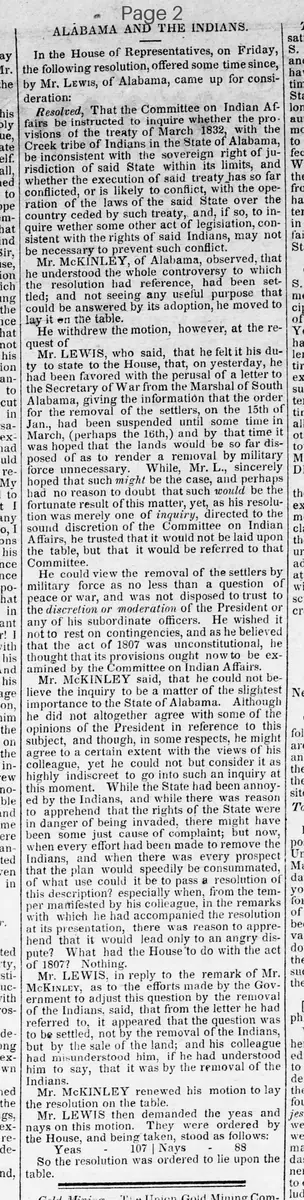
In the House of Representatives, on Friday, the following resolution, offered some time since, by Mr. Lewis, of Alabama, came up for consideration:
Resolved, That the Committee on Indian Affairs be instructed to inquire whether the provisions of the treaty of March 1832, with the Creek tribe of Indians in the State of Alabama, be inconsistent with the sovereign right of jurisdiction of said State within its limits, and whether the execution of said treaty has so far conflicted, or is likely to conflict, with the operation of the laws of the said State over the country ceded by such treaty, and, if so, to inquire whether some other act of legislation, consistent with the rights of said Indians, may not be necessary to prevent such conflict.
Mr. McKinley, of Alabama, observed that he understood the whole controversy to which the resolution had reference, had been settled; and not seeing any useful purpose that could be answered by its adoption, he moved to lay it on the table.
He withdrew the motion, however, at the request of Mr. Lewis, who said that he felt it his duty to state to the House, that, on yesterday, he had been favored with the perusal of a letter to the Secretary of War from the Marshal of South Alabama, giving the information that the order for the removal of the settlers, on the 15th of Jan., had been suspended until some time in March, (perhaps the 16th,) and by that time it was hoped that the lands would be so far disposed of as to render a removal by military force unnecessary. While, Mr. L., sincerely hoped that such might be the case, and perhaps had no reason to doubt that such would be the fortunate result of this matter, yet, as his resolution was merely one of inquiry, directed to the sound discretion of the Committee on Indian Affairs, he trusted that it would not be laid upon the table, but that it would be referred to that Committee.
He could view the removal of the settlers by military force as no less than a question of peace or war, and was not disposed to trust to the discretion or moderation of the President or any of his subordinate officers. He wished it not to rest on contingencies, and as he believed that the act of 1807 was unconstitutional, he thought that its provisions ought now to be examined by the Committee on Indian Affairs.
Mr. McKinley said that he could not believe the inquiry to be a matter of the slightest importance to the State of Alabama. Although he did not altogether agree with some of the opinions of the President in reference to this subject, and though, in some respects, he might agree to a certain extent with the views of his colleague, yet he could not but consider it as highly indiscreet to go into such an inquiry at this moment. While the State had been annoyed by the Indians, and while there was reason to apprehend that the rights of the State were in danger of being invaded, there might have been some just cause of complaint; but now, when every effort had been made to remove the Indians, and when there was every prospect that the plan would speedily be consummated, of what use could it be to pass a resolution of this description? especially when, from the temper manifested by his colleague, in the remarks with which he had accompanied the resolution at its presentation, there was reason to apprehend that it would lead only to an angry dispute? What had the House to do with the act of 1807? Nothing.
Mr. Lewis, in reply to the remark of Mr. McKinley, as to the efforts made by the Government to adjust this question by the removal of the Indians, said that from the letter he had referred to, it appeared that the question was to be settled, not by the removal of the Indians, but by the sale of the land; and his colleague had misunderstood him, if he had understood him to say that it was by the removal of the Indians.
Mr. McKinley renewed his motion to lay the resolution on the table.
Mr. Lewis then demanded the yeas and nays on this motion. They were ordered by the House, and being taken, stood as follows:
Yeas 107 Nays 88
So the resolution was ordered to lie upon the table.
What sub-type of article is it?
What themes does it cover?
What keywords are associated?
What entities or persons were involved?
Where did it happen?
Story Details
Key Persons
Location
House Of Representatives
Event Date
Friday
Story Details
Debate in the House on a resolution by Mr. Lewis inquiring if the 1832 treaty with the Creek Indians conflicts with Alabama's state jurisdiction and laws over ceded lands, amid concerns over settler removal and potential military force; opposed by Mr. McKinley, the resolution is tabled by vote.