Thank you for visiting SNEWPapers!
Sign up free
Editorial
February 11, 1960
Gadsden County Times
Quincy, Gadsden County, Florida
What is this article about?
The editorial discusses the 1960 Economic Report, praising its 'shared responsibility' philosophy that government should not solely manage prosperity, but criticizes high government spending at one-third of national income and the proposed budget increase, attributing expansions to pressure groups rather than public demand.
Clipping
OCR Quality
98%
Excellent
Full Text
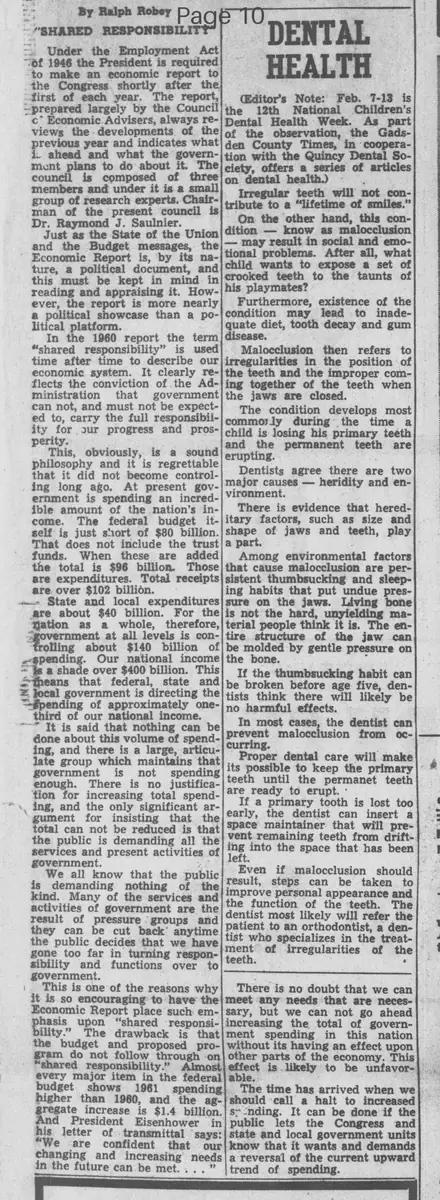
"SHARED RESPONSIBILITY"
Under the Employment Act of 1946 the President is required to make an economic report to the Congress shortly after the first of each year. The report, prepared largely by the Council of Economic Advisers, always reviews the developments of the previous year and indicates what is ahead and what the government plans to do about it. The council is composed of three members and under it is a small group of research experts. Chairman of the present council is Dr. Raymond J. Saulnier.
Just as the State of the Union and the Budget messages, the Economic Report is, by its nature, a political document, and this must be kept in mind in reading and appraising it. However, the report is more nearly a political showcase than a political platform.
In the 1960 report the term "shared responsibility" is used time after time to describe our economic system. It clearly reflects the conviction of the Administration that government can not, and must not be expected to, carry the full responsibility for our progress and prosperity.
This, obviously, is a sound philosophy and it is regrettable that it did not become controlling long ago. At present government is spending an incredible amount of the nation's income. The federal budget itself is just short of $80 billion. That does not include the trust funds. When these are added the total is $96 billion. Those are expenditures. Total receipts are over $102 billion.
State and local expenditures are about $40 billion. For the nation as a whole, therefore, government at all levels is controlling about $140 billion of spending. Our national income is a shade over $400 billion. This means that federal, state and local government is directing the spending of approximately one-third of our national income.
It is said that nothing can be done about this volume of spending, and there is a large, articulate group which maintains that government is not spending enough. There is no justification for increasing total spending, and the only significant argument for insisting that the total can not be reduced is that the public is demanding all the services and present activities of government.
We all know that the public is demanding nothing of the kind. Many of the services and activities of government are the result of pressure groups and they can be cut back anytime the public decides that we have gone too far in turning responsibility and functions over to government.
This is one of the reasons why it is so encouraging to have the Economic Report place such emphasis upon "shared responsibility." The drawback is that the budget and proposed program do not follow through on "shared responsibility." Almost every major item in the federal budget shows 1961 spending higher than 1960, and the aggregate increase is $1.4 billion.
And President Eisenhower in his letter of transmittal says: "We are confident that our changing and increasing needs in the future can be met..."
Under the Employment Act of 1946 the President is required to make an economic report to the Congress shortly after the first of each year. The report, prepared largely by the Council of Economic Advisers, always reviews the developments of the previous year and indicates what is ahead and what the government plans to do about it. The council is composed of three members and under it is a small group of research experts. Chairman of the present council is Dr. Raymond J. Saulnier.
Just as the State of the Union and the Budget messages, the Economic Report is, by its nature, a political document, and this must be kept in mind in reading and appraising it. However, the report is more nearly a political showcase than a political platform.
In the 1960 report the term "shared responsibility" is used time after time to describe our economic system. It clearly reflects the conviction of the Administration that government can not, and must not be expected to, carry the full responsibility for our progress and prosperity.
This, obviously, is a sound philosophy and it is regrettable that it did not become controlling long ago. At present government is spending an incredible amount of the nation's income. The federal budget itself is just short of $80 billion. That does not include the trust funds. When these are added the total is $96 billion. Those are expenditures. Total receipts are over $102 billion.
State and local expenditures are about $40 billion. For the nation as a whole, therefore, government at all levels is controlling about $140 billion of spending. Our national income is a shade over $400 billion. This means that federal, state and local government is directing the spending of approximately one-third of our national income.
It is said that nothing can be done about this volume of spending, and there is a large, articulate group which maintains that government is not spending enough. There is no justification for increasing total spending, and the only significant argument for insisting that the total can not be reduced is that the public is demanding all the services and present activities of government.
We all know that the public is demanding nothing of the kind. Many of the services and activities of government are the result of pressure groups and they can be cut back anytime the public decides that we have gone too far in turning responsibility and functions over to government.
This is one of the reasons why it is so encouraging to have the Economic Report place such emphasis upon "shared responsibility." The drawback is that the budget and proposed program do not follow through on "shared responsibility." Almost every major item in the federal budget shows 1961 spending higher than 1960, and the aggregate increase is $1.4 billion.
And President Eisenhower in his letter of transmittal says: "We are confident that our changing and increasing needs in the future can be met..."
What sub-type of article is it?
Economic Policy
Taxation
What keywords are associated?
Shared Responsibility
Economic Report
Government Spending
Federal Budget
National Income
What entities or persons were involved?
President Eisenhower
Council Of Economic Advisers
Dr. Raymond J. Saulnier
Congress
Editorial Details
Primary Topic
Critique Of Excessive Government Spending And Advocacy For Shared Responsibility In Economy
Stance / Tone
Supportive Of Shared Responsibility Philosophy But Critical Of Budget Increases
Key Figures
President Eisenhower
Council Of Economic Advisers
Dr. Raymond J. Saulnier
Congress
Key Arguments
The Economic Report Emphasizes 'Shared Responsibility' In The Economic System, Reflecting The Administration's View That Government Cannot Bear Full Responsibility For Progress And Prosperity.
Government Spending Is Excessively High, With Federal Budget Near $80 Billion Plus Trust Funds Totaling $96 Billion In Expenditures Against $102 Billion Receipts.
State And Local Expenditures Add $40 Billion, Making Total Government Spending About $140 Billion, Or One Third Of National Income Over $400 Billion.
There Is No Justification For Increasing Spending, And Reductions Are Possible Despite Claims Of Public Demand.
Many Government Services Result From Pressure Groups And Can Be Cut If The Public Decides To Reclaim Responsibilities.
The Budget Contradicts Shared Responsibility By Proposing $1.4 Billion Increase For 1961 Over 1960.