Thank you for visiting SNEWPapers!
Sign up free
Alexandria Advertiser And Commercial Intelligencer
Alexandria, Virginia
What is this article about?
Debate in the British House of Commons on March 11 regarding ministerial explanations on peace treaty, ongoing negotiations, and military preparations amid potential war risks. Chancellor of the Exchequer defends withholding details for diplomatic prudence; Mr. Fox argues for parliamentary right to information before voting supplies.
Merged-components note: These components are a continuation of the same parliamentary debate article across pages, with text flowing directly; relabeling the second from editorial to foreign_news as it is part of the foreign affairs report.
Clippings
1 of 2
OCR Quality
Full Text
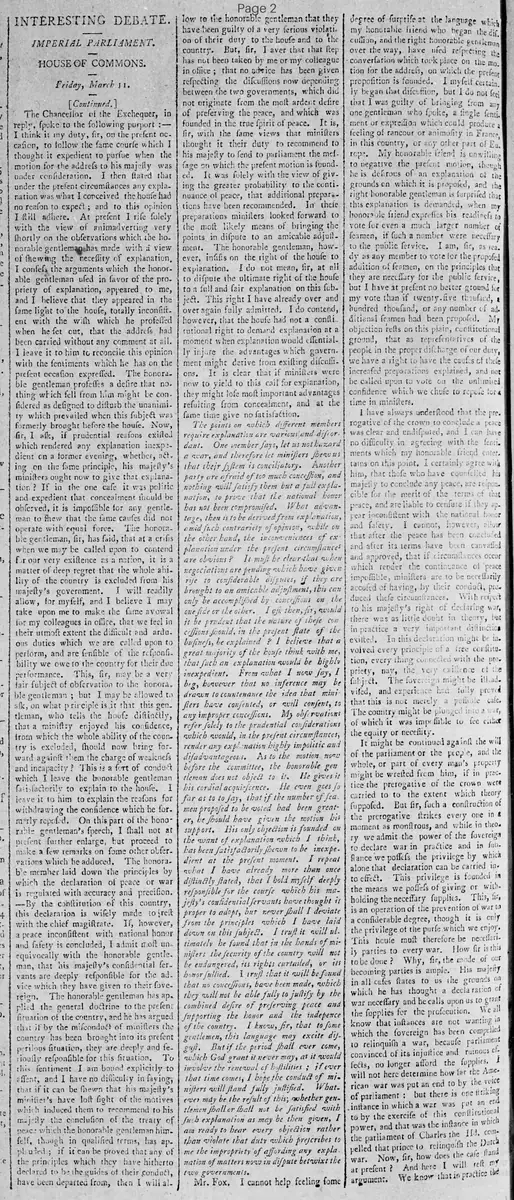
IMPERIAL PARLIAMENT.
HOUSE OF COMMONS.
Friday, March 11.
[Continued.]
The Chancellor of the Exchequer, in reply, spoke to the following purport:--
I think it my duty, sir, on the present occasion, to follow the same course which I thought it expedient to pursue when the motion for the address to his majesty was under consideration. I then stated that under the present circumstances any explanation was what I conceived the house had no reason to expect; and to this opinion I still adhere. At present I rise solely with the view of animadverting very shortly on the observations which the honorable gentleman has made with a view of showing the necessity of explanation.
I confess the arguments which the honorable gentleman used in favor of the propriety of explanation, appeared to me, and I believe that they appeared in the same light to the house, totally inconsistent with the wish which he professed when he set out, that the address had been carried without any comment at all. I leave it to him to reconcile this opinion with the sentiments which he has on the present occasion expressed. The honorable gentleman professes a desire that nothing which fell from him might be considered as designed to disturb the unanimity which prevailed when this subject was formerly brought before the house. Now, sir, I ask, if prudential reasons existed which rendered any explanation inexpedient on a former evening, whether, acting on the same principle, his majesty's ministers ought now to give that explanation? If in the one case it was politic and expedient that concealment should be observed, it is impossible for any gentleman to show that the same causes did not operate with equal force. The honorable gentleman, sir, has said, that at a crisis when we may be called upon to contend for our very existence as a nation, it is a matter of deep regret that the whole ability of the country is excluded from his majesty's government. I will readily allow, for myself, and I believe I may take upon me to make the same avowal for my colleagues in office, that we feel in their utmost extent the difficult and arduous duties which we are called upon to perform, and are sensible of the responsibility we owe to the country for their due performance. This, sir, may be a very fair subject of observation to the honorable gentleman; but I may be allowed to ask, on what principle is it that this gentleman, who tells the house distinctly, that a ministry enjoyed his confidence, from which the whole ability of the country is excluded, should now bring forward against them the charge of weakness and incapacity? This is a sort of conduct which I leave the honorable gentleman satisfactorily to explain to the house. I leave it to him to explain the reasons for withdrawing the confidence which he formerly reposed. On this part of the honorable gentleman's speech, I shall not at present further enlarge, but proceed to make a few remarks on some other observations which he adduced. The honorable member laid down the principles by which the declaration of peace or war is regulated with accuracy and precision.--By the constitution of this country, this declaration is wisely made to rest with the chief magistrate. If, however, a peace inconsistent with national honor and safety is concluded, I admit most unequivocally with the honorable gentleman, that his majesty's confidential servants are deeply responsible for the advice which they have given to their sovereign. The honorable gentleman has applied the general doctrine to the present situation of the country, and he has argued that if by the misconduct of ministers the country has been brought into its present perilous situation, they are deeply and seriously responsible for this situation. To this sentiment I am bound explicitly to assent, and I have no difficulty in saying, that if it can be shewn that his majesty's ministers have lost sight of the motives which induced them to recommend to his majesty the conclusion of the treaty of peace; which the honorable gentleman himself, though in qualified terms, has approved; if it can be proved that any of the principles which they have hitherto declared to be the guides of their conduct, have been departed from, then I will allow to the honorable gentleman that they have been guilty of a very serious violation of their duty to the house and to the country. But, sir, I aver that that step has not been taken by me or my colleagues in office; that no advice has been given respecting the discussions now depending between the two governments, which did not originate from the most ardent desire of preserving the peace, and which was founded in the true spirit of peace. It is, sir, with the same views that ministers thought it their duty to recommend to his majesty to send to parliament the message on which the present motion is founded. It was solely with the view of giving the greater probability to the continuance of peace, that additional preparations have been recommended. In these preparations ministers looked forward to the most likely means of bringing the points in dispute to an amicable adjustment. The honorable gentleman, however, insists on the right of the house to explanation. I do not mean, sir, at all to dispute the ultimate right of the house to a full and fair explanation on this subject. This right I have already over and over again fully admitted. I do contend, however, that the house had not a constitutional right to demand explanation at a moment when explanation would essentially injure the advantages which government might derive from existing discussions. It is clear that if ministers were now to yield to this call for explanation, they might lose most important advantages resulting from concealment, and at the same time give no satisfaction.
The points on which different members require explanation are various and discordant. One member says, let us not hazard a war, and therefore let ministers hear us that their system is conciliatory. Another party are afraid of too much concession, and nothing will satisfy them but a full explanation, to prove that the national honor has not been compromised. What advantage, then is to be derived from explanation, amid such contrariety of opinion, while on the other hand, the inconveniences of explanation under the present circumstances are obvious? It must be clear that when negotiations are pending which have given rise to considerable disputes, if they are brought to an amicable adjustment, this can only be accomplished by concessions on the one side or the other. I ask then, sir, would it be prudent that the nature of these concessions should, in the present state of the business, be explained? I believe that a great majority of the house think with me, that such an explanation would be highly inexpedient. From what I now say, I beg, however that no inference may be drawn to countenance the idea that ministers have consented, or will consent, to any improper concessions. My observations refer solely to the prudential considerations which would, in the present circumstances, render any explanation highly impolitic and disadvantageous. As to the motion now before the committee, the honorable gentleman does not object to it. He gives it his cordial acquiescence. He even goes so far as to say, that if the number of seamen proposed to be voted had been greater, he should have given the motion his support. His only objection is founded on the want of explanation which I think, has been satisfactorily shown to be inexpedient at the present moment. I repeat that I have already more than once distinctly stated, that I hold myself deeply responsible for the course which his majesty's confidential servants have thought it proper to adopt, but never shall I deviate from the principles which I have laid down on this subject. I trust it will ultimately be found that in the hands of ministers the security of the country will not be endangered, its rights curtailed, or its honor sullied. I trust that it will be found that no concessions, have been made, which they will not be able fully to justify by the combined desire of preserving peace and supporting the honor and the independence of the country. I know, sir, that to some gentlemen, this language may excite disgust. But if the period shall ever come, which God grant it never may, as it would involve the renewal of hostilities; if ever that time comes; I hope the conduct of ministers will stand fully justified. Whatever may be the result of this; whether gentlemen shall or shall not be satisfied with such explanation as may be then given, I am ready to bear every objection rather than violate that duty which prescribes to me the impropriety of affording any explanation of matters now in dispute betwixt the two governments.
Mr. Fox, I cannot help feeling some degree of surprise at the language which my honorable friend who began the discussion, and the right honorable gentleman over the way, have used respecting the conversation which took place on the motion for the address, on which the present proposition is founded. I myself certainly began that discussion, but I do not feel that I was guilty of bringing from any one gentleman who spoke, a single sentiment or expression which could produce a feeling of rancour or animosity in France, in this country, or any other part of Europe. My honorable friend is unwilling to negative the present motion, though he is desirous of an explanation of the grounds on which it is proposed, and the right honorable gentleman is surprised that this explanation is demanded, when my honorable friend expresses his readiness to vote for even a much larger number of seamen, if such a number were necessary to the public service. I am, sir, as ready as any member to vote for the proposed addition of seamen, on the principles that they are necessary for the public service. but I have at present no better ground for my vote than if twenty-five thousand, hundred thousand, or any number of additional seamen had been proposed. My objection rests on this plain, constitutional ground, that as representatives of the people in the proper discharge of our duty, we have a right to have the causes of these increased preparations explained, and not be called upon to vote on the unlimited confidence which we choose to repose for a time in ministers.
I have always understood that the prerogative of the crown to conclude a peace was clear and undisputed, and I can have no difficulty in agreeing with the sentiments which my honorable friend entertains on this point. I certainly agree with him, that those who have counselled his majesty to conclude any peace, are responsible for the merit of the terms of that peace, and are liable to censure if they appear inconsistent with the national honor and safety. I cannot, however, allow that after the peace has been concluded and after its terms have been canvassed and approved, that if circumstances occur which render the continuance of peace impossible, ministers are to be necessarily accused of having, by their conduct, produced these circumstances. With respect to his majesty's right of declaring war, there was as little doubt in theory, but in practice a very important distinction existed. In this declaration might be involved every principle of a free constitution, every thing connected with the propriety, nay, the very existence of the subject. The sovereign might be ill-advised, and experience had fully proved that this is not merely a possible case. The country might be plunged into a war of which it was impossible to see either the equity or necessity. It might be continued against the will of the parliament or the people, and the whole, or part of every man's property might be wrested from him, if in practice the prerogative of the crown were carried to the extent which theory supposed. But sir, such a construction of the prerogative strikes every one in a moment as monstrous, and while in theory we admit the power of the sovereign to declare war in practice and in substance we possess the privilege by which alone that declaration can be carried into effect. This privilege is founded in the means we possess of giving or withholding the necessary supplies. This, sir, is an operation of the prevention of war to a considerable degree, though it is only the privilege of the purse which we enjoy. This house must therefore be necessarily parties to every war. How far is this to be done? Why, sir, the mode of our becoming parties is ample. His majesty in all cases states to us the grounds on which he has thought a declaration of war necessary and he calls upon us to grant the supplies for the prosecution. We all know that instances are not wanting in which the sovereign has been compelled to relinquish a war, because parliament will not here determine how far the American effects, no longer afford the supplies. I instance in which a war was not an end of parliament: but there is one striking instance in which the American war was put an end to by the voice to by the exercise of this constitutional power, and that was the instance in which the parliament of Charles the IId. compelled that prince to relinquish the Dutch war. Now, sir, how does the case stand at present? And here I will rest my argument. We know that is practice the supply; and trust that, if danger really cation from the throne, or any vote of armaments precede any official communi- n rapidity correspondent to the emergency txilts, armaments are now going on with on which they are founded. to make us direct parties to any war to The certain effect of the vote is only which these armaments may be applied. any extraordinary preparation; and there. I have heard no grounds stated to justify What I object to, then, is simply, that enter my protest against the mode of pro- more, I must, on constitutional principles, case of the Russian armament is one in ceeding which has been adopted. The which many persons were desirous to pur- nue a course similar to that now proposed to be adopted; but I do not think that when the consequences of that armament are considered, that the proceedings then addpted will be very likely to encourage imitation. I hope, sir, I may be allowed to reason hypothetically respecting the in dependence of parliament in granting sup- phies for carrying on any war. I trust that we are not necessarily to be constant- ly guided by a spirit of humble docility, though our independence may appear more clearly in theory, than in any cases of mo- dern or recent experience. In whatever we chuse to exercise our constitutional right, the probability of its exercise will not be disputed. Possibly we might think that negociation was preferable at a mo- ment when ministers had plunged the coun- try in war; or, on the other hand, we might suppose, that measures of a more vigorous description would have done much more for the national honor than any negociation; and how is our opinion to be expressed, except in withholding the supplies, before we bind ourselves to be- come parties to a war? Therefore, sir, for one, contend against the house of com- mons being a mere echo, a mere docile re- ceiver of whatever communication mini- sters may think proper to make under the form of a message from the throne.
[To be continued.]
What sub-type of article is it?
What keywords are associated?
What entities or persons were involved?
Foreign News Details
Event Date
Friday, March 11.
Key Persons
Event Details
Debate in the House of Commons where the Chancellor of the Exchequer defends the government's refusal to provide detailed explanations on ongoing diplomatic discussions and peace treaty implementation, citing prudential reasons to avoid jeopardizing negotiations. He supports additional military preparations to aid amicable adjustments while maintaining national honor. Mr. Fox argues for the House's constitutional right to explanations before voting on increased seamen and supplies, emphasizing parliamentary control over war through the power of the purse, and references historical precedents like the Dutch war under Charles II.