Thank you for visiting SNEWPapers!
Sign up free
The Camden Journal
Camden, Kershaw County, South Carolina
What is this article about?
The Washington correspondent reports that General Scott received over $2,100 in extra compensation for his 1838 role in the Cherokee removal, paid by the new Whig Secretary of War despite prior rejections by Van Buren administration officials, raising questions of favoritism and calling for investigation.
Clipping
OCR Quality
Full Text
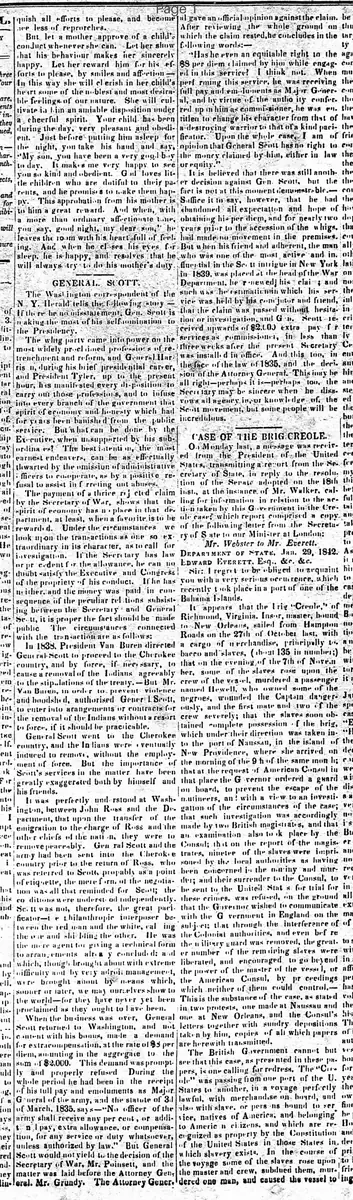
The Washington correspondent of the N. Y. Herald tells the following story. If there be no misstatement, Gen. Scott is making the most of his self-nomination to the Presidency.
The whig party came into power on the most widely proclaimed professions of retrenchment and reform, and General Harrison, during his brief presidential career, and President Tyler, up to the present hour, has manifested every disposition to carry out those professions, and to infuse into every branch of the government that spirit of economy and honesty which had for years been banished from the public service. But what can be done by the Executive, when unsupported by his subordinates? The best intentions, the most earnest endeavors, can be as effectually thwarted by the omission of administrative officers to co-operate, as by a positive refusal to assist in rooting out abuses.
The payment of a thrice-rejected claim by the Secretary of War, shows that the spirit of economy has no place in that department, at least, when a favorite is to be rewarded. Under the circumstances we look upon the transaction as so extraordinary in its character, as to call for investigation. If the Secretary has law or precedent for the allowance, he can no doubt satisfy the Executive and Congress of the propriety of his conduct. If he has neither, and the money was paid in consequence of the peculiar relations subsisting between the Secretary and General Scott, it is proper the act should be made public. The circumstances connected with the transaction are as follows:
In 1838, President Van Buren directed General Scott to proceed to the Cherokee country, and by force, if necessary, to cause a removal of the Indians agreeably to the stipulations of the treaty. But Mr. Van Buren, in order to prevent violence and bloodshed, authorized General Scott to enter into arrangements or contracts for the removal of the Indians without a resort to force, if it should be practicable.
General Scott went to the Cherokee country, and the Indians were eventually induced to remove, without the employment of force. But the importance of Scott's services in the matter have been greatly exaggerated both by himself and his friends.
It was perfectly understood at Washington, between John Ross and the Department, that upon the matter of the emigration to the charge of Ross and the other chiefs of the nation, they were to remove peaceably. General Scott and the army had been sent into the Cherokee country prior to the return of Ross, who was referred to Scott, probably as a point of etiquette, the meeting of the negotiation was all that remained for Scott; the conditions were understood independently.
Scott was not, therefore, the great pacificator—the philanthropic interposer between the red man and the white, calling the one and shielding the other. He was the mere agent for giving a technical form to arrangements already concluded; and which, though brought about with extreme difficulty and by very adroit management, were brought about because which sooner or later, we may ourselves show to the world—for these have never yet been proclaimed as they ought to have been.
When the business was over, General Scott returned to Washington, and not content with his bonus, made a demand for extra compensation, at the rate of $8 per diem, amounting in the aggregate to the sum of $2,000. This demand was promptly and properly refused. During the whole period he had been in the receipt of his full pay and emoluments as Major General of the army, and the statute of 31 of March, 1835, says—No officer of the army shall receive any per cent, or additional pay, extra allowance, or compensation, for any service or duty whatsoever unless authorized by law. But General Scott would not yield to the decision of the Secretary of War, Mr. Poinsett, and the matter was laid before the Attorney General, Mr. Grundy. The Attorney General gave an official opinion against the claim. After reviewing the whole ground on which the claim rested, he concludes in the following words:
"Has he even an equitable right to the $8 per diem claimed by him while engaged in this service? I think not. When performing this service, he was receiving full pay and emoluments as Maj. General, and by virtue of the authority conferred upon him as commissioner, he was entitled to change his character from that of a destroying carrier to that of a kind pacificator. Upon the whole case I am of opinion that General Scott has no right to the money claimed by him, either in law or equity."
It is believed that there was still another decision against Gen. Scott, but the fact is not at this moment determinable. Suffice it to say, however, that he had abandoned all expectation and hope of obtaining his per diem, and for nearly two years prior to the accession of the whigs, had made no movement in the premises.
But when his friend and adherent, the man who was one of the most active and influential in the Scott intrigue in New York in 1839, was placed at the head of the War Department, he renewed his claim; and such was the estimation in which his service was held by his coadjutor and friend, that the claim was passed without hesitation or investigation, and Gen. Scott received upwards of $2,100 extra pay for services as commissioner, in less than three weeks after the present Secretary was installed in office. And this too, in the face of the law of 1835, and the decision of the Attorney General. This may be all right—perhaps it is—perhaps too.—the Secretary may be sincere when he disavows all agency or knowledge of the Scott movement, but some people will be incredulous.
What sub-type of article is it?
What keywords are associated?
What entities or persons were involved?
Where did it happen?
Domestic News Details
Primary Location
Washington
Event Date
1838
Key Persons
Outcome
general scott received upwards of $2,100 in extra pay for services as commissioner, despite prior rejections and legal opinions against the claim.
Event Details
In 1838, General Scott was directed by President Van Buren to oversee the Cherokee removal, which occurred peacefully without force. Scott later demanded $2,000 extra compensation at $8 per diem, rejected by Secretary Poinsett and Attorney General Grundy as unlawful. After the Whig accession, the new Secretary of War approved and paid the claim quickly, prompting calls for investigation into favoritism.