Thank you for visiting SNEWPapers!
Sign up free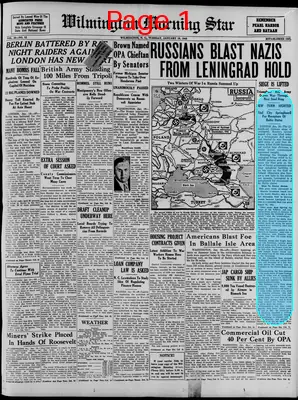
The Wilmington Morning Star
Wilmington, New Hanover County, North Carolina
What is this article about?
Soviet forces lift 17-month Leningrad siege, killing 13,000 Germans and routing four divisions; additional advances toward Kharkov, Rostov, and in Caucasus reported on Jan. 18, 1943.
Clipping

OCR Quality
Full Text
Red Army
Gnaws Way Through
Nazi Steel Ring
NEW
TURN
SIGHTED
Vital
City
Springboard
For Recapture Of
Baltic States
LONDON. Jan. 18--The 17-month-old German siege of Leningrad, Russia's second largest city, was lifted today by a triumphant Red army that blasted its way through eight miles of solid Nazi defenses, killed 13,000 Germans, and routed four divisions, a special Soviet communique announced tonight.
Breaking the blockade of Leningrad brings relief to 3,000,000 persons and also releases the Nazi grip on the flow of Soviet armaments and other industrial facilities in the big city on the Gulf of Finland. Observers also foresaw a new turn in the entire war because Leningrad is a springboard for reconquest of the Baltic states.
Blow To Enemy Morale
This great news, announced in a Moscow broadcast heard here by the Soviet Monitor, was a further damaging blow to German morale because Leningrad had been in a powerful Nazi vise since August 21, 1941.
"After seven days fighting the troops of the Volkhov and Leningrad fronts united on January 18 and so broke the blockade of Leningrad," said the communique.
But this wasn't the whole Russian story. Moscow announced important gains all along the snow covered front, extending clear into the Caucasus.
Other Red armies gained in the advance on Kharkov, steel city in the Ukraine, with Russian vanguard less than 118 miles from that city.
Russian troops also fought their way into Kamensk, railway point only 85 miles north of Rostov, and poured across the Donets river below that city on the most feasible route toward Rostov whose capture would bag all the Nazi armies in the Caucasus.
In the Caucasus they crossed the Manych river and seized Divnoye, rail terminal of a line that winds across the central area to Kropotkin on the Rostov-Baku railway.
Schluesselburg, big Nazi fortress on the south shore of Lake Ladoga about 25 miles east of Leningrad, was among a dozen localities stormed and captured by Russia's winter-hardened troops.
The Russians hit it from three directions, fighting their way through 14 kilometers-8.6 miles-of mine fields, barbed wire, steel and concrete pillboxes. One Red column fought eastward from Leningrad along the west bank of the along Lake Ladoga; and a third group crossed the Volkhov river to strike from the south.
Schluesselburg had been under sporadic Red army attack since the fall of 1941. By capturing it the Russians regained a railway running from Leningrad through Schluesselburg to connect with a line to Moscow, and another to Murmansk in the far north. Murmansk is the chief Arctic port for
What sub-type of article is it?
What keywords are associated?
Where did it happen?
Foreign News Details
Primary Location
Leningrad
Event Date
Jan. 18
Outcome
killed 13,000 germans, routed four divisions, lifted 17-month siege relieving 3,000,000 persons, regained railway connections
Event Details
The 17-month-old German siege of Leningrad was lifted by the Red Army blasting through eight miles of Nazi defenses. Troops of the Volkhov and Leningrad fronts united after seven days of fighting. Schluesselburg captured from three directions through mine fields and pillboxes. Other gains: advance on Kharkov (less than 118 miles away), into Kamensk (85 miles north of Rostov), across Donets river toward Rostov, crossed Manych river and seized Divnoye in Caucasus.