Thank you for visiting SNEWPapers!
Sign up free
The New Hampshire Gazette
Portsmouth, Rockingham County, New Hampshire
What is this article about?
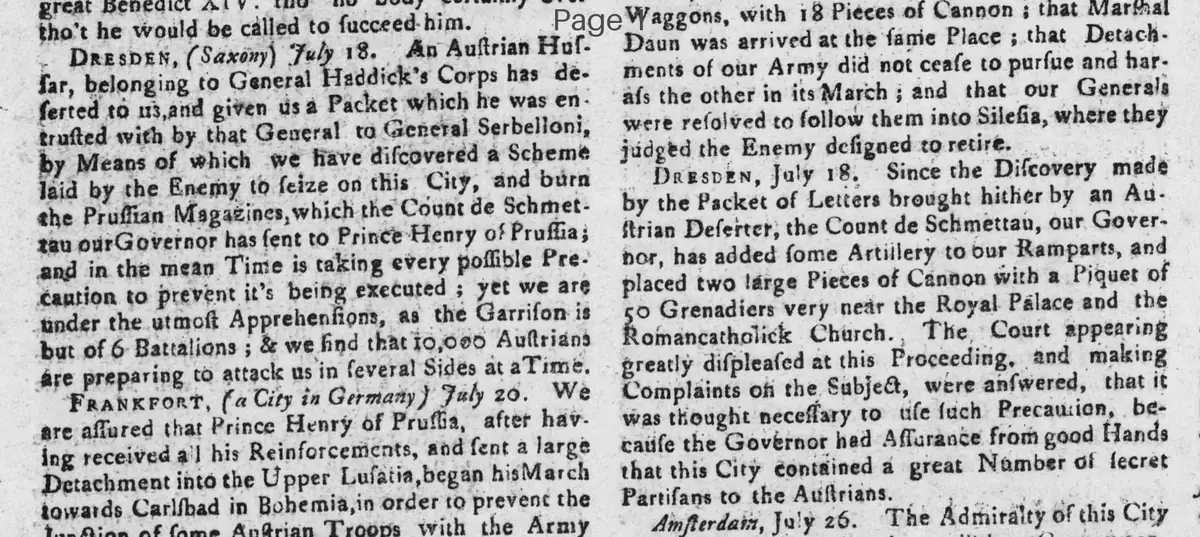
In Dresden, Saxony, an Austrian deserter reveals a plot to seize and burn the city, prompting Governor Count de Schmettau to bolster defenses amid fears of an impending attack by 10,000 Austrians, with the garrison limited to 6 battalions.
Merged-components note: These two components are continuations of the same news dispatch from Dresden, July 18, describing the deserter's packet and subsequent precautions taken.
Clipping
OCR Quality
Full Text
Dresden, July 18. Since the Discovery made by the Packet of Letters brought hither by an Austrian Deserter, the Count de Schmettau, our Governor, has added some Artillery to our Ramparts, and placed two large Pieces of Cannon with a Piquet of 50 Grenadiers very near the Royal Palace and the Romancatholic Church. The Court appearing greatly displeased at this Proceeding, and making Complaints on the Subject, were answered, that it was thought necessary to use such Precaution, because the Governor had Assurance from good Hands that this City contained a great Number of secret Partisans to the Austrians.
What sub-type of article is it?
What keywords are associated?
What entities or persons were involved?
Where did it happen?
Foreign News Details
Primary Location
Dresden, Saxony
Event Date
July 18
Key Persons
Outcome
discovery of austrian scheme to seize and burn dresden; precautions taken including added artillery and cannon placement; garrison of 6 battalions faces potential attack by 10,000 austrians; court complaints over measures.
Event Details
An Austrian Hussar from General Haddick's Corps deserted to Dresden, delivering a packet intended for General Serbelloni that revealed an enemy scheme to seize Prussian magazines, burn the city, and attack from multiple sides with 10,000 Austrians. Governor Count de Schmettau informed Prince Henry of Prussia and implemented precautions like adding artillery to ramparts and placing cannon and grenadiers near the royal palace and church, despite court displeasure, due to assurances of Austrian partisans in the city.