Thank you for visiting SNEWPapers!
Sign up free
Imperial Valley Press
El Centro, Imperial County, California
What is this article about?
Russian forces launch a counterattack from Kletskaya to relieve pressure on Stalingrad, now in its 40th day of siege. German casualties exceed those of Verdun, estimated at 80,000-120,000. Soviet flanking maneuvers and air offensive resume amid heavy fighting.
Merged-components note: Continuation of Stalingrad battle report across pages.
Clippings
1 of 2
OCR Quality
Full Text
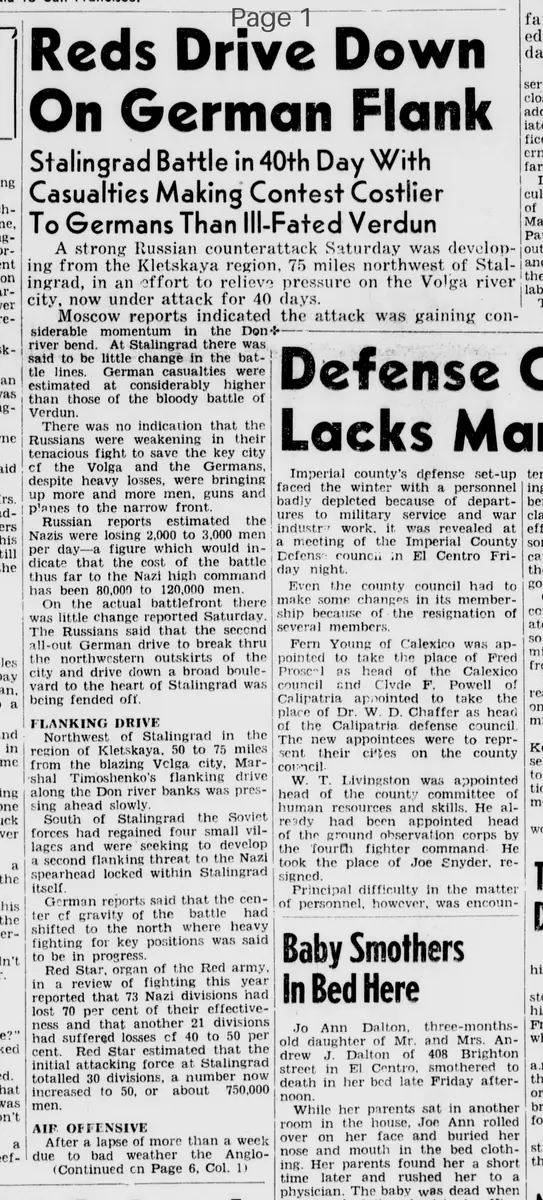
Drive
Down
On
German
Flank
Stalingrad Battle in 40th Day With
Casualties Making Contest Costlier
To Germans Than Ill-Fated Verdun
A strong Russian counterattack Saturday was developing from the Kletskaya region, 75 miles northwest of Stalingrad, in an effort to relieve pressure on the Volga river city, now under attack for 40 days.
Moscow reports indicated the attack was gaining considerable momentum in the Don river bend. At Stalingrad there was said to be little change in the battle lines. German casualties were estimated at considerably higher than those of the bloody battle of Verdun.
There was no indication that the Russians were weakening in their tenacious fight to save the key city of the Volga and the Germans, despite heavy losses, were bringing up more and more men, guns and planes to the narrow front.
Russian reports estimated the Nazis were losing 2,000 to 3,000 men per day - a figure which would indicate that the cost of the battle thus far to the Nazi high command has been 80,000 to 120,000 men.
On the actual battlefront there was little change reported Saturday.
The Russians said that the second all-out German drive to break thru the northwestern outskirts of the city and drive down a broad boulevard to the heart of Stalingrad was being fended off.
FLANKING DRIVE
Northwest of Stalingrad in the region of Kletskaya, 50 to 75 miles from the blazing Volga city, Marshal Timoshenko's flanking drive along the Don river banks was pressing ahead slowly.
South of Stalingrad the Soviet forces had regained four small villages and were seeking to develop a second flanking threat to the Nazi spearhead locked within Stalingrad itself.
German reports said that the center of gravity of the battle had shifted to the north where heavy fighting for key positions was said to be in progress.
Red Star, organ of the Red army, in a review of fighting this year reported that 73 Nazi divisions had lost 70 per cent of their effectiveness and that another 21 divisions had suffered losses of 40 to 50 per cent. Red Star estimated that the initial attacking force at Stalingrad totalled 30 divisions, a number now increased to 50, or about 750,000 men.
AIR OFFENSIVE
After a lapse of more than a week due to bad weather the Anglo-
(Continued on Page 6, Col. 1)
What sub-type of article is it?
What keywords are associated?
What entities or persons were involved?
Where did it happen?
Foreign News Details
Primary Location
Stalingrad
Event Date
Saturday, 40th Day Of Battle
Key Persons
Outcome
german casualties estimated at 80,000 to 120,000 men thus far, higher than verdun; nazis losing 2,000 to 3,000 men per day; 73 nazi divisions lost 70% effectiveness, 21 divisions 40-50%; soviet forces regaining villages and pressing flanking drives
Event Details
A strong Russian counterattack developing from Kletskaya region to relieve pressure on Stalingrad under attack for 40 days. Attack gaining momentum in Don river bend. Little change in Stalingrad battle lines. Germans bringing up more men, guns, planes despite heavy losses. Second German drive to break through northwestern outskirts fended off. Flanking drive by Marshal Timoshenko along Don river banks pressing ahead slowly. South of Stalingrad, Soviets regained four small villages to develop second flanking threat. Center of gravity shifted north with heavy fighting. Initial German force 30 divisions, now 50 or 750,000 men. Air offensive resuming after weather lapse.