Thank you for visiting SNEWPapers!
Sign up free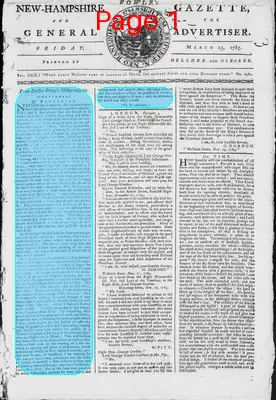
Literary
March 25, 1785
Fowle's New Hampshire Gazette And General Advertiser
Portsmouth, Rockingham County, New Hampshire
What is this article about?
In this continuation of his observations on education, Dr. Price discusses the human tendency to cling to opinions and the need for education to counteract dogmatism. He reflects on his intellectual growth, influenced by Butler, Clark, and Hume, and affirms faith in virtue and Christianity amid uncertainties.
Clipping
OCR Quality
98%
Excellent
Full Text
From Doctor Price's Observations.
(Continued.)
Of EDUCATION.
NATURE has so made us, that an attachment must take place within us to opinions once formed ; and it was proper that we should be so made, in order to prevent that desultoriness of mind which might have been the consequence had we been ready to give up our opinions too easily and hastily. But this natural tendency, however wisely given us, is apt to extend beyond its proper limits, and to render us unreasonably tenacious. It ought, therefore, like all our other natural propensities, to be carefully watched and guarded ; and education should put us upon doing this. An observation before made should in particular be inculcated, "that all mankind have hitherto been most tenacious when most in the wrong, and reckoned themselves most enlightened when most in the dark." This is, indeed, a very mortifying fact ; but attention to it is necessary to cure that miserable pride and dogmaticalness which are some of the worst enemies to improvement. Who is there that does not remember the time when he was entirely satisfied about points which deeper reflection has shown to be above his comprehension : Who, for instance, does not remember a time when he would have wondered at the question, why does water run "down hill :" What ignorant man is there who is not persuaded that he understands this perfectly ? But every improved man knows it to be a question he cannot answer; and what distinguishes him in this instance from the less improved part of mankind is his knowing this. The like is true in numberless other instances. One of the best proofs of wisdom is a sense of our want of wisdom ; and he who knows most possesses most of this sense.
In thinking of myself I derive some encouragement from this reflection. I now see, that I do not understand many points which once appeared to me very clear. The more I have enquired, the more sensible I have been growing of my own darkness ; and a part of the history of my life is that which follows.
In early life I was charmed with Bishop Butler's Analogy of religion natural and revealed to the constitution and course of nature. I reckon it happy for me that this book was one of the first that fell into my hands. It taught me the proper mode of reasoning on moral and religious subjects, and particularly the importance of paying a due regard to the imperfection of human knowledge. His sermons also, I then thought, and do still think, excellent. Next to his works, I have always been an admirer of the writings of Dr. CLARK. And I cannot help adding, however strange it may seem, that I owe much to the philosophical writings of Mr. Hume, which I likewise studied early in life. Though an enemy to his Scepticism, I have profited by it. By attacking, with great ability, every principle of truth and reason, he put me upon examining the ground upon which I stood, and taught me not hastily to take any thing for granted. The first fruits of my reading and studies were laid before the public in a Treatise entitled, A Review of the principal Questions and Difficulties in Morals. This publication has been followed by many others on various subjects. And now, in the evening of a life devoted to enquiry, and spent in endeavours (weak indeed and feeble) to serve the best interests, present and future, of mankind, I am waiting for the GREAT TEACHER, convinced that the order of nature is perfect ; that infinite wisdom and goodness govern all things : and that Christianity comes from God : But at the same time puzzled by many difficulties, anxious for more light, and resting with full and constant assurance only on this one truth--That the practice of virtue is the duty and dignity of man ; and, in all events, his wisest and safest course.
(To be continued.)
(Continued.)
Of EDUCATION.
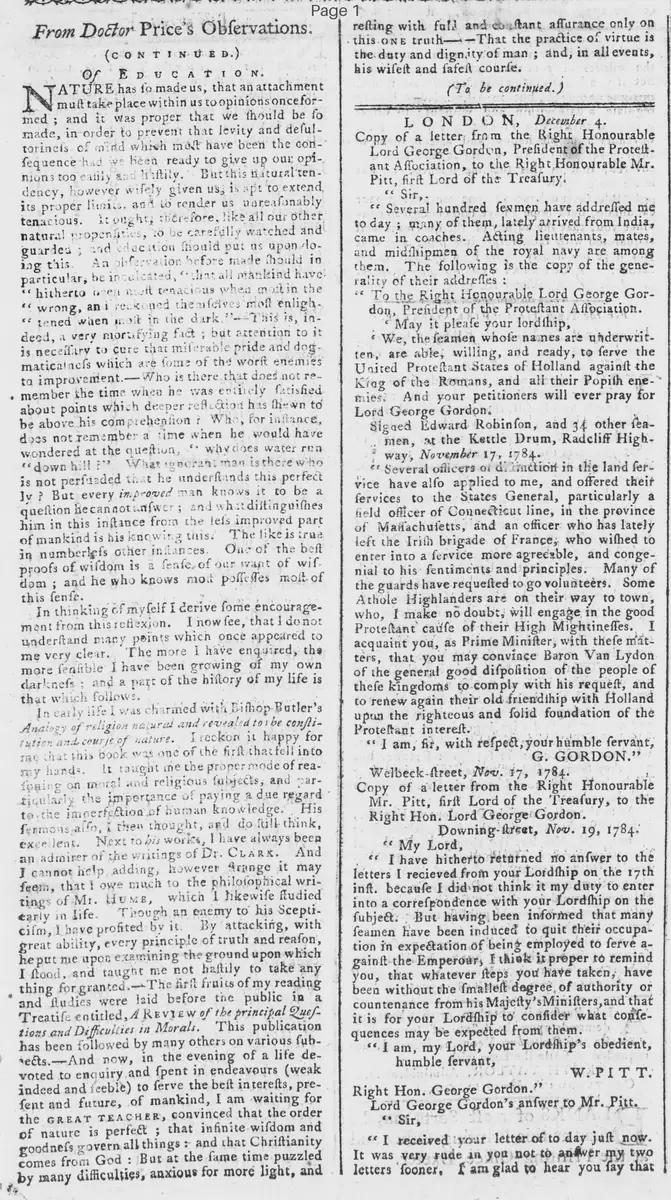
NATURE has so made us, that an attachment must take place within us to opinions once formed ; and it was proper that we should be so made, in order to prevent that desultoriness of mind which might have been the consequence had we been ready to give up our opinions too easily and hastily. But this natural tendency, however wisely given us, is apt to extend beyond its proper limits, and to render us unreasonably tenacious. It ought, therefore, like all our other natural propensities, to be carefully watched and guarded ; and education should put us upon doing this. An observation before made should in particular be inculcated, "that all mankind have hitherto been most tenacious when most in the wrong, and reckoned themselves most enlightened when most in the dark." This is, indeed, a very mortifying fact ; but attention to it is necessary to cure that miserable pride and dogmaticalness which are some of the worst enemies to improvement. Who is there that does not remember the time when he was entirely satisfied about points which deeper reflection has shown to be above his comprehension : Who, for instance, does not remember a time when he would have wondered at the question, why does water run "down hill :" What ignorant man is there who is not persuaded that he understands this perfectly ? But every improved man knows it to be a question he cannot answer; and what distinguishes him in this instance from the less improved part of mankind is his knowing this. The like is true in numberless other instances. One of the best proofs of wisdom is a sense of our want of wisdom ; and he who knows most possesses most of this sense.
In thinking of myself I derive some encouragement from this reflection. I now see, that I do not understand many points which once appeared to me very clear. The more I have enquired, the more sensible I have been growing of my own darkness ; and a part of the history of my life is that which follows.
In early life I was charmed with Bishop Butler's Analogy of religion natural and revealed to the constitution and course of nature. I reckon it happy for me that this book was one of the first that fell into my hands. It taught me the proper mode of reasoning on moral and religious subjects, and particularly the importance of paying a due regard to the imperfection of human knowledge. His sermons also, I then thought, and do still think, excellent. Next to his works, I have always been an admirer of the writings of Dr. CLARK. And I cannot help adding, however strange it may seem, that I owe much to the philosophical writings of Mr. Hume, which I likewise studied early in life. Though an enemy to his Scepticism, I have profited by it. By attacking, with great ability, every principle of truth and reason, he put me upon examining the ground upon which I stood, and taught me not hastily to take any thing for granted. The first fruits of my reading and studies were laid before the public in a Treatise entitled, A Review of the principal Questions and Difficulties in Morals. This publication has been followed by many others on various subjects. And now, in the evening of a life devoted to enquiry, and spent in endeavours (weak indeed and feeble) to serve the best interests, present and future, of mankind, I am waiting for the GREAT TEACHER, convinced that the order of nature is perfect ; that infinite wisdom and goodness govern all things : and that Christianity comes from God : But at the same time puzzled by many difficulties, anxious for more light, and resting with full and constant assurance only on this one truth--That the practice of virtue is the duty and dignity of man ; and, in all events, his wisest and safest course.
(To be continued.)
What sub-type of article is it?
Essay
What themes does it cover?
Moral Virtue
Religious
What keywords are associated?
Education
Wisdom
Dogmatism
Philosophy
Virtue
Christianity
Scepticism
What entities or persons were involved?
Doctor Price
Literary Details
Title
Of Education.
Author
Doctor Price
Subject
Reflections On Education And Intellectual Development
Key Lines
One Of The Best Proofs Of Wisdom Is A Sense Of Our Want Of Wisdom ; And He Who Knows Most Possesses Most Of This Sense.
Though An Enemy To His Scepticism, I Have Profited By It.
That The Practice Of Virtue Is The Duty And Dignity Of Man ; And, In All Events, His Wisest And Safest Course.