Thank you for visiting SNEWPapers!
Sign up free
Daily National Intelligencer
Washington, District Of Columbia
What is this article about?
A letter to the editors critiques 'A Columbian's' essay on South American emancipation, pointing out inconsistencies in British policy under the Prince Regent regarding officers joining the Patriot cause and defending U.S. neutrality under the Law of Nations, while supporting the cause without endorsing unjust means.
Merged-components note: The editorial note is directly appended to and explains the letter to the editor, forming a single logical unit.
Clipping
OCR Quality
Full Text
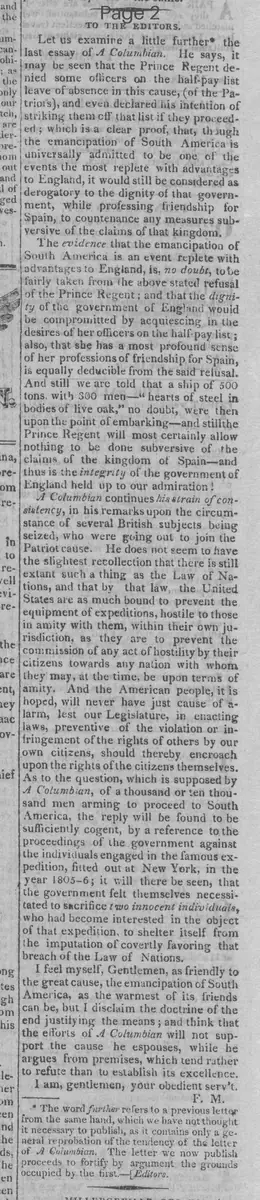
Let us examine a little further the last essay of A Columbian. He says, it may be seen that the Prince Regent denied some officers on the half-pay list leave of absence in this cause, (of the Patriots), and even declared his intention of striking them off that list if they proceeded; which is a clear proof, that, though the emancipation of South America is universally admitted to be one of the events the most replete with advantages to England, it would still be considered as derogatory to the dignity of that government, while professing friendship for Spain, to countenance any measures subversive of the claims of that kingdom.
The evidence that the emancipation of South America is an event replete with advantages to England, is, no doubt, to be fairly taken from the above stated refusal of the Prince Regent; and that the dignity of the government of England would be compromised by acquiescing in the desires of her officers on the half-pay list; also, that she has a most profound sense of her professions of friendship for Spain, is equally deducible from the said refusal. And still we are told that a ship of 500 tons, with 300 men—“hearts of steel in bodies of live oak,” no doubt, were then upon the point of embarking—and still the Prince Regent will most certainly allow nothing to be done subversive of the claims of the kingdom of Spain—and thus is the integrity of the government of England held up to our admiration!
A Columbian continues his strain of consistency, in his remarks upon the circumstance of several British subjects being seized, who were going out to join the Patriot cause. He does not seem to have the slightest recollection that there is still extant such a thing as the Law of Nations, and that by that law, the United States are as much bound to prevent the equipment of expeditions, hostile to those in amity with them, within their own jurisdiction, as they are to prevent the commission of any act of hostility by their citizens towards any nation with whom they may, at the time, be upon terms of amity. And the American people, it is hoped, will never have just cause of alarm, lest our Legislature, in enacting laws, preventive of the violation or infringement of the rights of others by our own citizens, should thereby encroach upon the rights of the citizens themselves.
As to the question, which is supposed by A Columbian, of a thousand or ten thousand men arming to proceed to South America, the reply will be found to be sufficiently cogent, by a reference to the proceedings of the government against the individuals engaged in the famous expedition, fitted out at New York, in the year 1805-6; it will there be seen, that the government felt themselves necessitated to sacrifice two innocent individuals, who had become interested in the object of that expedition, to shelter itself from the imputation of covertly favoring that breach of the Law of Nations.
I feel myself, Gentlemen, as friendly to the great cause, the emancipation of South America, as the warmest of its friends can be, but I disclaim the doctrine of the end justifying the means; and think that the efforts of A Columbian will not support the cause he espouses, while he argues from premises, which tend rather to refute than to establish its excellence.
I am, gentlemen, your obedient serv't.
F. M.
* The word further refers to a previous letter from the same hand, which we have not thought it necessary to publish, as it contains only a general reprobation of the tendency of the letter of A Columbian. The letter we now publish proceeds to fortify by argument the grounds occupied by the first.—[Editors.
What sub-type of article is it?
What themes does it cover?
What keywords are associated?
What entities or persons were involved?
Letter to Editor Details
Author
F. M.
Recipient
The Editors
Main Argument
the letter critiques a columbian's essay for inconsistent arguments on british policy toward south american emancipation and defends u.s. obligations under the law of nations to prevent hostile expeditions, while supporting the patriot cause without accepting that the end justifies the means.
Notable Details