Thank you for visiting SNEWPapers!
Sign up free
Letter to Editor
May 16, 1862
Cedar Falls Gazette
Cedar Falls, Black Hawk County, Iowa
What is this article about?
A correspondent from the 3rd Iowa Infantry at Shiloh, May 2, 1862, reflects on the recent battle, defends Col. Peabody's actions, praises Iowa regiments' bravery across campaigns, criticizes the surprise attack, and describes the encampment and impending conflict.
Clipping
OCR Quality
95%
Excellent
Full Text
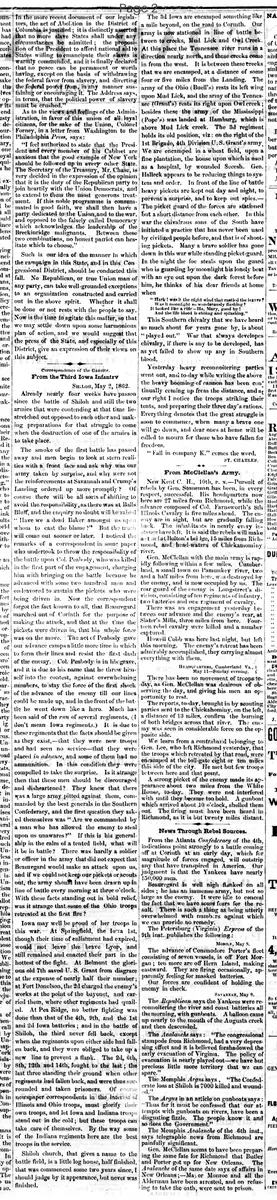
Correspondence of the Gazette
From the Third Iowa Infantry
Shiloh, May 2, 1862
Already nearly four weeks have passed since the battle of Shiloh and still the two armies that were contending at that time lie stretched out opposed to each other and making preparations for that struggle to come when the destruction of one of the armies is to take place.
The smoke of the first battle has passed away and men begin to look at stern realities with a front face and ask why was our army taken by surprise, and why were not the reinforcements at Savannah and Crump's Landing ordered up more promptly? Of course there will be all sorts of shifting to avoid the responsibility, as there was at Ball's Bluff, and the inquiry no doubt will be raised "Have we a dead Baker amongst us upon whom to cast the blame?" But the truth will come out sooner or later. I noticed the remarks of a correspondent in some paper who undertook to throw the responsibility of the battle upon Col. Peabody, who was killed in the first part of the engagement, charging him with bringing on the battle because he advanced with some two hundred men and endeavored to sustain the pickets who were being driven in. Now the correspondent forgot the fact known to all, that Beauregard marched out of Corinth for the purpose of making the attack, and that at the time the pickets were driven in, that his whole force was on the move. The act of Peabody gave our advance camps a little more time in which to form their lines and resist the first dash of the enemy. Col. Peabody is in his grave, and it is due to his name that he threw himself into the contest, against overwhelming numbers, to stay the force of the first shock of the advance of the enemy till our lines could be made up, and in the front of the battle he went down like a hero. Much has been said of the run of several regiments, (I don't mean Iowa regiments. It is due to these regiments that the facts should be given as they exist,—that they were new troops and had seen no service—that they were placed in advance, and some of them had no ammunition. In this condition they were compelled to take the surprise. Is it strange then that these men should be discouraged and disheartened? They knew that there was a large army pitted against them, commanded by the best generals in the Southern Confederacy, and the first question they asked themselves was "Are we commanded by a man who has allowed the enemy to steal upon us unawares?" If this is his generalship in the calm of a tented field, what will it be in battle? There was hardly a soldier or officer in the army that did not expect that Beauregard would make an attack upon us, and if we could not keep our pickets or scouts out, the army should have been drawn up in line of battle every morning at three o'clock. With these facts standing out in bold relief, was it strange that some of the Ohio troops retreated at the first fire?
Iowa may well be proud of her troops in this war.—At Springfield, the Iowa 1st, though their time of enlistment had expired, would not leave the brave Lyon, and still remained and enacted their part in the hottest of the fight. At Belmont the glorious old 7th saved U. S. Grant from disgrace at the expense of nearly half their number; at Fort Donelson, the 2d charged the enemy's works at the point of the bayonet, and carried them, where other regiments had quailed. At Pea Ridge, no better fighting was done than that of the 4th, 9th, and the 1st and 2d Iowa batteries; and in the battle of Shiloh, the third never fell back, except when the regiments upon either side had fallen back, and they were obliged to take up a new line to prevent a flank. The 2d, 6th, 8th, 12th and 14th, fought to the last; the last three standing their ground when other regiments had fallen back, and were thus surrounded and taken prisoners. Of course newspaper correspondents in the interest of Illinois and Ohio troops, must glorify their own troops, and let Iowa and Indiana troops stand out in the cold; but these troops can take care of themselves. By the way some of the Indiana regiments here are the best troops in the service.
Shiloh church, that gives a name to the battle field, is a little log house, half finished, that was commenced some two years since, I should judge by its appearance, but never was finished.
The 3d Iowa are encamped something like a mile beyond, on the road to Corinth. Our army is now stationed in line of battle between two creeks, Mud Lick and Owl Creek. At this place the Tennessee river runs in a direction nearly north, and these creeks come in from the west. It is between these creeks that we are encamped, at a distance of some four or five miles from the Landing. The army of the Ohio (Buell's) rests its left wing upon Mud Lick, and the army of the Tennessee (Grant's) rests its right upon Owl creek; besides these the army of the Mississippi (Pope's) was landed at Hamburg, which is above Mud Lick creek. The 3d regiment holds its old position, viz: on the right of the 1st Brigade, 4th Division U.S. Grant's army. We are encamped in a wheat field, upon a fine plantation, the house upon which is used as a hospital, by wounded Secesh. Gen. Halleck appears to be reducing things to system and order. In front of the line of battle heavy pickets are kept out day and night, to prevent a surprise, and to keep out spies. The picket guard of the forces are stationed but a short distance from each other. In this war the chivalrous sons of the South have initiated a practice that has never been used by civilized people before, and that is of shooting pickets. Many a brave soldier has gone down in this war while standing picket-guard. In the night the foe steals upon the guard who is guarding by moonlight his lonely beat with an eye out upon the dark forest before him, he thinks of his dear friends at home when
"Hark! was it the night wind that rustled the leaves?
Was it moonlight so wondrously flashing?
It looked like a rifle—ha, Mary, good bye
And the life blood is ebbing and splashing."
This Southern chivalry that we have heard so much about for years gone by, is about "played out." War that always develops chivalry, if there is any to be developed, has as yet failed to show up any in Southern blood.
Yesterday heavy reconnoitering parties went out, and to-day while writing the above the heavy booming of cannon has been continually coming up from the distance, and on our right I notice the troops striking their tents, and preparing their three days' rations. Everything denotes that the great struggle is soon to commence, when many a brave one will go down, and dear ones at home will be called to mourn for those who have fallen for freedom.
"Fall in company K." comes the word.
ST. CHARLES.
From the Third Iowa Infantry
Shiloh, May 2, 1862
Already nearly four weeks have passed since the battle of Shiloh and still the two armies that were contending at that time lie stretched out opposed to each other and making preparations for that struggle to come when the destruction of one of the armies is to take place.
The smoke of the first battle has passed away and men begin to look at stern realities with a front face and ask why was our army taken by surprise, and why were not the reinforcements at Savannah and Crump's Landing ordered up more promptly? Of course there will be all sorts of shifting to avoid the responsibility, as there was at Ball's Bluff, and the inquiry no doubt will be raised "Have we a dead Baker amongst us upon whom to cast the blame?" But the truth will come out sooner or later. I noticed the remarks of a correspondent in some paper who undertook to throw the responsibility of the battle upon Col. Peabody, who was killed in the first part of the engagement, charging him with bringing on the battle because he advanced with some two hundred men and endeavored to sustain the pickets who were being driven in. Now the correspondent forgot the fact known to all, that Beauregard marched out of Corinth for the purpose of making the attack, and that at the time the pickets were driven in, that his whole force was on the move. The act of Peabody gave our advance camps a little more time in which to form their lines and resist the first dash of the enemy. Col. Peabody is in his grave, and it is due to his name that he threw himself into the contest, against overwhelming numbers, to stay the force of the first shock of the advance of the enemy till our lines could be made up, and in the front of the battle he went down like a hero. Much has been said of the run of several regiments, (I don't mean Iowa regiments. It is due to these regiments that the facts should be given as they exist,—that they were new troops and had seen no service—that they were placed in advance, and some of them had no ammunition. In this condition they were compelled to take the surprise. Is it strange then that these men should be discouraged and disheartened? They knew that there was a large army pitted against them, commanded by the best generals in the Southern Confederacy, and the first question they asked themselves was "Are we commanded by a man who has allowed the enemy to steal upon us unawares?" If this is his generalship in the calm of a tented field, what will it be in battle? There was hardly a soldier or officer in the army that did not expect that Beauregard would make an attack upon us, and if we could not keep our pickets or scouts out, the army should have been drawn up in line of battle every morning at three o'clock. With these facts standing out in bold relief, was it strange that some of the Ohio troops retreated at the first fire?
Iowa may well be proud of her troops in this war.—At Springfield, the Iowa 1st, though their time of enlistment had expired, would not leave the brave Lyon, and still remained and enacted their part in the hottest of the fight. At Belmont the glorious old 7th saved U. S. Grant from disgrace at the expense of nearly half their number; at Fort Donelson, the 2d charged the enemy's works at the point of the bayonet, and carried them, where other regiments had quailed. At Pea Ridge, no better fighting was done than that of the 4th, 9th, and the 1st and 2d Iowa batteries; and in the battle of Shiloh, the third never fell back, except when the regiments upon either side had fallen back, and they were obliged to take up a new line to prevent a flank. The 2d, 6th, 8th, 12th and 14th, fought to the last; the last three standing their ground when other regiments had fallen back, and were thus surrounded and taken prisoners. Of course newspaper correspondents in the interest of Illinois and Ohio troops, must glorify their own troops, and let Iowa and Indiana troops stand out in the cold; but these troops can take care of themselves. By the way some of the Indiana regiments here are the best troops in the service.
Shiloh church, that gives a name to the battle field, is a little log house, half finished, that was commenced some two years since, I should judge by its appearance, but never was finished.
The 3d Iowa are encamped something like a mile beyond, on the road to Corinth. Our army is now stationed in line of battle between two creeks, Mud Lick and Owl Creek. At this place the Tennessee river runs in a direction nearly north, and these creeks come in from the west. It is between these creeks that we are encamped, at a distance of some four or five miles from the Landing. The army of the Ohio (Buell's) rests its left wing upon Mud Lick, and the army of the Tennessee (Grant's) rests its right upon Owl creek; besides these the army of the Mississippi (Pope's) was landed at Hamburg, which is above Mud Lick creek. The 3d regiment holds its old position, viz: on the right of the 1st Brigade, 4th Division U.S. Grant's army. We are encamped in a wheat field, upon a fine plantation, the house upon which is used as a hospital, by wounded Secesh. Gen. Halleck appears to be reducing things to system and order. In front of the line of battle heavy pickets are kept out day and night, to prevent a surprise, and to keep out spies. The picket guard of the forces are stationed but a short distance from each other. In this war the chivalrous sons of the South have initiated a practice that has never been used by civilized people before, and that is of shooting pickets. Many a brave soldier has gone down in this war while standing picket-guard. In the night the foe steals upon the guard who is guarding by moonlight his lonely beat with an eye out upon the dark forest before him, he thinks of his dear friends at home when
"Hark! was it the night wind that rustled the leaves?
Was it moonlight so wondrously flashing?
It looked like a rifle—ha, Mary, good bye
And the life blood is ebbing and splashing."
This Southern chivalry that we have heard so much about for years gone by, is about "played out." War that always develops chivalry, if there is any to be developed, has as yet failed to show up any in Southern blood.
Yesterday heavy reconnoitering parties went out, and to-day while writing the above the heavy booming of cannon has been continually coming up from the distance, and on our right I notice the troops striking their tents, and preparing their three days' rations. Everything denotes that the great struggle is soon to commence, when many a brave one will go down, and dear ones at home will be called to mourn for those who have fallen for freedom.
"Fall in company K." comes the word.
ST. CHARLES.
What sub-type of article is it?
Historical
Informative
Reflective
What themes does it cover?
Military War
What keywords are associated?
Shiloh Battle
Iowa Infantry
Col Peabody
Beauregard Attack
Civil War Troops
Picket Shooting
Southern Chivalry
What entities or persons were involved?
St. Charles.
Gazette
Letter to Editor Details
Author
St. Charles.
Recipient
Gazette
Main Argument
the union army was surprised at shiloh due to poor preparation, but iowa troops performed heroically; col. peabody's advance was necessary and honorable, not blameworthy.
Notable Details
Defends Col. Peabody's Actions
Praises Iowa Regiments At Springfield, Belmont, Fort Donelson, Pea Ridge, Shiloh
Criticizes Shooting Of Pickets By Southern Forces
Includes Poetic Stanza On Picket Duty