Thank you for visiting SNEWPapers!
Sign up free
Litchfield Enquirer
Litchfield, Litchfield County, Connecticut
What is this article about?
Article discusses Boston's shift to informal preaching venues like Music Hall, profiling liberal theologians Rev. Alger and Rev. Murray; critiques Murray's sermon on New England religion's shortcomings and the irony of his position at historic Park Street Church.
Clipping
OCR Quality
Full Text
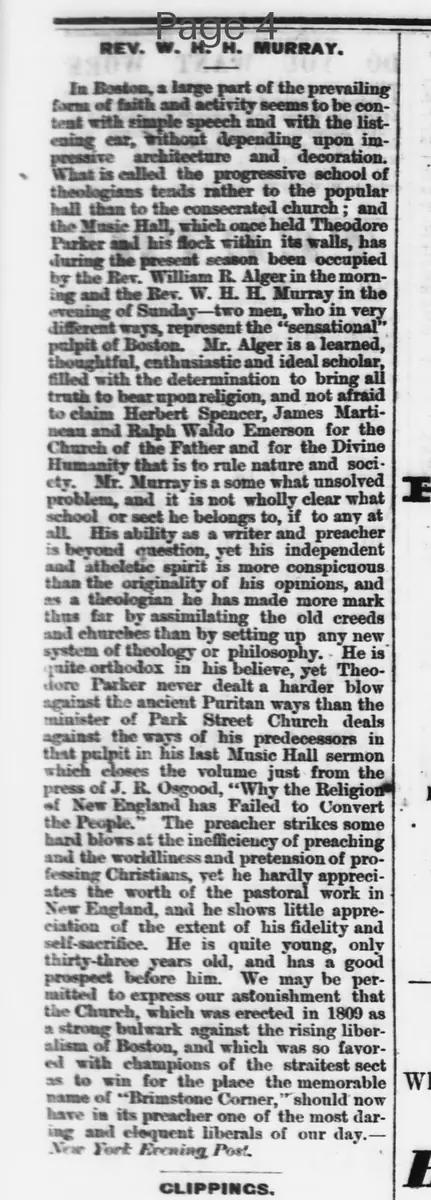
In Boston, a large part of the prevailing formal of faith and activity seems to be content with simple speech and with the listening ear, without depending upon impressive architecture and decoration.
What is called the progressive school of theologians tends rather to the popular hall than to the consecrated church; and the Music Hall, which once held Theodore Parker and his flock within its walls, has during the present season been occupied by the Rev. William R. Alger in the morning and the Rev. W. H. H. Murray in the evening of Sunday—two men, who in very different ways, represent the "sensational" pulpit of Boston. Mr. Alger is a learned, thoughtful, enthusiastic and ideal scholar filled with the determination to bring all truth to bear upon religion, and not afraid to claim Herbert Spencer, James Martineau and Ralph Waldo Emerson for the Church of the Father and for the Divine Humanity that is to rule nature and society. Mr. Murray is a somewhat unsolved problem, and it is not wholly clear what school or sect he belongs to, if to any at all. His ability as writer and preacher is beyond question, yet his independent and athletic spirit is more conspicuous than the originality of his opinions, and as a theologian he has made more mark thus far by assimilating the old creeds and churches than by setting up any new system of theology or philosophy. He is quite orthodox in his belief, yet Theodore Parker never dealt a harder blow against the ancient Puritan ways than the minister of Park Street Church deals against the ways of his predecessors in that pulpit in his last Music Hall sermon which closes the volume just from the press of J. R. Osgood, "Why the Religion of New England has Failed to Convert the People."
The preacher strikes some hard blows at the inefficiency of preaching and the worldliness and pretension of professing Christians, yet he hardly appreciates the worth of the pastoral work in New England, and he shows little appreciation of the extent of his fidelity and self-sacrifice. He is quite young, only thirty-three years old, and has a good prospect before him. We may be permitted to express our astonishment that the Church, which was erected in 1809 as a strong bulwark against the rising liberalism of Boston, and which was so favored with champions of the straitest sect as to win for the place the memorable name of "Brimstone Corner," should now have in its preacher one of the most daring and eloquent liberals of our day.
New York Evening Post.
What sub-type of article is it?
What themes does it cover?
What keywords are associated?
What entities or persons were involved?
Where did it happen?
Story Details
Key Persons
Location
Boston, Music Hall, Park Street Church
Event Date
Present Season, Church Erected 1809
Story Details
Commentary on Boston's progressive theologians using Music Hall for services; profiles Rev. Alger's scholarly approach and Rev. Murray's orthodox yet liberal preaching, including his sermon critiquing New England religion's failure to convert people; notes irony of liberal Murray at conservative Park Street Church.