Thank you for visiting SNEWPapers!
Sign up free
Story
July 28, 1876
The True Northerner
Paw Paw, Van Buren County, Michigan
What is this article about?
On March 29, 1848, shifting winds pushed thick ice from Lake Erie into the Niagara River, damming it and causing the falls to nearly dry up overnight; the ice broke the next day, restoring the river's flow.
Clipping
OCR Quality
98%
Excellent
Full Text
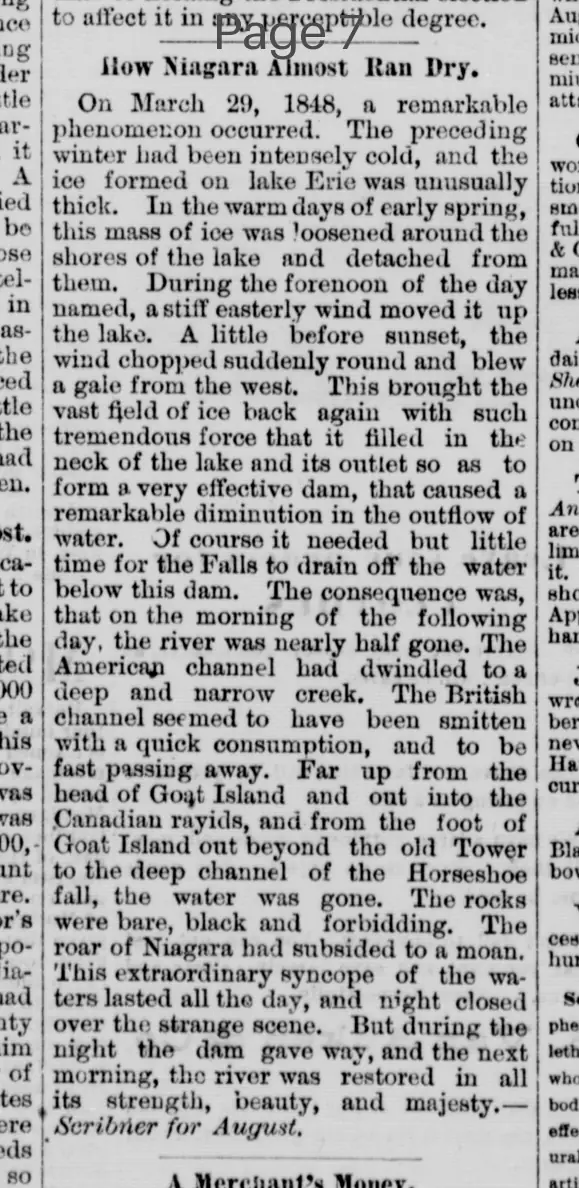
How Niagara Almost Ran Dry.
On March 29, 1848, a remarkable phenomenon occurred. The preceding winter had been intensely cold, and the ice formed on Lake Erie was unusually thick. In the warm days of early spring, this mass of ice was loosened around the shores of the lake and detached from them. During the forenoon of the day named, a stiff easterly wind moved it up the lake. A little before sunset, the wind chopped suddenly round and blew a gale from the west. This brought the vast field of ice back again with such tremendous force that it filled in the neck of the lake and its outlet so as to form a very effective dam, that caused a remarkable diminution in the outflow of water. Of course it needed but little time for the Falls to drain off the water below this dam. The consequence was, that on the morning of the following day, the river was nearly half gone. The American channel had dwindled to a deep and narrow creek. The British channel seemed to have been smitten with a quick consumption, and to be fast passing away. Far up from the head of Goat Island and out into the Canadian rapids, and from the foot of Goat Island out beyond the old Tower to the deep channel of the Horseshoe fall, the water was gone. The rocks were bare, black and forbidding. The roar of Niagara had subsided to a moan. This extraordinary syncope of the waters lasted all the day, and night closed over the strange scene. But during the night the dam gave way, and the next morning the river was restored in all its strength, beauty, and majesty.—Scribner for August.
On March 29, 1848, a remarkable phenomenon occurred. The preceding winter had been intensely cold, and the ice formed on Lake Erie was unusually thick. In the warm days of early spring, this mass of ice was loosened around the shores of the lake and detached from them. During the forenoon of the day named, a stiff easterly wind moved it up the lake. A little before sunset, the wind chopped suddenly round and blew a gale from the west. This brought the vast field of ice back again with such tremendous force that it filled in the neck of the lake and its outlet so as to form a very effective dam, that caused a remarkable diminution in the outflow of water. Of course it needed but little time for the Falls to drain off the water below this dam. The consequence was, that on the morning of the following day, the river was nearly half gone. The American channel had dwindled to a deep and narrow creek. The British channel seemed to have been smitten with a quick consumption, and to be fast passing away. Far up from the head of Goat Island and out into the Canadian rapids, and from the foot of Goat Island out beyond the old Tower to the deep channel of the Horseshoe fall, the water was gone. The rocks were bare, black and forbidding. The roar of Niagara had subsided to a moan. This extraordinary syncope of the waters lasted all the day, and night closed over the strange scene. But during the night the dam gave way, and the next morning the river was restored in all its strength, beauty, and majesty.—Scribner for August.
What sub-type of article is it?
Curiosity
Extraordinary Event
Historical Event
What themes does it cover?
Nature
What keywords are associated?
Niagara Falls
Ice Dam
Lake Erie
Natural Phenomenon
Wind Shift
Where did it happen?
Niagara Falls
Story Details
Location
Niagara Falls
Event Date
March 29, 1848
Story Details
Ice from Lake Erie formed a dam in the Niagara River due to shifting winds, causing the falls to nearly run dry for a day before the ice broke and restored the flow.