Thank you for visiting SNEWPapers!
Sign up free
Staunton Spectator, And General Advertiser
Staunton, Virginia
What is this article about?
Lajos Kossuth, exiled Governor of Hungary after its defeat by Austria and Russia, writes from Widdin, Turkey, appealing to Lord Palmerston for protection for himself and fellow exiles facing Turkish demands, influenced by Russia, to convert to Islam or be extradited. He requests asylum in England for his family and support for Hungary.
Clipping
OCR Quality
Full Text
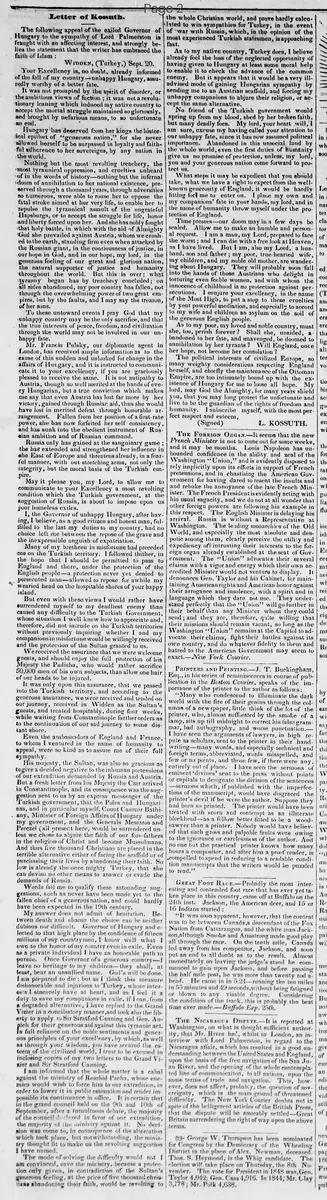
The following appeal of the exiled Governor of Hungary to the sympathy of Lord Palmerston is fraught with an affecting interest, and strongly belies the statement that the writer has embraced the faith of Islam:
Widdin, (Turkey,) Sept. 20.
Your Excellency is, no doubt, already informed of the fall of my country—unhappy Hungary, assuredly worthy of a better fate. It was not prompted by the spirit of disorder, or the ambitious views of faction; it was not a revolutionary leaning which induced my native country to accept the mortal struggle maintained so gloriously, and brought by nefarious means, to so unfortunate an end.
Hungary has deserved from her kings the historical epithet of "generous nation," for she never allowed herself to be surpassed in loyalty and faithful adherence to her sovereigns, by any nation in the world.
Nothing but the most revolting treachery, the most tyrannical oppression, and cruelties unheard of in the words of history—nothing but the infernal doom of annihilation to her national existence, preserved through a thousand years, through adversities so numerous, were able to rouse her to oppose the fatal stroke aimed at her very life, to enable her to repulse the tyrannical assault of the ungrateful Hapsburgs, or to accept the struggle for life, honor and liberty forced upon her. And she has nobly fought that holy battle, in which with the aid of Almighty God she prevailed against Austria, whom we crushed to the earth, standing firm even when attacked by the Russian giant, in the consciousness of justice, in our hope in God, and in our hope, my lord, in the generous feeling of our great and glorious nation, the natural supporter of justice and humanity throughout the world. But this is over: what tyranny began has by treachery concluded; on all sides abandoned, my poor country has fallen, not through the overwhelming power of two great empires, but by the faults, and I may say the treason, of her sons.
To these untoward events I pray God that my unhappy country may be the only sacrifice, and that the true interests of peace, freedom, and civilization through the world may not be involved in our unhappy fate.
Mr. Francis Pulsky, our diplomatic agent in London, has received ample information as to the cause of this sudden and unlooked for change in the affairs of Hungary, and is instructed to communicate it to your excellency, if you are graciously pleased to receive the same. It is not antipathy to Austria, though so well merited at the hands of every Hungarian, but a true conviction which makes me say that even Austria has lost far more by her victory, gained through Russian aid, than she would have lost in merited defeat through honorable arrangement. Fallen from her position of a first-rate power, she has now forfeited her self consistency, and has sunk into the obedient instrument of Russian ambition and of Russian command.
Russia only has gained at the sanguinary game; she has extended and strengthened her influence in the East of Europe and threatens already, in a fearful manner, with out-stretching arms, not only the integrity, but the moral basis of the Turkish empire.
May it please you, my Lord, to allow me to communicate to your Excellency a most revolting condition which the Turkish government, at the suggestion of Russia, is about to impose upon us poor homeless exiles.
I, the Governor of unhappy Hungary, after having, I believe, as a good citizen and honest man, fulfilled to the last my duties to my country, had no choice left me between the repose of the grave and the inexpressible anguish of expatriation.
Many of my brethren in misfortune had preceded me on the Turkish territory. I followed thither, in the hope that I should be permitted to pass to England and there, under the protection of the English people—a protection never yet denied to persecuted man—allowed to repose for awhile my wearied head on the hospitable shores of your happy island.
But even with these views I would rather have surrendered myself to my deadliest enemy than caused any difficulty to the Turkish Government, whose situation I well knew how to appreciate and therefore, did not intrude on the Turkish territories without previously inquiring whether I and my companions in misfortune would be willingly received and the protection of the Sultan granted to us.
We received the assurance that we were welcome guests, and should enjoy the full protection of his Majesty the Padishah, who would rather sacrifice 50,000 men of his own subjects, than allow one hair of our heads to be injured.
It was only upon this assurance, that we passed into the Turkish territory, and according to the generous assurance, we were received and tended on our journey, received in Widdin as the Sultan's guests, and treated hospitably, during four weeks, while waiting from Constantinople farther orders as to the continuation of our sad journey to some distant shore.
Even the ambassadors of England and France, to whom I ventured in the name of humanity to appeal, were so kind as to assure me of their full sympathy.
His majesty, the Sultan, was also so gracious as to give a decided negative to the inhuman pretensions of our extradition demanded by Russia and Austria.
But a fresh letter from his Majesty the Czar arrived in Constantinople, and its consequence was the suggestion sent to us by an express messenger of the Turkish government, that the Poles and Hungarians, and in particular myself, Count Casimir Batthyany, Minister of Foreign Affairs of Hungary under my government, and the Generals Meszaros and Perczel (all present here), would be surrendered unless we chose to abjure the faith of our fore-fathers in the religion of Christ and become Mussulmans.
And thus five thousand Christians are placed in the terrible alternative either of facing the scaffold or of purchasing their lives by abandoning their faith. So low is already the once mighty Turkey, that she can devise no other means to answer or evade the demands of Russia.
Words fail me to qualify these astounding suggestions, such as never have been made yet to the fallen chief of a generous nation, and could hardly have been expected in the 19th century.
My answer does not admit of hesitation. Between death and shame the choice can be neither dubious nor difficult. Governor of Hungary and elected to that high place by the confidence of fifteen millions of my countrymen, I know well what I owe to the honor of my country even in exile. Even as a private individual I have an honorable path to pursue. Once Governor of a generous country—I leave no heritage to my children—they shall, at least, bear an unsullied name. God's will be done.
I am prepared to die; but as I think this measure dishonorable and injurious to Turkey, whose interests I sincerely have at heart, and as I feel it a duty to save my companions in exile, if I can, from a degraded alternative, I have replied to the Grand Vizier in a conciliatory manner, and took also the liberty to apply to Sir Stratford Canning and Gen. Aupick for their generous aid against this tyrannic act.
In full reliance on the noble sentiments and generous principles of your excellency, by which, as well as through your wisdom, you have secured the esteem of the civilized world, I trust to be excused in enclosing copies of my two letters to the Grand Vizier and Sir Stratford Canning.
I am informed that the whole matter is a cabal against the ministry of Reschid Pacha, whose enemies would wish to force him to our extradition, in order to lower it in public estimation and render impossible its continuance in office. It is certain that in the grand council held on the 9th and 10th of September, after a tumultuous debate, the majority of the council declared in favor of our extradition, the majority of the ministry against it. No decision was come to, in consequence of the altercation which took place, but notwithstanding, the ministry thought fit to make us the revolting suggestion I have named.
The mode of solving the difficulty would not, I am convinced, save the ministry, because a protection only given, in contradiction of the Sultan's generous feeling, at the price of five thousand Christians abandoning their faith, would be revolting to the whole Christian world, and prove hardly calculated to win sympathies for Turkey, in the event of war with Russia, which, in the opinion of the most experienced Turkish statesmen, is approaching fast.
As to my native country, Turkey does, I believe, already feel the loss of the neglected opportunity of having given to Hungary at least some moral help to enable it to check the advance of the common enemy. But it appears that it would be a very ill-advised mode of gaining Hungarian sympathy by sending me to an Austrian scaffold, and forcing my unhappy companions to abjure their religion, or accept the same alternative.
No friend of the Turkish government would spring up from my blood, shed by her broken faith, but many deadly foes. My lord, your heart will, I am sure, excuse my having called your attention to our unhappy fate, since it has now assumed political importance. Abandoned in this unsocial land by the whole world, even the first duties of humanity give us no promise of protection, unless, my lord, you and your generous nation come forward to protect us.
What steps it may be expedient that you should take, what we have a right to expect from the well-known generosity of England, it would be hardly fitting for me to enter on. I place my own and my companions' fate in your hands, my lord, and in the name of humanity throw myself under the protection of England.
Time presses—our doom may in a few days be sealed. Allow me to make an humble and personal request. I am a man, my Lord, prepared to face the worst: and I can die with a free look at Heaven, as I have lived. But I am, also my Lord, a husband, son and father; my poor, true-hearted wife, my children, and my noble old mother, are wandering about Hungary. They will probably soon fall into the hands of those Austrians who delight in torturing even feeble women, and with whom the innocence of childhood is no protection against persecutions. I conjure your excellency, in the name of the Most High, to put a stop to these cruelties by your powerful mediation, and especially to accord to my wife and children an asylum on the soil of the generous English people.
As to my poor, my loved and noble country, must she, too, perish forever? Shall she, unaided, abandoned to her fate, and unavenged, be doomed to annihilation by her tyrants? Will England, once her hope, not become her consolation?
The political interests of civilized Europe, so many weighty considerations respecting England herself, and chiefly the maintenance of the Ottoman Empire, are too intimately bound up with the existence of Hungary for me to lose all hope. My lord, may God the Almighty, for many years shield you, that you may long protect the unfortunate and live to be the guardian of the rights of freedom and humanity. I subscribe myself, with the most perfect respect and esteem,
(Signed) L. KOSSUTH.
What sub-type of article is it?
What keywords are associated?
What entities or persons were involved?
Where did it happen?
Foreign News Details
Primary Location
Widdin, Turkey
Event Date
Sept. 20
Key Persons
Outcome
hungary has fallen due to treachery and abandonment; exiles, including 5000 christians, face extradition or forced conversion to islam; no final decision yet, but pressure from russia via turkey.
Event Details
Lajos Kossuth, exiled Governor of Hungary after its defeat in struggle against Austria and Russia, appeals from Widdin, Turkey, to Lord Palmerston for protection against Turkish government demands, suggested by Russia, to convert to Islam or be surrendered to Austria. He recounts Hungary's loyal history, the noble fight, betrayal leading to fall, initial Turkish hospitality and Sultan's refusal of extradition, but new Russian pressure leading to the ultimatum. Kossuth refuses conversion, seeks English intervention, and requests asylum for his family.